But don’t worry, most writers are and I’m here to help because reading them is making me cRAzY.
I’m writing this because I’ve read three otherwise great romance novels back to back featuring characters dealing with PTSD (or PTSD symptoms) and each one of them made the same dream mistakes. I honestly can’t think of a fiction book I’ve read that didn’t make these mistakes, so I thought I’d compile a handy dandy list of mistakes and how to fix them.
Lucky for you, I have PTSD and a ton of fellow veteran friends who deal with these symptoms.
*This is based on my experience and things told to me by friends. This is not to say that the below doesn’t happen in real life, only that it’s not as common as you might think.
The issue with these dreams is twofold: on one side is the psychological accuracy of the dream and on the other side is how you’re using the dream within the narrative.
Oh an Black Sails spoilers-ish ahead.
1) Stop writing the dream as a shot-by-shot accurate retelling of Traumatic Event.
Listen, not only do dreams seldom follow reality, but our own memories are tricky at best. I don’t remember getting beaten up because a) it was horrifying and we block stuff like that out and b) I was going in and out of consciousness. It would be pretty strange for me to dream something I don’t even fully remember. Our brains are simply not wired to do these vivid factually-accurate cinematic retellings.
My friend dreams things that did happen, but in his own words those dreams are always wrong in some noticeable or bizarre way. For instance, he’s getting chased through the streets of Iraq by a werewolf.
2) Dreams are informed by reality, not direct reflections of it.
It’s entirely likely my friend dreamt of a werewolf in Iraq because I got him binge watching Supernatural and the two ideas merged in his dreamstate. But see, that’s how dreams work.
The trauma event exists as a constant in his subconscious, but he has all this other information right there in his conscious mind all day, every day. In dreams, there isn’t a clear delineation between that information.
My dreams are often dependent on whatever I’ve fallen asleep watching on television. The themes are consistent, but not the content.
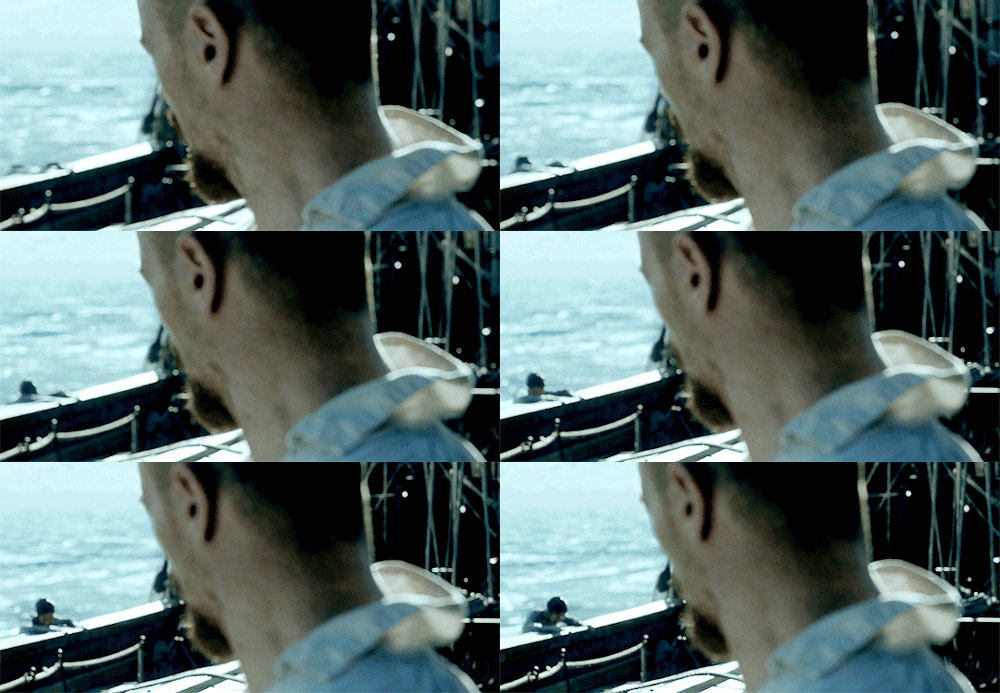
In Black Sails, Captain Flint’s trauma dreams feature his dead partner and friend following him around his empty ship. You have an element of the trauma (the animated corpse of his friend) + his daily existence (his ship). The two things intersect to form these unsettling nightmares as expressions of his fears and grief. He never once relives the event itself in his dreams as shown on screen.
Speaking of…
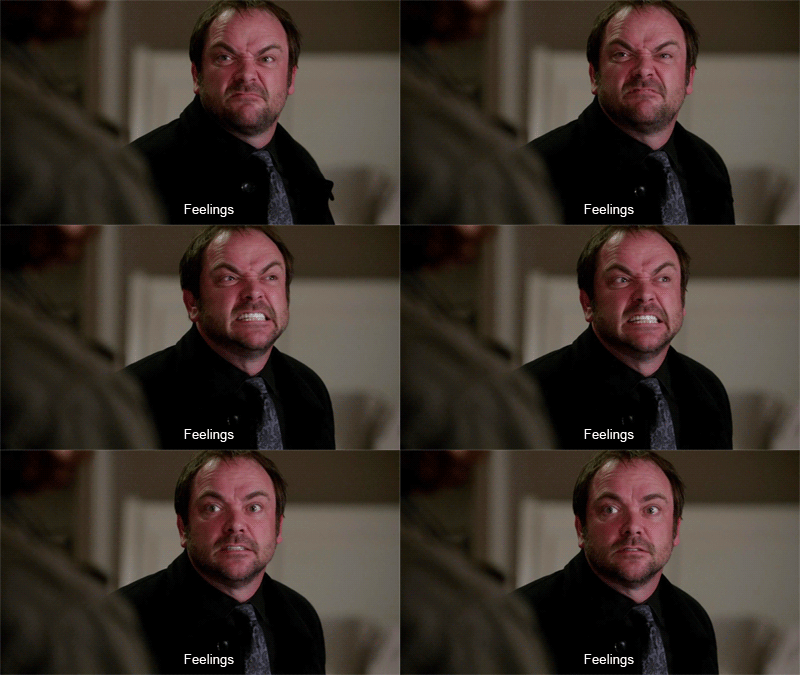
3) Trauma dreams often revolve around feelings, not necessarily the events themselves.
The PTSD package generally includes heaps of shame, guilt, anger and fear. As someone who survived a beating when I should have had control of the situation, my dreams tend to revolve around fear that people will know I’m a fraud or being unable to act in a dangerous situation.
Again, it’s entirely common for trauma victims to not remember large chunks (or the whole thing) of the trauma event. So why should their dreams be stunningly accurate? What we remember are feelings. Real strong feelings.
You cannot go wrong if you write your trauma dream around feelings, not a specific event.
4) If you present trauma dreams as expressions of themes, you can let go of the trauma dream as an exposition dump/way overused suspense trope.
You know you’ve read this: MC has dreams that are a shot-by-shot retelling of Traumatic Event that always cut off right before Traumatic Event, so that the Big Reveal must happen by a discovery later in the novel.
If I were the MC in a book, the easy and common thing would be to use the “dream sequence” as an expository retelling of Traumatic Event as a way to give some backstory to why I might be surly, mistrustful, afraid to try something new, whatever, and to clumsily shoehorn in suspense where there doesn’t need to be.
The much more interesting thing might be if my dreams were inconsistent in content but consistent in theme. In one I’m on an alien planet (because I fell asleep watching the Science Channel again) and the ground opens up and I fall into a pit from which I can’t escape because I am helpless. In another a man is watching me while I sleep where I am again frozen and helpless. This would force the reader to think: what is the recurring issue in these dreams? Why is it important? What is this telling me about this character and what happened to her?
It could be a personal preference, but I’d rather see the Traumatic Event either told in narrative flashbacks (not dreams) or verbally retold by the character in question. Let the dreams tell me something deeper about the character. It’s not that I was beat up, it’s that I feel like a failure because of it. One of these things is a shallow factual detail, the other tells you something about me as a person that I’m sharing with you, gentle reader, because talking about this stuff is healthy.
5) The Traumatic Event doesn’t have to be a big secret.
In Black Sails, we know what happened to Captain Flint’s partner. It happened in real time in the show. That didn’t make his uber disturbing dreams less disturbing or mysterious. Fans still debate exactly what the symbolism was and what they were telling us about James Flint in those moments. We do know from the dreams that he was disturbed, obsessed, and also monumentally guilty and blaming himself for what happened.
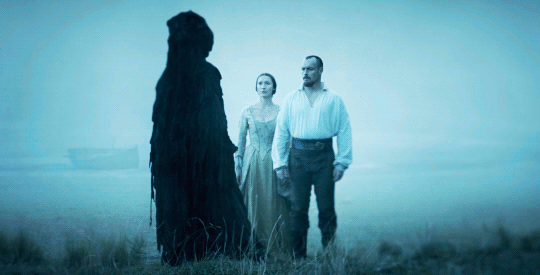
The mystery was perhaps more heightened by the fact that the dreams weren’t direct reflections of reality. We know who this person was, what she believed, and why she died. That Flint is imagining her screaming silently in his ear is horrifying and discordant with what we know to be factual. This adds emotional complexity to his character and the decisions he’s making while suffering these dreams.
^^^this didn’t happen. It was a dream. A real unsettling dream.
Once you let go of the concept of the trauma dream as a literal retelling and exposition dump, you have the entire dreamscape to work in other narrative elements, like symbolism, metaphor, foreshadowing, etc.
To those fanfic writers that are not english native speakers: sometimes, when I read your work, I notice that english isn’t your first language, because there are strange phrases. I know immediately that to you, they are perfectly normal, since it’s the way your language describes things. And I love that, because here you go, creating your art, in a language you spent so much time learning, just so that other people can enjoy your stories! It is so amazing and I will never criticise you for that, but instead I will be thankful that you put in all the effort.
I love you all, you are amazing. Keep creating, please!
Writing is hard. Writing in a language that is not your native tongue is even harder. I love and respect the hell out of you all!
I read a book a while back, which I have completely forgotten the name of, but the author mentioned teaching poetry workshops to children of different age groups and said that the a lot of the younger kids came out with some really sublime stuff because they hadn’t internalised as many cliches and boring stock phrases in the English language yet, while the older kids tended to write very formulaic stuff in comparison. I think that writers working in a language that’s not their native tongue bring a similar quality to their work. You’ll see phrases that a native speaker could never come up with that are so fresh and beautiful.
We native English speakers tend to do a lot of washing in each others’ water, so to speak, when it comes to writing. We’re all drawing from the same stock pool of set phrases, idioms, metaphors, and classic literary references.
You second-language folks, you bring the fresh and the new into that pool, and I absolutely am grateful for that.
As a non-native English speaker, I can attest that the struggle to create something in another language is real. Sometimes you get stuck because you can’t put into words what you have in mind, or you’re forced to change parts of the plot because you don’t know how to describe certain settings and not even google can help.
But it’s great to know that people out there appreciate us.
If you’re planning on writing a fanfic/story with a trans character, you might want to read this. If you’re cis and you’re planning on writing a fanfic/story with a trans character, I would quite recommend that you read this. Even if you’re not planning on writing a trans character anytime soon, you could want to read this. These are some things about trans people to keep in mind when you’re writing, brought to you by your local nonbinary emo who is very angry and very desperate for respectful trans representation.
(Okay, seriously, I really would appreciate it if you’d read this because I think it could possibly be very helpful.)
great question, dear anon!! i also like to write mez/riosi and sometimes even dabble in mez/acarzha/riosi!
hahaha
okay but on a serious note: i would! right now, my otp list has shrunk down to my rps but uh hell yeah i would, in general. gimme a good pairing, shroom, idk, hit me
Alright so since some people seem to need help with these things, I’m gonna do a PSA on common fanfic turns of phrase and what they’re actually driving at:
‘Humming’, as in, when a character ‘hums in agreement’ or ‘hums happily’, isn’t them suddenly breaking out a tune. It’s referring to an inarticulate sound, usually with the lips closed. ‘Mmhmm’ for example is a hum. ‘Hummed a question’ is less common, but generally means something along the lines of ‘hmm?’
If someone ‘moans in appreciation’ of something, like food or a good massage, that is usually indicating a lower ‘mmm’ noise than ‘humming’, with the tone being defined by the context of the situation. At some point actually writing out ‘yum’ or ‘oooh’ or similar became unpopular in fic, so describing the noise took prominence. The ‘mmm’ sound is fairly indistinct, and is technically a moan. It’s not actually an inherently sexual term, even though it’s used overwhelmingly in sexual contexts. (In older stories characters would even moan in pain, though that’s less common now).
Toeing off your shoes refers to taking off your shoes without bending down and using your hands in any way. You’re using your toes instead. It’s actually more common with slippers (which are designed for this) but can apply to any footwear that doesn’t need untying or unbuckling or something in order to come loose. Related to ‘kicking off your shoes’ but less dramatic in terms of the implied action involved.
Carding your fingers through something (i.e. hair, feathers) comes from a process (carding) for disentangling cloth or wool fibers (usually a special type of card-shaped tool was used for this, hence the term). It’s got nothing to do with playing cards or shuffling, and here’s the wikipedia article on the process, just for the skeptics. It basically means ‘gently disentangle’ in the fanfic context.
Thus concludes the PSA.
I do know all of this… but the constant repetition can still make things sound silly.
This is true! But it’s also probably worth considering two points on that front.
One is that if you like fanfic, you’re probably going to read way more fic than published novels. So common turns of phrase or idioms that show up in fanfiction writing communities will seem even more repetitive. Because you are reading a ton of it. I mean, you could read nothing but fanfiction until you die and never run out of it, even if everyone stopped writing it today, and it’s all free and readily available so long as you have internet access. People binge reading fics and then getting sick of seeing the tropes or phrases most common to them is a bit like gorging on ice cream and then going ‘ugh sugar disgusts me now for some mysterious reason, why do people put so much of it in food???’
The other point is that, of course, fanfic writers are often amateurs. Repetition within a single story is gonna happen more often when the author is new to writing. It’s something writers just have to learn how to not do. Usually by building up broader vocabularies and learning how to pace things better, which takes practice.
After all, while fanfiction serves many purposes, one of them is a practice ground for people who are still learning.
So the two biggest reasons for perfectly serviceable and innocuous phrases to be ‘over used’ in fics are, themselves, pretty much just unavoidable and minor downsides caused by the unique status of fanfiction itself.
And if somebody just really dislikes a certain turn of phrase ‘just because’, and is not actually unfamiliar with it and picturing something totally bizarre, that’s understandable too. But really the best recourse to that is to just come up with alternatives and fling them out into the community. Writers are ALWAYS looking for new, concise ways to describe things and help fill out their prose. It’s one of the reasons why, when a useful turn of phrase comes along, it will catch on and start showing up in other fics. Trust me, when you’re trying to make thousands upon thousands of words flow, it’s way better to get more options than to feel like you have to avoid certain common turns of phrase.
Where are the fic where the super-slick super-spy is thwarted by their seduction target’s complete lack of self-esteem and inability to believe for one second that someone that hot wants to fuck them?
….
I don’t know if I need to read this or I need to write this, but I need this.
why has no one pointed out that if this is the case incubus doesn’t mean male sex demon it means TOP sex demon and succubus is BOTTOM sex demon and concubus is VERSATILE sex demon (procubus remains the same tho), gender isn’t about whether you top or not
Concept: a TV series consisting entirely of “filler episodes” from some notional story of grand adventure whose ongoing events can only be inferred from the incidental context of whatever character-driven bullshit is happening this week.
Like, maybe they’re a D&D-style adventuring party, and we only ever see them during downtime between adventures. Sometimes one of them is suffering from some improbable injury or bizarre curse, and the particulars of how it happened are only vaguely alluded to – their entire professional lives are basically one big Noodle Incident from the audience’s perspective.
I think you could get some use out of “previously on” and “next time on” segments showing footage that never happened.
For example: “Previously on, Champions of Karamore!” *Shot of a scepter lying on a pedestal in a tomb somewhere* Wizard: “The Scepter of Aratoom is the key to Garroth’s Ascension” *Four Seconds of the Heroes engaged in epic combat* Warrior: “I’LL HOLD THEM OFF, GET THE SCEPTER” Rogue *Looking at empty pedestal*: “IT’S GONE! WE’RE TOO LATE!” *Dark cloaked figure that the audience has never actually seen before, holding the scepter* “At last…it begins”
And then the entire episode consists of them hanging around the nearest inn, looking at maps and arguing about different ways they could have gotten there, and if any of those methods would have gotten them to the Tomb fast enough. “I told you we should have sold the horses in Roksport and taken a ship to Veremen” “We paid good money for those horses! Staying overland cut at least three days off our trip!” “It would have, HAD THE HORSES NOT BEEN EATEN BY WEREWOLVES!” “There’s no way we could have known about the Werewolves.” “THE TOWN WAS CALLED LYCANSBURG JEREMY!”
I’d like to see a Star Trek that’s all lower-deck functions on a big starship that gets occasionally interrupted by red alerts and ship-rocking explosions and whatnot, never with much context. Are they at war? Are they testing volatile new technologies? Are they lost in the Delta Quadrant? Who knows? Certainly not our characters.
The highest-ranked main character is an ensign, and she’s only peripherally present. The rest are random spacers and civilian support staff.
We see the captain once, off down the hallway.
It’s like five episodes in before the audiences even know the name of the ship.


 i'll apple your turnover