One of my favorite studies of Harry Potter is that of the ring composition found both in the individual novels and overall composition. To me, that very composition is what makes Harry Potter such a satisfying story. In my view, it’s a large part of the reason Harry Potter is destined to become a classic.
And it’s an integral part of the series many people are completely unaware of.
So what is ring composition?
It’s a well-worn, beautiful, and (frankly) very satisfying way of structuring a story. John Granger, known online as The Hogwarts Professor, has written extensively on it.
Ring Composition is also known as “chiastic structure.” Basically, it’s when writing is structured symmetrically, mirroring itself: ABBA or ABCBA.
Poems can be structured this way. Sentences can be structured this way. (Ask not what your country can do for you — ask what you can do for your country.) Stories of any length and of any form can be structured this way.
In a novel, the basic structure depends on three key scenes: the catalyst, the crux, and the closing.
The catalyst sets the story into the motion.
The crux is the moment when everything changes. (It is not the climax).
The closing, is both the result of the crux and a return to the catalyst.
In Harry Potter, you might recognise this structure:
Voldemort casts a killing curse on Harry and doesn’t die.
Voldemort attempts to come back to power
Voldemort comes back to power.
Harry learns what it will take to remove Voldemort from power.
Voldemort casts a killing curse on Harry and dies.
But all stories should have this structure. A book’s ending should always reference its beginning. It should always be the result of some major turning point along the way. Otherwise, it simply wouldn’t be a very good story.
What’s most satisfying about chiastic structure is not the basic ABA structure, but the mirroring that happens in between these three major story points.
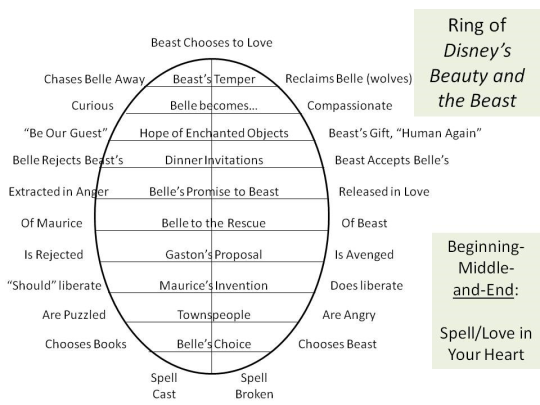
To illustrate what a more complicated ABCDEFGFEDCBA structure looks like, (but not as complicated as Harry Potter’s, which you can see here and here) Susan Raab has put together a fantastic visual of ring composition in Beauty and the Beast (1991), a movie which most agree is almost perfectly structured.
What’s so wonderful about ring composition in this story is that it so clearly illustrates how that one crucial decision of Beast changes everything in the world of the story. Everything from the first half of the story comes back in the second half, effected by Beast’s decision. This gives every plot point more weight because it ties them all to the larger story arc. What’s more, because it’s so self-referential, everything feels tidy and complete. Because everything has some level of importance, the world feels more fully realized and fleshed out. No small detail is left unexplored.
How great would Beauty and the Beast be if Gaston hadn’t proposed to Belle in the opening, but was introduced later on as a hunter who simply wanted to kill a big monster? Or if, after the magnificent opening song, the townspeople had nothing to do with the rest of the movie? Or if Maurice’s invention had never been mentioned again after he left the castle?
Humans are nostalgic beings. We love returning to old things. We don’t want the things we love to be forgotten.
This is true of readers, too.
We love seeing story elements return to us. We love to know that no matter how the story is progressing, those events that occurred as we were falling in love with it are still as important to the story itself as they are to us. There is something inside us all that delights in seeing Harry leave Privet Dr. the same way he got there–in the sidecar of Hagrid’s motorbike. There’s a power to it that would make any other exit from Privet Dr. lesser.
On a less poetic note, readers don’t like to feel as though they’ve wasted their time reading about something, investing in something, that doesn’t feel very important to the story. If Gaston proposed to Belle in Act 1 and did nothing in Act 3, readers might ask “Why was he even in the movie then? Why couldn’t we have spent more time talking about x instead?” Many people do ask similar questions of plot points and characters that are important in one half of a movie or book, but don’t feature in the rest of it.
Now, ring composition is odiously difficult to write, but even if you can’t make your story a perfect mirror of itself, don’t let story elements leave quietly. Let things echo where you can–small moments, big moments, decisions, characters, places, jokes.
It’s the simplest way of building a story structure that will satisfy its readers.
If there’s no place for something to echo, if an element drops out of the story half-way through, or appears in the last act, and you simply can’t see any other way around it, you may want to ask yourself if it’s truly important enough to earn its place in your story.
Further reading:
If you’d like to learn more about ring theory, I’d recommend listening to the Mugglenet Academia episode on it: x
You can also read more about symmetry in HP here: x
And more about ring structure in Lolita and Star Wars here: x and x
And about why story endings and beginnings should be linked here: x
“if it’s not plot relevant, cut it!!” is such awful writing advice
if JRR Tolkien had cut every bit of Lord of the Rings that wasn’t directly related to the central plot, it would have been just one book long, COLOURLESS and DULL AS DIRT.
all the little worldbuilding/character details are what draw you in and give the central plot weight, FOOL
The plot is not the same thing as the story. The plot is the mechanics of how one thing causes another.
Some classic stories have no plot to speak of – the characters just wander from one situation to the next. Alice in Wonderland and The Wizard of Oz are examples.
Some stories have partial plots, where some things in the story cause other things, but other things come out of the blue and pass away without consequence. This category includes classics too: Huckleberry Finn, The Wind in the Willows.
Even in stories with a strong plot, sometimes the most iconic moments fall outside that plot. Think of the No-Man’s-Land scene in Wonder Woman or the dying dinosaur in Jurassic World II.
Ah, but those aren’t classics, I hear someone say. Well, I disagree in the case of Wonder Woman (although time will tell), but let’s go right to the top of the English canon, Shakespeare’s Hamlet.
What’s the most iconic scene, if you had to pick one to illustrate for the front cover or the playbill poster? Ninety-nine times out of a hundred, it’s the Yorick skull scene. What does that have to do with the plot? Precious little. It’s just a way to keep Hamlet busy until Ophelia’s funeral arrives. And even there it’s not very well fit for purpose, because it doesn’t explain why Hamlet is hanging around in a graveyard anyway.
That’s because, tight though the plot of Hamlet is, the story of Hamlet is not reducible to its plot. Hamlet is a three-hour exploration of death and skulls and murder and corpses and funerals and ghosts and “what dreams may come”. The plot is just there to drive you around between the features of that mental landscape.
So the question isn’t “Does this serve the plot?” The question is “Does this help explore the idea that the story is about?”
(Why yes, I have written all this somewhere before.)
One really helpful thing I learned- and I can’t remember if it was from a writing class or a lit class, so I don’t even who to thank for it- is that each scene should move at least two or three aspects of what you’re writing forward.
That can be plot. It can be story.
It can be worldbuilding. It can be theme. It can be character. It can be relationships. It can be any number of things, but it needs to be more than one.
If a scene does nothing but move plot forward, it’s not accomplishing enough to earn its real estate on the page, any more than a scene that just builds character does.
When I look at it not as prioritizing plot, but as not prioritizing any one aspect of the story above all others, it makes it easier for me to figure out what strengthens my writing and what doesn’t, or,at the very least, how to make a scene that’s important to me more useful to the story as a whole.
So I think my favorite type of character isn’t strong characters or weak characters, emotional characters or stoic characters. Instead, its a type which manages to embody all of these at once: the brittle character.
See, most characters, they have levels. Annoy them and they’ll get irritated. Keep irritating them, and they might move into anger. Keep annoying them, and they might snap into outright fury. Same with pain. Hurt them, and they’ll wince. Hurt them more and they might shout, or scream. Where they switch between these levels will vary, of course, but they’ll all be there. Brittle characters are different.
Brittle characters don’t get those levels. Because brittle characters are basically just this raw, emotional, completely open character – the soul of the character, you could even say, surrounded by a shell. A hard shell, to be sure, but a thin one. And maybe some characters have a candied shell on the outside, while others have corrugated aluminum or something, but they all have their shells.
And if you hurt a brittle character, they won’t flinch. They won’t react. They’ll just stand there and take it…and take it…and take it…until suddenly they don’t. Until suddenly that shell shatters – maybe you hit a weak point, or maybe it just couldn’t withstand the pain anymore. And you get the pure essence of who the character is, something that is harder to see in less brittle characters because of all the levels protecting that. There’s none of that here. It’s all or nothing.
Brittle characters, people. Sure, you have to break them completely to see what they’re made of, but it’s worth it.
This honestly doesn’t need an addition because, wow, what flawless analysis of why I love brittle characters too.
It’s so freeing to write the reaction of a brittle character because any action from them is a release from this tight ball of raw vulnerability they’ve become. And, to them, that action isn’t something they can weigh—there’s no “should I?” By the time they’re compelled to act, it’s the only thing they can do. The essence of who they are, as OP says.
“Scene: I’m reading some fat fantasy book set in Yet Another Faux Medieval Europe. Nothing in this story jibes with my understanding of actual medieval Europe. There’s no fantasy version of the Silk Road bringing spices and agricultural techniques and ideas from China and India and Persia. There’s been no Moorish conquest. There aren’t even Jewish merchants or bankers, stereotypical as that would be. Everyone in this “Europe” looks the same but for minor variations of hair or eye color. They speak the same language, worship the same gods — and everyone, even the very poor people, seems inordinately concerned with the affairs of the nobility, as if there’s nothing else going on that matters. There are dragons and magic in the story, but it’s the human fantasy that I’m having trouble swallowing. It doesn’t matter which book I’m reading. I could name you a dozen others just like it. This isn’t magical medieval Europe; it’s some white supremacist, neo-feudalist fantasy of same, and I’m so fucking sick of it that I put the book down and open my laptop and start writing. Later people read what I’ve written and remark on how angry the story is. Gosh, I wonder why.”
When a character doesn’t realize they’ve been, like, shot or whatever and they hand brushes against their side and comes away wet with blood, and they’re just staring at it like wtf is this and then their knees just totally give out on them and they sink down, maybe gasping a little as the reality finally hits them. That’s good stuff.
I see that, and raise you a character who knows they’ve been shot, but waits until the rest of their crew is out of sight to put their hand against the slowly spreading stain of blood on their shirt, then trying to steady their breathing so they can follow without letting on how injured they are.
Okay but like the character who doesn’t realize they’ve been hurt trying to see if everyone else is okay only to slowly realize that everyone is looking at them with mounting horror. Then they touch their side to find it’s wet and oh no
all 3 of you are evil but i admire, respect, and fear you
We writers often categorize ourselves as “plotters” or “pantsers”, based on how much of our story we prefer to outline before we begin writing actual scenes. As I consider my writing process, I’m beginning to think this framework isn’t very useful for describing how I turn my ideas into a full-fledged story. But I think I’ve discovered a more useful way to frame this difference. Instead of “plotter vs. pantser”, consider: are you a deductive storyteller or an inductive storyteller?
Deductive reasoning starts with general premises and draws specific conclusions. In a similar way, deductive storytellers start with general concepts and work their way down to specific details.The Snowflake Method is the purest form of deductive storytelling–you start with the most basic overview, and at each level, you add more details and get more specific, until you wind up with a first draft.
To a deductive storyteller, the overarching framework is necessary in order to develop the small details. For example, if I were writing deductively, I’d decide that Suzie is a brave character, and then write scenes that show Suzie’s bravery. I’d also needs to figure out the steps of the plot before coming up with the details of any specific scene–I’d need to know that Suzie will argue with Dave so I can set up the tension that will lead to that scene. The big picture needs to come first, and any necessary details can be logically drawn from this framework.
In contrast, inductive reasoning starts with specific data and draws general conclusions. Therefore, inductive storytelling starts with specific details of a scene, and from that, draws general conclusions about the characters, plot, and setting. This type of writer aligns more closely with the “pantser” end of the spectrum, and is likely to get more ideas from writing scenes than from writing an outline.
An inductive storyteller needs to write out scenes, and use the small details in the prose to figure out broader facts about the plot, characters, and setting. For example, if I were writing inductively, I might write a scene in which Suzie was the only person in her party to enter a haunted house without hesitation. From this, I’d determine that Suzie was brave, and would use this insight to inform Suzie’s behavior in future scenes. I’d also use the details of early scenes to figure out the next logical steps of my plot. For example, Suzie and Dave are having tense interactions across multiple scenes, so it’s logical that it will erupt into an argument in the next scene. The small details have to come first, so they can be combined logically to draw larger conclusions about the story.
This framework hasgiven me insight into why I write the way I do. The “plotter vs. pantser” argument is generally framed as “do you get bored if you know the story beforehand”? But the difference goes much deeper than that–it ties into which method of story building feels more logical to you. I find that detailed outlines often destroy my stories. I might have a plot plan and character sheets that work extremely well in summary form, but I find I can’t use those big pictures to extrapolate the small details I need for a scene–the resulting story feels vague and artificial. It works much better if I write at least a few scenes first–see the characters interacting in their environment–and then dig deeper into what those details tell me about my characters, plot, and setting so I can further develop the story. Other people might find that they can’t come up with useful details unless they know the larger picture. Neither way is better–it just depends on your preferred storytelling strategy.
Obviously, writers will fall on a spectrum somewhere between these two extremes. But I feel that the “inductive vs. deductive” terminology is a more useful distinction than plain old “plotter vs. pantser”.The important thing isn’t whether you outline, but why an outline may or may not help you create the story you want to tell.
This is FABULOUS. I’ve never seen such a good description of my own (inductive) process before, and it actually helps to clarify some very important things for me about the project I’m currently working on — namely that I won’t find my way into the story by doing more research and taking more notes, I need to sit down and start writing scenes instead. (Which I really should know by now, because when has it worked for me any other way?)
What I really love about the deductive/inductive way of looking at writing is that it removes the value judgment implicit in the whole “pantser vs plotter” debate, where the very terms used invite a negative reaction from one group or the other (“You’re writing by the seat of your pants, how disorganized and lazy” or “You’re a plotter, clearly you’re approaching writing as a mechanical process and sucking all the life out of it”). With these terms it’s so much clearer that they are both viable, logical processes, and one is not superior to the other — they’re just different methods of telling a good story.
Thank you, @fictionadventurer! I’m going to use these terms when I talk about writing methods from now on.
This really brings home to me that I’m a third category– much as I am in other inductive vs deductive schemas. I call it a Bouncer– I go from one, to the other, and then back again. So I’ll have an idea for a scene, and then I’ll bounce to the broad picture and figure out how that fits in (which will help me generate the broad picture). Then I’ll bounce to a new scene and snowflake that out, and using the details from that I’ll bounce back to the broad picture again. I always considered myself a pantser because I don’t always outline, but in fact I’ve always formed a kind of mental outline very early on– and this is why! Cool!
something people writing post-apocalyptic fiction always seem to forget is how extremely easy basic 20th century technology is to achieve if you have a high school education (or the equivalent books from an abandoned library), a few tools (of the type that take 20 years to rust away even if left out in the elements), and the kind of metal scrap you can strip out of a trashed building.
if you want an 18th century tech level, you really need to somehow explain the total failure of humanity as a whole to rebuild their basic tech infrastructure in the decade after your apocalypse event.
i am not a scientist or an engineer, i’m just a house husband with about the level of tech know-how it takes to troubleshoot a lawn mower engine, but i could set up a series of wind turbines and storage batteries for a survivor compound with a few weeks of trial and error out of the stuff my neighbors could loot from the wreckage of the menards out on highway 3. hell, chances are the menards has a couple roof turbines in stock right now. or you could retrofit some from ceiling fans; electric motors and electric generators are the same thing, basically.
radio is garage-tinkering level tech too. so are electric/mechanical medical devices like ventilators and blood pressure cuffs. internal combustion’s trickiest engineering challenge is maintaining your seals without a good source of replacement parts, so after a few years you’re going to be experimenting with o-rings cut out of hot water bottles, but fuel is nbd. you can use alcohol. you can make bio diesel in your back yard. you can use left-over cooking oil, ffs.
what i’m saying is, we really have to stop doing the thing where after the meteor/zombies/alien invasion/whatever everyone is suddenly doing ‘little house on the prairie’ cosplay. unless every bit of metal or every bit of knowlege is somehow erased, folks are going to get set back to 1950 at the most. and you need to account somehow for stopping them from rebuilding the modern world, because that’s going to be a lot of people’s main life goal from the moment the apocalypse lets them have a minute to breathe.
nobody who remembers flush toilets will ever be content with living the medieval life, is what i’m saying. let’s stop writing the No Tech World scenario.
Also, like, you can loot a Bunnings – or even a camping goods store – and get your hands on a couple of portable solar panels.
Not that I’ve given this a lot of thought, but come the apocalypse, I know exactly which sections of the local hardware superstore to hit for necessary supplies, from generators to solar lights to fruit and veg seedlings.


 i'll apple your turnover