Like when I say ‘white people need to talk to bigots because bigots don’t listen to minorities’ I did not say ‘and it will be easy and fun’.
I know it’s easier to be like ~boo hooo the world is so evil and there’s nothing I can dooo~ but it’s statistically and experientially understood, just by fucking 3rd grade logic, that a bigot will be less amenable towards the subject of their bigotry.
Bigots don’t just ~not like~ minorities- they don’t think we’re human. It’s not about whether they agree with you or not in the moment. Like, pause.
Understand this:
Calls to action for white people to oppose bigotry are calls for white people to position themselves as opposition. THEY ARE NOT CALLS FOR ~SUCCESSFUL DEBATE~
Do not think you are expected nor are you likely to just go around arguing with bigots and they’ll go ‘I agree with you because you’re white!’.
Your job is to be sandpaper.
Every time they open their mouths to make a bigoted joke, or a bigoted remark, or post their shitty bigoted opinion online, you grate against them.
Your job is to make it hard to be a bigot or a fascist. Your job is to ostracize them. Your job is to speak over them the way they love to speak over minorities. Your job is to make it difficult, lonely, annoying, stressful and unwelcome to be a bigot.
When you are white and silent, You are making it easy. You are just letting it happen.
When minorities speak up for themselves, they are in danger, and the bigot just writes off our arguments as the chattering of ‘lessers’.
You, white people, whether you think so or not, are their peers.
Specifically those of you who look and talk like, to an outside observation, your average white american.
Bigots think you all think like them, but are too scared to say it. That, or you’re too much of a coward to stop them.
YOUR JOB IS TO PUSH BACK AND PROVE THEM WRONG.
YOUR JOB IS TO SEPARATE THEM FROM THEIR OWN COMMUNITY AT LARGE.
There are devils among you and if you want to stop being associated with them then fucking prove it. You’re pretty much the only people who can.
One of the white participants left the session and went back to her desk, upset at receiving (what appeared to the training team as) sensitive and diplomatic feedback on how some of her statements had impacted several of the people of color in the room. […] [Later] her friends wanted to alert us to the fact that she was in poor health and “might be having a heart attack.” Upon questioning from us, they clarified that they meant this literally. These co-workers were sincere in their fear that the young woman might actually die as a result of the feedback.
All of this is going to feel very familiar to anyone who’s blogged about racism in fandom.
“White fragility functions as a form of bullying: ‘I am going to make it so miserable for you to confront me — no matter how diplomatically you try to do so — that you will simply back off, give up, and never raise the issue again.’ White fragility keeps people of color in line and “in their place.” In this way, it is a powerful form of white racial control. Social power is not fixed; it is constantly challenged and needs to be maintained.”
In a new book, “White Fragility,”
DiAngelo attempts to explicate the phenomenon of white people’s
paper-thin skin. She argues that our largely segregated society is set
up to insulate whites from racial discomfort, so that they fall to
pieces at the first application of stress—such as, for instance, when
someone suggests that “flesh-toned” may not be an appropriate name for a
beige crayon. Unused to unpleasantness (more than unused to it—racial
hierarchies tell white people that they are entitled to peace and
deference), they lack the “racial stamina” to engage in difficult
conversations. This leads them to respond to “racial triggers”—the show
“Dear White People,” the term “wypipo”—with “emotions such as anger,
fear and guilt,” DiAngelo writes, “and behaviors such as argumentation,
silence, and withdrawal from the stress-inducing situation.”
Listen, in the build-up to the Civil War, one of the most powerful political forces in the United States was a trend toward moderation that advocated for a moderate amount of slavery, and they saw the abolitionists who wanted zero slavery to be “just as bad” as the planters and fire-eaters who wanted slavery everywhere. This is the “house divided” that Lincoln was talking about; a movement that “rejected extremism on both sides” so that we would have medium slavery.
As it is, so it ever was.
Reading what people wrote about slavery back then had a big impact on me. It was all too familiar how it was justified.
And liberals are perpetually trying to justify this stance with, “Oh, that was just the way things were back then, don’tcha know,”
and I’m just staring at them like
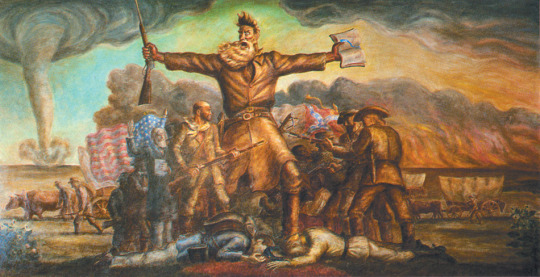
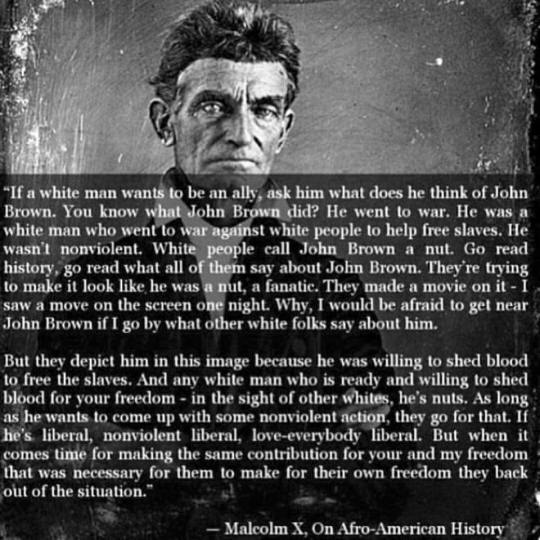
“John Brown having none of your shit” needs to be used more often as a reaction image on this site.
Every single depiction of the man looked like a meme template, even
Worth keeping in mind: when John Kelly said the civil war was started over a “lack of compromise,” he’s trying not to admit, “the South refused to compromise on the idea that slavery should be legal everywhere.”
The abolitionists were not a strong, solid majority. They were the extremists, the people saying “burn it all down” was better than a partial fix. And most white people (y’know, the only people who could vote) were content with “we could have SOME slavery, just… there should be limits.”
The South refused to accept limits. That’s the “lack of compromise” that kicked off the Civil War.
When some asshole Nazi wannabe tells you “look, both sides have some valid opinions; we should have more compromise,” know that what he really means is, “YOU should compromise; I should have the right to be as vicious as I want to anyone I wish.” And the people actually advocating for compromise? Again, they mean, “the bigots have been a big part of our history and we need to keep making them feel welcome. Their targets need to accept the gains they’ve gotten, and shut up about actually getting equality.”
So fuck compromise. Compromise only works when you’re starting from equal positions.
If ever there was a paragraph that described Canadian-Brand Racist Jackassetry, THIS IS VERY IT.
‘When you believe niceness disproves the presence of racism, it’s easy to start believing bigotry is rare, and that the label racist should be applied only to mean-spirited, intentional acts of discrimination. The problem with this framework–besides being a gross misunderstanding of how racism operates in systems and structures enabled by nice people–is that it obligates me to be nice in return, rather than truthful. I am expected to come closer to racists. Be nicer to them. Coddle them.’
“All white people benefit from racism,” is a statement of fact, not an accusation. It’s similar to, “All rich people have money.” As white people, we can use what we have to help people, we can just sit on it and reap the benefits (passively hurting people who don’t have what we have) or we can actively use it to hurt people, but that’s up to us.
I’ve thought about whether one could explain white privilege to white people (such as myself) by using the Catholic concept of original sin. As with original sin, you didn’t personally ask for white privilege; you were born into it willy-nilly; there is no way to rid yourself of it (Catholic doctrine holds that original sin can only be washed away via God’s grace, usually bestowed via baptism). Though you may have done nothing to attain it, you still have it, and it’s still your responsibility to fight it. If that doesn’t seem ‘fair,’ well, it’s nowhere near as unfair as racism is.
But then I think that although this analogy is striking, it reinforces the very problem that the OP is addressing, which is that to point out the existence of white privilege (or systemic racism, which is what sustains white privilege) to a white person often results in their becoming so personally offended by your supposed “accusation” of their own moral impurity that they reject the entire concept and therefore the reality of systemic racism.
And then I wonder if part of what creates white fragility in the first place is that white people are, consciously or unconsciously, conceiving of racism in theological rather than social terms, as if it is a sin that one must expiate as opposed to a problem that one must help to solve. Because this seems to me to be one of the barriers to addressing systemic racism (as opposed to interpersonal racism): getting white people such as myself to understand that the problem with racism is not that it stains our personal souls, but that it harms other people–and that the goal of fighting racism is not moral purity for us, but less harm done to people of color.
Black Panther is about $20 million shy of breaking the Avengers record for highest grossing film in North America (so yes, this means I will in fact be seeing it one more time), but it does bother me that the entire industry keeps focusing on Black Panther in relation to other movies, as if it’s somehow stealing box office revenue from other films.
1) If your movie is good, people are probably gonna want to go see it, even if they saw another movie that month. Middling reviews do not inspire people to shell out $15 a ticket regardless of whether there is a massive juggernaut released at the same time.
2) WE TOLD Y’ALL THIS MOVIE WOULD BE BIG. As soon as the movie was released, critics, box office watchers, and Chads of all stripes were predicting a $60 million open with maybe a $200 million end run. Because of that, studios decided to go ahead and release their tentpoles and big releases in this pre-summer period before the big blockbusters come out because they didn’t see Black Panther as a big blockbuster. Underestimating Black folks bit you in the ass again.
3) Suffer. I don’t know what else to tell you.
I’m trying to imagine this white guy and his white editor whining about white-starring blockbusters breaking box-office records. As one black Tweet said, black folks have been told from day one they had to be twice as good to be treated half as well, and now it’s THEIR fault BP is doing so well?







 i'll apple your turnover