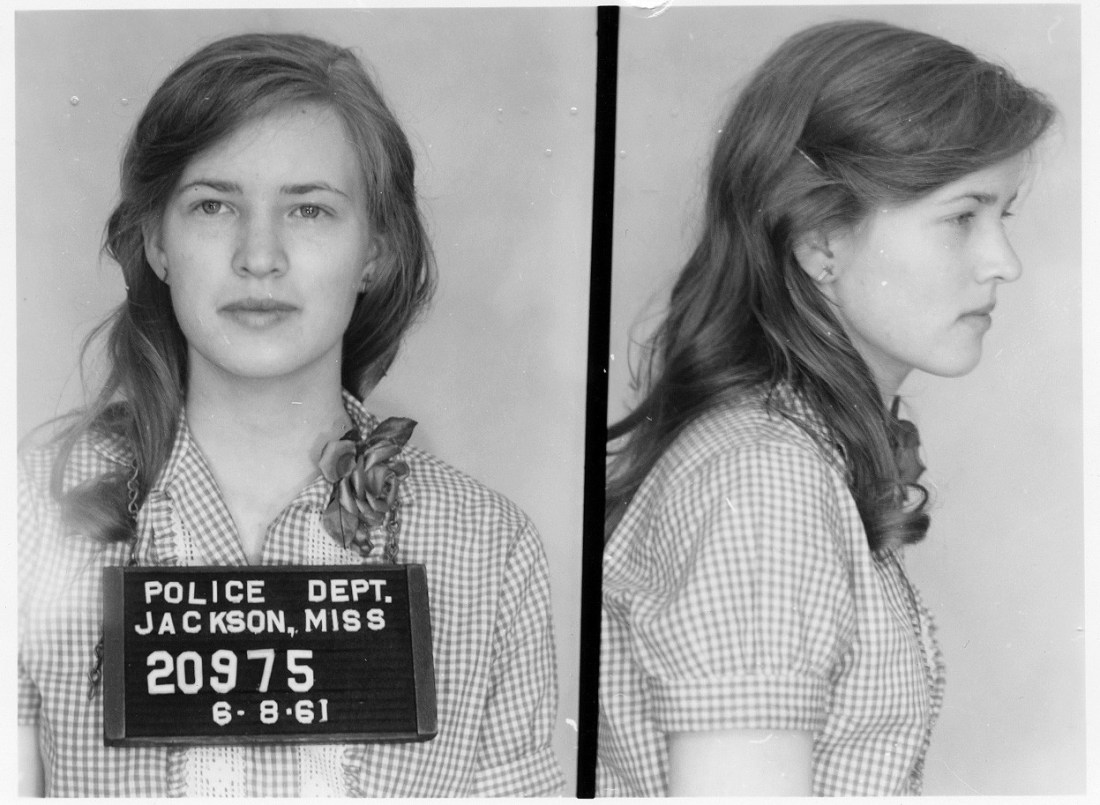
Mugshot of a teenage girl arrested for protesting segregation, Mississippi, 1961.
Her name is Joan Trumpauer Mulholland. Her family disowned her for her activism. After her first arrest, she was tested for mental illness, because Virginia law enforcement couldn’t think of any other reason why a white Virginian girl would want to fight for civil rights.
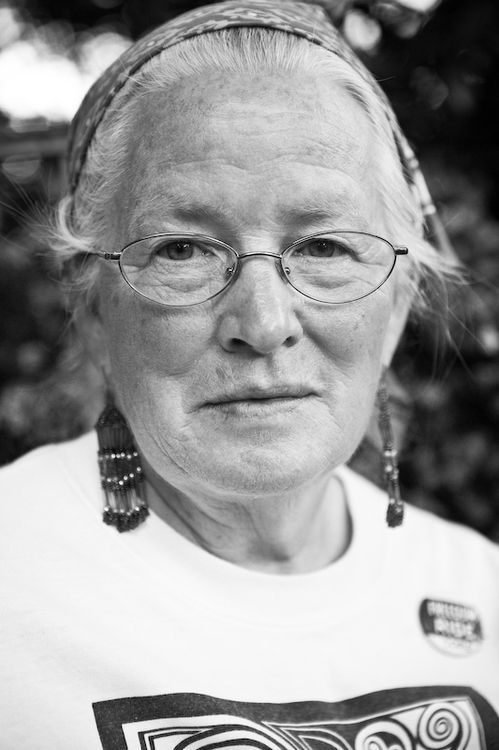
She also created the Joan Trumpauer Mullholland Foundation. Most recently, she was interviewed on Samatha Bee’s Full Frontal on February 15 for their segment on Black History Month.
Don’t reduce civil rights heroes to “teenage girl”.
Her great-grandparents were slave owners in Georgia, and after the United States Civil War, they became sharecroppers. Trumpauer later recalled an occasion that forever changed her perspective, when visiting her family in Georgia during summer. Joan and her childhood friend Mary, dared each other to walk into “n*gger” town, which was located on the other side of the train tracks. Mulholland stated her eyes were opened by the experience: “No one said anything to me, but the way they shrunk back and became invisible, showed me that they believed that they weren’t as good as me. At the age of 10, Joan Trumpauer began to recognize the economic divide between the races. At that moment she vowed to herself that if she could do anything, to help be a part of the Civil Rights Movement and change the world, she would.
In the spring of 1960, Mulholland participated in her first of many sit-ins. Being a white, southern woman, her civil rights activism was not understood. She was branded as mentally ill and was taken in for testing after her first arrest. Out of fear of shakedowns, Mulholland wore a skirt with a deep, ruffled hem where she would hide paper that she had crumpled until it was soft and then folded neatly. With this paper, Mulholland was able to write a diary about her experiences that still exists today. In this diary, she explains what they were given to eat, and how they sang almost all night long. She even mentioned the segregation in the jail cells and stated, “I think all the girls in here are gems but I feel more in common with the Negro girls & wish I was locked in with them instead of these atheist Yankees.
Soon after Mulholland’s release, Charlayne Hunter-Gault and Hamilton E. Holmes became the first African American students to enroll at the University of Georgia. Mulholland thought, “Now if whites were going to riot when black students were going to white schools, what were they going to do if a white student went to a black school?” She then became the first white student to enroll in Tougaloo College in Jackson, where she met Medgar Evers, Dr. Martin Luther King Jr., Reverend Ed King, and Anne Moody.
She received many letters scolding or threatening her while she was attending Tougaloo. Her parents later tried to reconcile with their daughter, and they tried to bribe her with a trip to Europe. She accepted their offer and went with them during summer vacation. Shortly after they returned, however, she went straight back to Tougaloo College.
She ultimately retired after teaching English as a Second Language for 40 years and started the Joan Trumpauer Mulholland Foundation, dedicated to educating the youth about the Civil Rights Movement and how to become activists in their own communities.
I watched a YouTube video once (by a guy who’s name escapes me) about the importance of making sure the stories of white activists are told. His point was that it’s not about lavishing praise on them just because they were white and “woke”, it’s about letting other white allies see that others have come before them who were willing to sacrifice and do the hard work. This way they can see themselves in someone and realize that destroying inequality isn’t a fringe interest or just an “us vs. them” issue. It has to be ALL OF US.
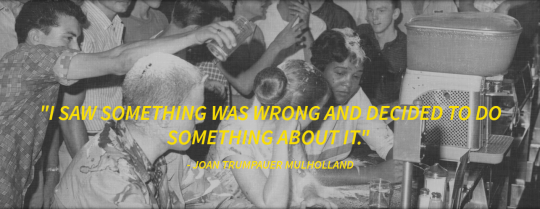
I thought I recognized Joan’s name…and the black woman in that picture of the Woolworth’s sit-in with her face turned to the camera, covered in food. That’s Anne Moody, who wrote probably my favorite autobiography ever (and fave book in general, let’s be honest) about her life and her work during the Civil rights movement. The book is called Coming of Age in Mississippi.
Anne and Joan, along with other Tougaloo students staged the sit in at the counter under the direction of the NAACP. Three black students, Anne, Memphis, and Pearlena started the sit-in at the counter. Newsmen arrived pretty quickly, and although some of the white people at the counter expressed sympathy for the movement, things devolved from there. A drunk protestor that Moody recognized from another sit in pulled a knife. The three protestors started to pray and then “all hell broke loose.”
A man threw Memphis from his seat and slapped Anne across the face. Another man threw her into the counter. Memphis was bleeding from the head, and men were kicking him in the head. A plainclothes police officer eventually arrested both Memphis and his attacker.
Pearlena and Anne got back on their stools, while some white Tougaloo teachers asked if they wanted to leave before things got violent again. Joan Trumpauer joined them at the counter at that point, making the protest integrated.
The crowd started chanting “Communists! Comunists!” at the three women until an old man in the crowd ordered men to take the women off the stools. They grabbed the “white n*gger” first–Joan and ripped her off of the stool, even as Anne was grabbed by two high school boys and dragged 30 feet by her hair. They let her go, and she and the others raced back to the counter, joined by Lois Chaffee, a white Tougaloo staff member.
That’s when the crowd started smearing them with food. They were joined by John Slater, the head of their NAACP chapter. He was hit in the face by someone wearing brass knuckles. And them someone literally threw salt into the wound.
The protestors were joined by others; the school chaplain, a CORE field worker, a Jackson State student, and a black high school boy. The mob started spray painting the protestors with nasty words.
The protestors–Anne and Joan among them, sat there for three hours, enduring the increasingly abusive assaults from the crowd, who had thrown food, paint and anything they could get their hands on at them. The store manager begged everyone to leave, but the crowd would not leave until the students did.
The president of Tougaloo, Dr. Beittel, ran in to tell them that 90 cops were waiting outside and had watched the whole thing through the windows, but had not stopped it. Beittel asked the police chief to escort the students out, but he refused to enter the store. Beittel lead the protestors out, while the cops formed a single line to block the crowds outside the store from getting at the students.
That did not stop the crowd from throwing things at them. However, they were picked up and taken safely to the NAACP headquarters.
“After the sit-in, all I could think of was how sick Mississippi whites were. They believed so much in the segregated Southern way of life, they would kill to preserve it. I sat there in the NAACP office and thought of how many times they had killed when this way of life was threatened. I knew that the killing had just begun. “Many more will die before it is over with,” I thought. Before the sit-in, I had always hated the whites in Mississippi. Now I knew it was impossible for me to hate sickness. The whites had a disease, an incurable disease in its final stage. What were our chances against such a disease?“ – Anne Moody
Please remember this. All Anne and Joan and the others did was sit at a lunch counter…and look at how the whites treated them. Never forget. And don’t let racists forget either.
Listen, in the build-up to the Civil War, one of the most powerful political forces in the United States was a trend toward moderation that advocated for a moderate amount of slavery, and they saw the abolitionists who wanted zero slavery to be “just as bad” as the planters and fire-eaters who wanted slavery everywhere. This is the “house divided” that Lincoln was talking about; a movement that “rejected extremism on both sides” so that we would have medium slavery.
As it is, so it ever was.
Reading what people wrote about slavery back then had a big impact on me. It was all too familiar how it was justified.
And liberals are perpetually trying to justify this stance with, “Oh, that was just the way things were back then, don’tcha know,”
and I’m just staring at them like
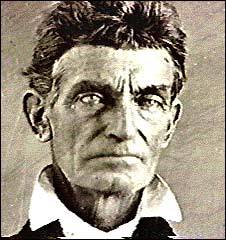
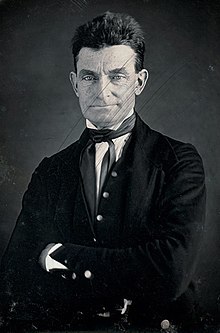
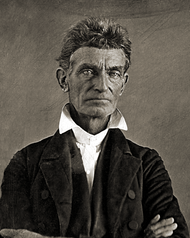
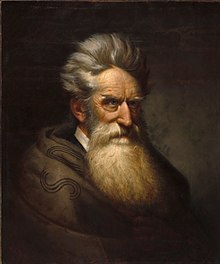
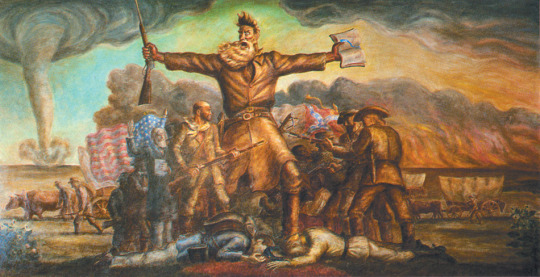
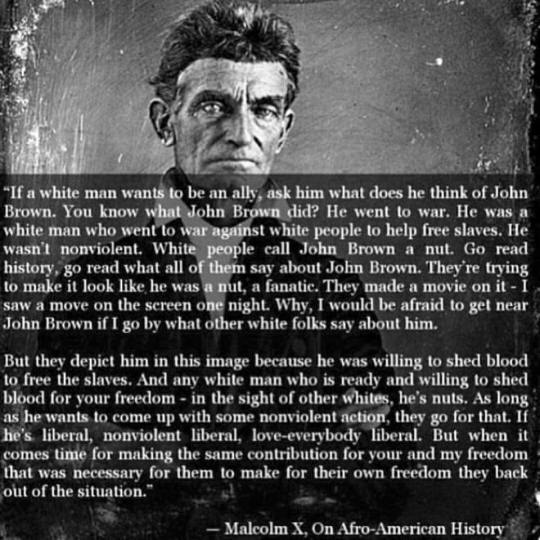
“John Brown having none of your shit” needs to be used more often as a reaction image on this site.
Every single depiction of the man looked like a meme template, even
Worth keeping in mind: when John Kelly said the civil war was started over a “lack of compromise,” he’s trying not to admit, “the South refused to compromise on the idea that slavery should be legal everywhere.”
The abolitionists were not a strong, solid majority. They were the extremists, the people saying “burn it all down” was better than a partial fix. And most white people (y’know, the only people who could vote) were content with “we could have SOME slavery, just… there should be limits.”
The South refused to accept limits. That’s the “lack of compromise” that kicked off the Civil War.
When some asshole Nazi wannabe tells you “look, both sides have some valid opinions; we should have more compromise,” know that what he really means is, “YOU should compromise; I should have the right to be as vicious as I want to anyone I wish.” And the people actually advocating for compromise? Again, they mean, “the bigots have been a big part of our history and we need to keep making them feel welcome. Their targets need to accept the gains they’ve gotten, and shut up about actually getting equality.”
So fuck compromise. Compromise only works when you’re starting from equal positions.



 i'll apple your turnover