the thing I really like about The Good Place is that it thematically revolves around ethics and what makes a person good or bad (both in the sense of– how do we define good and bad, and in the sense of–what aspects of someone’s formative environment and social group influence how they will treat other people).
and the conclusion that the show comes to over and over is both that it is possible to become a better person, and because it’s possible we owe it to each other to keep trying to be better– for all eternity if we must.
there’s no end to it, and (should I make a prediction) no real “good place” where you’ve gotten to the finish line and “won” at being a good person. it’s an eternal commitment to other people.
you create your own good place, because whether you’re in a good place or a bad place is defined by how people treat each other. when your community has collectively learned to respect, value, and help each other, you experience the peace and support that you might have once imagined in the abstract being awarded to the truly “good”
Sartre famously said that the Bad Place is other people. The Good Place argues that the Good Place is, too.
That’s because Mike Schur is Jewish.
The underlying theme of all of his shows is essentially chesed (חֶסֶד), which basically translates to loving-kindness. But not just like, loving kindness? But a DUTY to loving-kindness, a duty to tikkun olam, or repairing the world through acts of genuine chesed.
Tahani was committed to good works, but not out of a commitment to loving-kindness. Not for others and, tbh, not for herself, since she spent her whole life feeling “less” than Kamilah. To love others as yourself, you have to love yourself.
Similarly, Chidi was desperately unkind and unloving to himself, and thus denied the *whole world* loving-kindness. TGP shows this in the way Chidi’s thought- and behavior patterns that hurt him throughout his life were also inherently harming the people around him who loved him.
Eleanor purposely acted against loving-kindness, to the point where seeing others engaged in it made her angry.
Jason, honestly, had a very kind and loving soul, but his actions caused harm to others (whether that was his intention or not, and honestly it seems like he mostly just didn’t understand the impact of his choices a lot of the time… but harm is harm).
“You are not obligated to complete the work, but neither are you free to desist from it,” “learn to do good,” etc. I’m not saying that TGP ~is Jewish, because it’s not, but I AM saying that you can see Schur’s ethical framework in his art, and trying to look at any of his shows through a Christian lens is going to skew them.
Also the whole thing where there’s not really a heaven nor a hell, and that it seems like in The Good Place’s eschatology, actions are ultimately judged solely by the impact they have (on the self AND/OR on others) – which I feel like was also one of the main themes of Parks & Rec, and is wrestled with in B99. The highest ethical order is chesed.
It sounds like an interesting mix of Virtue Ethics and Deontology. You can learn to be good by doing good and, therefore, you have a duty to attempt it whole-assedly
Yes!
Pragmatist ethics in its highest formulation is s mixture of deontology and virtue ethics. It is ethics without a fixed form. The project in The Good Place requires the characters to treat one another and know themselves as complex wholes, involve the moral imagination, and keep interactions and relationships at the center of the ethical question.
The thing about Jason Mendoza in the good place is that he’s the only character on the show with any emotional intelligence, like, period.
The others might all be smart in their own ways and him really, really uneducated (i’d call him stupid, but after the vague jokes about his schooling i think this is meant to be commentary on how him not being fortunate enough to be given a good education contributed to him ending up in the bad place) but, he’s actually really, really emotionally intelligent!
He helps the others sort through their own emotional baggage without seeming to even realise he’s doing it, and he picks up on it and confronts Tahani on her bad behaviour against him. He didn’t have the book smarts at the time to label exactly what it was that she was doing that was unfair to him, but he Did know she was being out of line. He’s also, in general, a kind human being, he’s not cruel or mean like any of the others, he may be self-centered at times, but never mean (which Eleanor and Tahani can definitely be).
The other three humans, plus Janet and Michael, have no clue about emotions! The blanket statement that Jason is stupid in all areas is flawed, because if we stopped measuring that standard by book smarts or street smarts, Jason would leave them in the dust because he’s actually in touch with his own and others’ emotions, and they genuinely need his emotional compass to move forward imo.
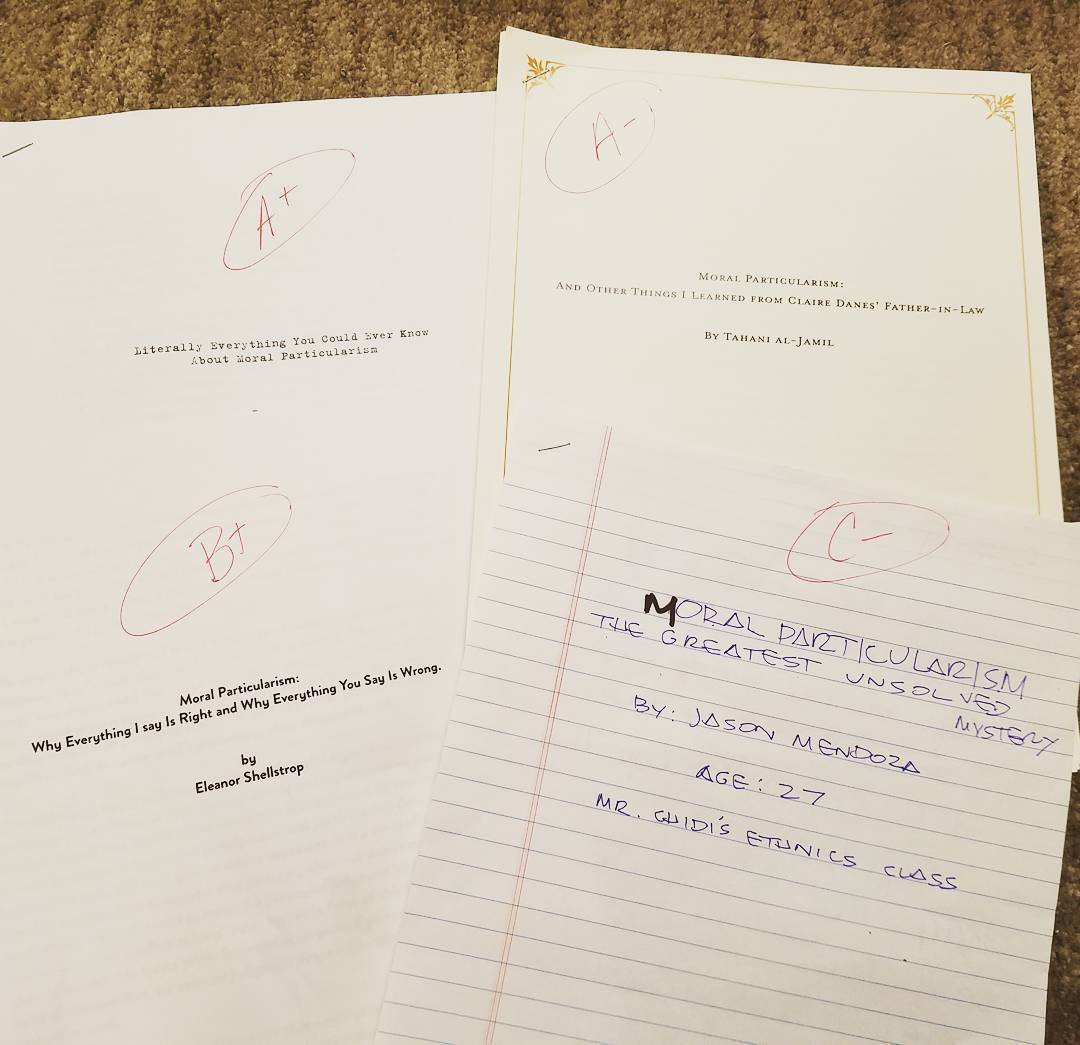
I was a member of a 60-person dance crew in Jacksonville. We were called “Dance Dance Resolution: We Resolve to Dance.” One day, Donkey Doug (JASON’S DAD) and I got into a fight because I’d framed his girlfriend (HIS DAD’S GIRLFRIEND) for boogie board theft. So he (STILL JASON’S LITERAL DAD) started a new dance crew called “Hashtag Doug Life” (#DAD) and immediately challenged us to a dance-off. He (THE ACTUAL FATHER OF JASON MENDOZA) said, “Meet us inside the abandoned orange juice factory at midnight.” That night, as the clock struck 12, me and my crew came together with a determination we had never shown before … and slashed all their tires (INCLUDING THE TIRES OF HIS VERY OWN FATHER’S CAR). It was dope. The end. By Jason Mendoza.
So ethically we should tell Jason he used to be married to Janet and it sure would be terrible if that ultimately led to Derek’s death. Wink. No, winking is bad. You should not be winking – or saying the word ‘wink’!
the thing I really like about The Good Place is that it thematically revolves around ethics and what makes a person good or bad (both in the sense of– how do we define good and bad, and in the sense of–what aspects of someone’s formative environment and social group influence how they will treat other people).
and the conclusion that the show comes to over and over is both that it is possible to become a better person, and because it’s possible we owe it to each other to keep trying to be better– for all eternity if we must.
there’s no end to it, and (should I make a prediction) no real “good place” where you’ve gotten to the finish line and “won” at being a good person. it’s an eternal commitment to other people.
you create your own good place, because whether you’re in a good place or a bad place is defined by how people treat each other. when your community has collectively learned to respect, value, and help each other, you experience the peace and support that you might have once imagined in the abstract being awarded to the truly “good”
Sartre famously said that the Bad Place is other people. The Good Place argues that the Good Place is, too.
That’s because Mike Schur is Jewish.
The underlying theme of all of his shows is essentially chesed (חֶסֶד), which basically translates to loving-kindness. But not just like, loving kindness? But a DUTY to loving-kindness, a duty to tikkun olam, or repairing the world through acts of genuine chesed.
Tahani was committed to good works, but not out of a commitment to loving-kindness. Not for others and, tbh, not for herself, since she spent her whole life feeling “less” than Kamilah. To love others as yourself, you have to love yourself.
Similarly, Chidi was desperately unkind and unloving to himself, and thus denied the *whole world* loving-kindness. TGP shows this in the way Chidi’s thought- and behavior patterns that hurt him throughout his life were also inherently harming the people around him who loved him.
Eleanor purposely acted against loving-kindness, to the point where seeing others engaged in it made her angry.
Jason, honestly, had a very kind and loving soul, but his actions caused harm to others (whether that was his intention or not, and honestly it seems like he mostly just didn’t understand the impact of his choices a lot of the time… but harm is harm).
“You are not obligated to complete the work, but neither are you free to desist from it,” “learn to do good,” etc. I’m not saying that TGP ~is Jewish, because it’s not, but I AM saying that you can see Schur’s ethical framework in his art, and trying to look at any of his shows through a Christian lens is going to skew them.
Also the whole thing where there’s not really a heaven nor a hell, and that it seems like in The Good Place’s eschatology, actions are ultimately judged solely by the impact they have on others – which I feel like was also one of the main themes of Parks & Rec, and is wrestled with in B99. The highest ethical order is chesed.
Ok now I’m struck by the fact that there’s 4 main humans in this show and for some reason my brain immediately went to the 4 children from the Passover Seder and it fits so well?
Like obvs Chidi seems the choice for the wise and Eleanor fits the wicked, and it’s tempting to say Jason is the ignorant child, but then I realized he spent much of S1 in silence and is the child who cannot ask. Which leaves Tahani as the ignorant child which imo fits as well.









 i'll apple your turnover