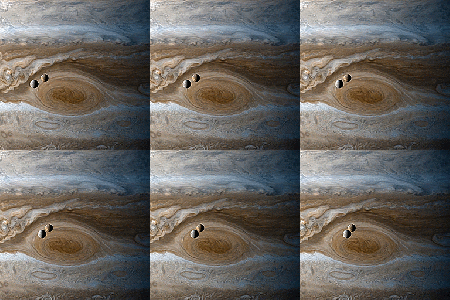
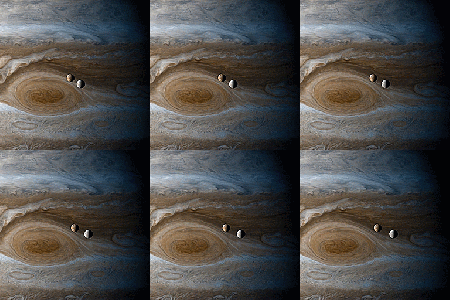
Created using still images taken by the Cassini spacecraft during it’s flyby of Jupiter and while at Saturn. Shown is Io and Europa over Jupiter’s Great Red Spot.
I don’t think most people realize how terrifying the Moon Landings were. They look back at it, and see this great achievement in human spaceflight but don’t grasp the gravity of the situation. (No pun intended)
OP mentions Michael Collins, who is often forgotten. He was the third member of the Apollo 11 mission, who manned the Command Module whilst the other two landed with the Lander Module. People might hear that and thing he got the short end of the stick, but honestly… I’d argue the opposite. At 20:17:40 UTC on Sunday July 20 1969 the Landing Module touched down on the Moon. Neil Armstrong and Buzz Aldren spent 21 hours, 36 minutes on the surface of the Moon before beginning ascent to rendezvous with Michael Collins in the Command Module.
This is where things get unnerving. The thruster used on the Lunar Ascent Propulsion System used a hypergolic fuel, which is a fuel that spontaneously ignites when the fuel and oxidizer meet. Hypergolic fuels are useful for when spacecrafts need reliable ignition or repeated ignitions, however they’re nasty things. The specific fuel used for this thruster was a mixture of Aerozine 50 and Dinitrogen tetroxide. These are incredibly toxic, and more importantly incredibly corrosive. In fact, they are so corrosive that once you fire an engine you essentially have to completely rebuild it in order to reuse it. This means that the engine on the Lunar Ascent Propulsion System had never been fired before.
That engine was their bridge home. If it failed, they would be stranded on the surface of the Moon. As mentioned the Moon Landing lasted roughly 22 hours. For twenty two hours the two astronauts were on the moon, completely unsure if the never-before fired thruster would even fire up. Completely unsure if they’d be able to go home.
This picture shows the entirety of the human race on January 21st, 1969. All of it except the man who took it, that is. Micheal Collins stayed back on the Command Module during the mission to await Aldrin and Armstrong’s return… or potential lack thereof. This earned him the title “The Loneliest Man in the Universe”. For about 50 minutes for each orbit around the Moon Collins would be out of contact with the earth. That means for about 50 minutes during each orbit he’d have no way to contact any other human, completely alone over 230,000 miles from earth. For roughly 50 minutes during each orbit Collins had no clue whether his fellow astronauts were still alive, and them not returning was a very real possibility. Orders were in place that if the other two could not return to the command module that Collins would return alone.
This wasn’t just some disaster protocol either. This was a very real possibility. Both the astronauts, and NASA were very much prepared for it to happen. So much so that Richard Nixon, the president at the time, had a speech prepared if it were to happen. It doesn’t sugar coat it. It starts off
“Fate has ordained that the men who went to the moon to explore in peace will stay on the moon to rest in peace. These brave men, Neil Armstrong and Edwin Aldrin, know that there is no hope for their recovery.“
If that isn’t bone chilling, then I’m not really sure what is. People often romanticize space exploration, but back then, and even today, well… this is the reality of it. All of that is what astronauts go through.
The Sun may look unchanging to us here on Earth, but that’s not the whole story.
In visible light – the light our eyes can see – the Sun looks like an almost featureless orange disk, peppered with the occasional sunspot. (Important note: Never look at the Sun directly, and always use a proper filter for solar viewing – or tune in to our near-real time satellite feeds!)
But in other kinds of light, it’s a different picture. The Sun emits light across the electromagnetic spectrum, including the relatively narrow range of light we can see, as well as wavelengths that are invisible to our eyes. Different wavelengths convey information about different components of the Sun’s surface and atmosphere, so watching the Sun in multiple types of light helps us paint a fuller picture.
Watching the Sun in these wavelengths reveals how active it truly is. This image, captured in a wavelength of extreme ultraviolet light at 131 Angstroms, shows a solar flare. Solar flares are intense bursts of light radiation caused by magnetic events on the Sun, and often associated with sunspots. The light radiation from solar flares can disturb part of Earth’s atmosphere where radio signals travel, causing short-lived problems with communications systems and GPS.
Looking at the Sun in extreme ultraviolet light also reveals structures like coronal loops (magnetic loops traced out by charged particles spinning along magnetic field lines)…
…solar prominence eruptions…
…and coronal holes (magnetically open areas on the Sun from which solar wind rushes out into space).
Though extreme ultraviolet light shows the Sun’s true colors, specialized instruments let us see some of the Sun’s most significant activity in visible light.
A coronagraph is a camera that uses a solid disk to block out the Sun’s bright face, revealing the much fainter corona, a dynamic part of the Sun’s atmosphere. Coronagraphs also reveal coronal mass ejections, or CMEs, which are explosions of billions of tons of solar material into space. Because this material is magnetized, it can interact with Earth’s magnetic field and trigger space weather effects like the aurora, satellite problems, and even – in extreme cases – power outages.
The Sun is also prone to bursts of energetic particles. These particles are blocked by Earth’s magnetic field and atmosphere, but they could pose a threat to astronauts traveling in deep space, and they can interfere with our satellites. This clip shows an eruption of energetic particles impacting a Sun-observing satellite, creating the ‘snow’ in the image.
We keep watch on the Sun 24/7 with a fleet of satellites to monitor and better understand this activity. And this summer, we’re going one step closer with the launch of Parker Solar Probe, a mission to touch the Sun. Parker Solar Probe will get far closer to the Sun than any other spacecraft has ever gone – into the corona, within 4 million miles of the surface – and will send back unprecedented direct measurements from the regions thought to drive much of the Sun’s activity. More information about the fundamental processes there can help round out and improve models to predict the space weather that the Sun sends our way.
Keep up with the latest on the Sun at @NASASun on Twitter, and follow along with Parker Solar Probe’s last steps to launch at nasa.gov/solarprobe.
Make sure to follow us on Tumblr for your regular dose of space: http://nasa.tumblr.com.
Spirit sends one of those pictures that looks like it could come from the red rock deserts of the American West, but actually shows part of the landscape in Gusev crater, a mere 60 million miles away. Credit: NASA
The dune field at the center of Victoria Crater, seen in a new false-color shot. Credit: NASA
It wrinkles my brain that Jupiter’s moon Europa has oceans that are sixty miles deep, while Earth’s oceans only reach seven miles deep at most. I’m willing to bet good money that there’s life in Europa’s oceans. Like five bucks. You hear me, NASA? I bet you five bucks that there’s life on Europa… Now that there’s money and reputation on the line, I bet they send a mission there real quick.
I have no idea when this was originally posted, but NASA is working on their Europa mission RIGHT NOW to look for alien life! But get this, they theorize that because of the depth, gravity, and composition of the oceans, any organisms that lived there would be waaay bigger than aquatic life on Earth. So far everything’s going well with regards to their Europa mission so they should have a spacecraft on its way to look for giant sea monsters in space in only a few years. (The planned date is in the early 2020s.)
Looks like my negotiations worked. You’re welcome, humanity.
I’ve never been gripped with such cold terror and pure delight in my LIFE





 i'll apple your turnover