SHORT STORY/ONE-SHOT/ONE CHAPTER/COMICS 101 CRASH COURSE RAPIDPUNCHES’ STYLE
I’m NOT an expert but I have some working experience I can share. You need experience to become great. Here is my set of instructions, tips, and notes towards making a 12-page comic.
My method is to work backwards. Personally I work “backwards” because the end is the only wholly necessary page or set of panels in the story. Everything in between is open to editing and hacking as the most important moments are emphasized and chosen.
I even plan/draw the end page first. The end is the last page a reader sees- so spend your freshest energies on making it as epic, memorable, poignant, and beautiful as #$%^&.
If you draw the pages from 1 to 12 sequentially you run the risk of fresh to burnt out- an uneven distribution of drawing skill. (treat the first page and the 2-page splash as you would the last).
Roughly… the steps to making your comic is
WRITE
PLAN THUMBNAILS
DRAW
…BEGIN THE WRITING (DO NOT SKIP NO MATTER WHAT) like this, in this order:
How does it end?
Does the protag succeed or fail?
What is the turning point of their story?
What the protag do that led them there?
Where does it start?
Who is this protag?
EXAMPLE:
Guy gets mauled by a bear.
This is a fail on the guy’s half.
The bear must eat something or he’ll starve to death.
It’s the guy’s fault the bear can’t find other food. He caused the avalanche that buried all the cabins.
The guy is yodeling in an avalanche zone.
The guy is some guy.
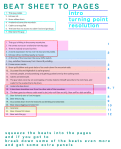
CREATING “THE BEAT SHEET” Take the above stuff and reorder it to make sense.
This guy yodels.
Echoes roll.
Snow slides down.
Avalanche buries the mountain.
Cabins are engulfed.
This bear has no access to cabin food and garbage.
Bear eats this guy.
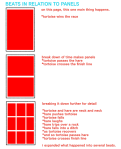
Expand. Blow up important beats for emphasis. Keep less important beats brief.
This guy is hiking in the snowy mountains.
He comes across an avalanche warning sign.
There is nobody around but him.
A dumb expression forms over his face and he yodels.
Echoes roll but nothing nearby is moved.
At the top of the mountain the snow drifts twitch.
Guy, satisfied, hikes away from there still yodeling.
Frozen snow cracks.
Snow puffs billow and great slabs of ice crash down the mountain side.
Guy sees this and hightails it to safer ground.
Animals, people, are all panicking and getting pushed over by the rushing snow.
Cabins are destroyed.
The guy takes cover by an outcropping of rocks, fastens himself securely to the rock face, and waits for the avalanche to die down.
Avalanche dies down.
A lone bear shambles over from the other side of the mountain.
The bear goes to where a cabin used to be (only roof tiles are left). Bear sniffs a dish satellite.
Bear forlornly eats a food wrapper.
Bear tries to dig.
Guy comes down from the rocks he as climbing and sees bear.
Bear stops digging and sees him.
Guy runs.
Bear chases him down.
Bear eats the guy.
BEAT SHEET COMPLETED!!!
After the beat sheet, write up all the sound effects and speech bubbles and conversation/dialogue you want to be in your comic.
Since comics are a visual medium, highest priority is given to the beats. If a story can’t be told with the art without the dialogue– you messed up and it’s time to rethink your life choices.
Try to keep all your text chunks as short as a tweet. Professionally you don’t want more than 25 words per speech bubble and no more than 250 words per page.
Next is translating the beats to pages…
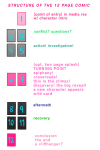
STRUCTURE OVERVIEW:
[1] point of entry, in media res, hero intro
[2][3] conflict. establish conflict, setting, and mood by the third page. [4][5] rising action/false resolution to conflict/investigation
[6][7] turning point/plot twist/epiphany (this one epic image, to page spread is pivotal, spend a lot of effort into creating this)
[8][9] aftermath/“darkness before dawn”/struggle [10][11] recovery/“rise and conquer”/“fall”
[12] resolution/final end/cliffhanger
[front cover][interior] [interior][back cover]
——————–
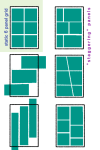
My maximum per page is nine panels but I’ve seen pages that have way more. I like to have about 3 to 4 panels per row or less but I’ve seen the “rules” broken before. Advanced comic book artists manipulate time with the number of panels and the size of each panel.
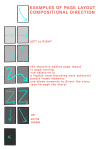
remember, DIAGONALS!!! open up an issue of batman, superman, spider man, deadpool or whatever youre reading theyre everywhere.
———-
…DRAW IN THIS ORDER:
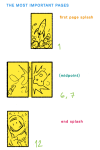
Page 12,
Page 6 and 7 (this is typically one large image that takes up the space of two pages),
Page 1,
and then the rest.
ONLY “DEVIATION” ALLOWED:
Page 12 and 1*
Page 6 and 7,
and then the rest.
*Draw the first and last page as a spread in situations where the beginning of the story mirrors the end of the story.
Cover is dead last.
———-
(If at the very end you find out you need more pages and it’s absolutely unavoidable and totally necessary you have to add them in fours. Try to stick to 12 pages for this crash course.)
——————–
FURTHER NOTES:
Plan and draw the pages in spreads (the twos) since this is how it will appear in print and when you submit them to an editor for review guess what, the pages with an exception to the first and last will be reviewed as spreads.
You at most only need one establishing panel of the setting and environment (scene) per page.
Forget “true to life” perspective outside of the establishing panel). Practice diagonal composition of objects and subjects within panels. For dynamism.
You don’t have to present the text all in one go (one paragraph or bubble). You can and should break up paragraphs, sentences, and if you need to single out words– to make smaller, more easily managed bubbles to scatter through the panel.
Less important moments have smaller panels and or lesser detail. More details (or more word bubbles) slow down time. More drawn detail also creates a concentration of values (it’s darker and sometimes combines together as one shape or mass)
Know your light sources. Control the blacks. Control the values.
Amazon just recced me a show called Hidden Killers of the Edwardian and Victorian Home and I’m a little creeped out by how well it knows me.
I’m like 10 minutes in and have learned more about early household electricity than I probably wanted to know but seriously anyone writing 19th and early 20th century mystery fics needs to watch this show because I can tell it has a wealth of period specific ways to cover up a murder.
Also anyone who knows even a little bit about the history of consumer and worker safety especially in the industrial revolution and is still anti regulation 100% cares more about profits than people.
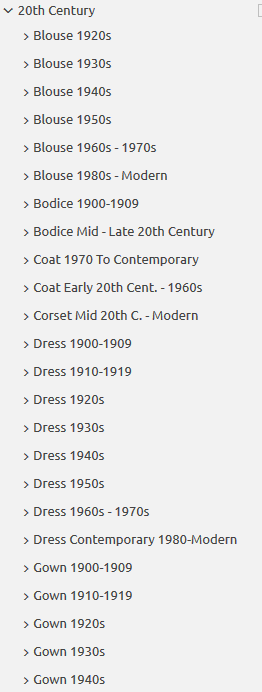
Do you design a lot of characters living in not-modern eras and you’re tired of combing through google for the perfect outfit references? Well I got good news for you kiddo, this website has you covered! Originally @modmad made a post about it, but her link stopped working and I managed to fix it, so here’s a new post. Basically, this is a costume rental website for plays and stage shows and what not, they have outfits for several different decades from medieval to the 1980s. LOOK AT THIS SELECTION:
OPEN ANY CATEGORY AND OH LORDY–
There’s a lot of really specific stuff in here, I design a lot of 1930s characters for my ask blog and with more chapters on the way for the game it belongs to I’m gonna be designing more, and this website is going to be an invaluable reference. I hope this can be useful to my other fellow artists as well! 🙂
So if you’re a dm like me, you probably want to be relatively skilled in some typical fantasy accents for your game to make things feel that much more real. So i’ve decided to throw together a little master post of “how to” videos on some various accents. This is mostly for my own reference, but if you’d like to save this for yourself too, go right ahead. Feel free to add on to this, as well!
something people writing post-apocalyptic fiction always seem to forget is how extremely easy basic 20th century technology is to achieve if you have a high school education (or the equivalent books from an abandoned library), a few tools (of the type that take 20 years to rust away even if left out in the elements), and the kind of metal scrap you can strip out of a trashed building.
if you want an 18th century tech level, you really need to somehow explain the total failure of humanity as a whole to rebuild their basic tech infrastructure in the decade after your apocalypse event.
i am not a scientist or an engineer, i’m just a house husband with about the level of tech know-how it takes to troubleshoot a lawn mower engine, but i could set up a series of wind turbines and storage batteries for a survivor compound with a few weeks of trial and error out of the stuff my neighbors could loot from the wreckage of the menards out on highway 3. hell, chances are the menards has a couple roof turbines in stock right now. or you could retrofit some from ceiling fans; electric motors and electric generators are the same thing, basically.
radio is garage-tinkering level tech too. so are electric/mechanical medical devices like ventilators and blood pressure cuffs. internal combustion’s trickiest engineering challenge is maintaining your seals without a good source of replacement parts, so after a few years you’re going to be experimenting with o-rings cut out of hot water bottles, but fuel is nbd. you can use alcohol. you can make bio diesel in your back yard. you can use left-over cooking oil, ffs.
what i’m saying is, we really have to stop doing the thing where after the meteor/zombies/alien invasion/whatever everyone is suddenly doing ‘little house on the prairie’ cosplay. unless every bit of metal or every bit of knowlege is somehow erased, folks are going to get set back to 1950 at the most. and you need to account somehow for stopping them from rebuilding the modern world, because that’s going to be a lot of people’s main life goal from the moment the apocalypse lets them have a minute to breathe.
nobody who remembers flush toilets will ever be content with living the medieval life, is what i’m saying. let’s stop writing the No Tech World scenario.
Also, like, you can loot a Bunnings – or even a camping goods store – and get your hands on a couple of portable solar panels.
Not that I’ve given this a lot of thought, but come the apocalypse, I know exactly which sections of the local hardware superstore to hit for necessary supplies, from generators to solar lights to fruit and veg seedlings.
download these two then setup paint studio right click one of the icons after its done and click “file location” copy the crack files into the main paint studio file then click on the crack.exe till it says ok open paint studio
Writing is a rough gig. Get paid where you can. Here’s a bunch of places that will pay professional rates for genre (fantasy/science fiction/horror) short stories. All these markets take (and actually publish) unsolicited submissions – you don’t need an agent, and you don’t need to have previously published works.
Remember to format your shit, write a simple cover letter, don’t send the same story to more than one place at a time, make sure submissions windows are actually open, and never respond to rejection letters ever. Have fun!
(Information gathered from both Submissions Grinder – an essential resource for people actively submitting their work – and my own excessive and somewhat ridiculous reading habits.)
Current as of May 2018. Markets are listed alphabetically. Detailed info below the cut.
uhHHHH I don’t mean to be dramatic or anything but I literally wrote 50k words in two weeks without fuckening trying,like won NaNoWriMo in 2 weeks,TWO WEEKS, after joining4thewords.comand I’m like
w h a t
OK so it’s pretty much like Neopets + Gaia Online + RPG, But You Level Up Through Writing
You “battle” cute online critters with your word count
You can dress up your avatar and whatnot and there are different regions and crafting quests
and my weird brain apparently responds VERY WELL to nerd gamification
because Holy Shit I wrote 50,600 words in 2 fuckening weeks
and am now 4thewords’ new hype squad
(also if you join, use the referral code PEUOC65061 so if you get a full membership, which I totally am, we will both be rewarded)
basically, wow I have never been this productive in my LIFE and I can’t wait for their July mini nanowrimo event (they’re doing a pride month one right now so you can get a rainbow shirt and fight rainbow beasties it’s freakin adorable)
and if this sounds like something you would enjoy, go for it, try to catch me, just do it, come at me friends let’s write some good shit together
After spending a week with the 6.25“x10” Monoprice, my Yiynova and Cintiq remain unplugged and I gave my Intuos away to a friend. The Monoprice tracks subtle pressure variances and small movements with less lag and more crisp fidelity than any of the others. It is, put crudely, fucking awesome, in both OSX Lion and Windows 7 x64.
I have one of these, 10×6.5 I bought about two months ago for 48 bucks. It’s a billion times better than my old Wacom Bamboo and works like a fuckin dream.
ATTENTION ALL PENNY-PINCHING ART FRIENDS!!!
ooo reblogging this for potential future purchase
oh
I’m definitely thinking of getting one of these, or asking for one for Christmas. ‘Cause as much as I appreciate Ian giving me his old tablet, I think the pen might be on it’s last legs. ;~;
Oh my god these start at $25 for a little one.
I would be so okay with a little one.
Reblogging this again because I fucking lost it and don’t want to forget it again.
I know a few young or beginning artists who have been asking me about tablets and were sad that the prices were so high. I told them that was only for wacom tablets, and you can find tablets that are just as good (or even better) for much more reasonable prices. I’m reblogging this for those interested in getting an economically priced tablet. These days, when you buy wacom it’s mostly for the name.







 i'll apple your turnover