obvs there is something great about when a Big Scary turns into a Big Softie where Tiny Useless is concerned, but what i like better is:
Tiny Useless decides, with no prompting and for no apparent reason whatsoever, that Big Scary needs protecting. and if no one else will do it then this accidentally-gets-stepped-on, blows-away-in-a-stiff-breeze motherfucker is going to have to be the one to protect this living mountain of pain. you wanna get to this troll, you’re gonna have to go through this pixie. you try to come for this tibetan mastiff, this chihuahua’s gonna try to kick your ass first.
and the Big Scary is mostly just?? really confused???? there are at least twenty different reasons why this is fucking dumb. but also this feeble lil shit is the first person in the entire world to try and stand up for this person that absolutely does not need it. Big Scary continues to be huge and terrifying but now Tiny Useless has their undying loyalty and it will probably not end well for anyone.
i like seeing all of the ships this has been tagged with, but, i am going to be completely honest with you guys, when i wrote this i was thinking about little girls like my sister, who at the age of five had a strict ‘talk shit get hit’ policy about the incredible hulk
seeing a lot of folks with some weak-ass “but actually the tiny one is deadly and the big one is nice” tags and lemme tell ya
that is a different trope
do you think i picked the words Tiny Useless by accident. do you think there is no reason i called the Big Scary a mountain of pain?
not to get petty but this isn’t an idea about appearances being deceiving, or the amusement of reversing expectations, or the aesthetic.
this is about someone who can absolutely take whatever punishment the world throws at them, and probably throw plenty back, being told that their capacity for horror doesn’t mean they should have to endure it. someone who can’t defend themselves choosing to try to defend someone who can because to them there is no moral difference.
hogarth didn’t save the iron giant by punching a tank, my dudes. the iron giant didn’t have to be helpless to be worth protecting. you know what i mean?
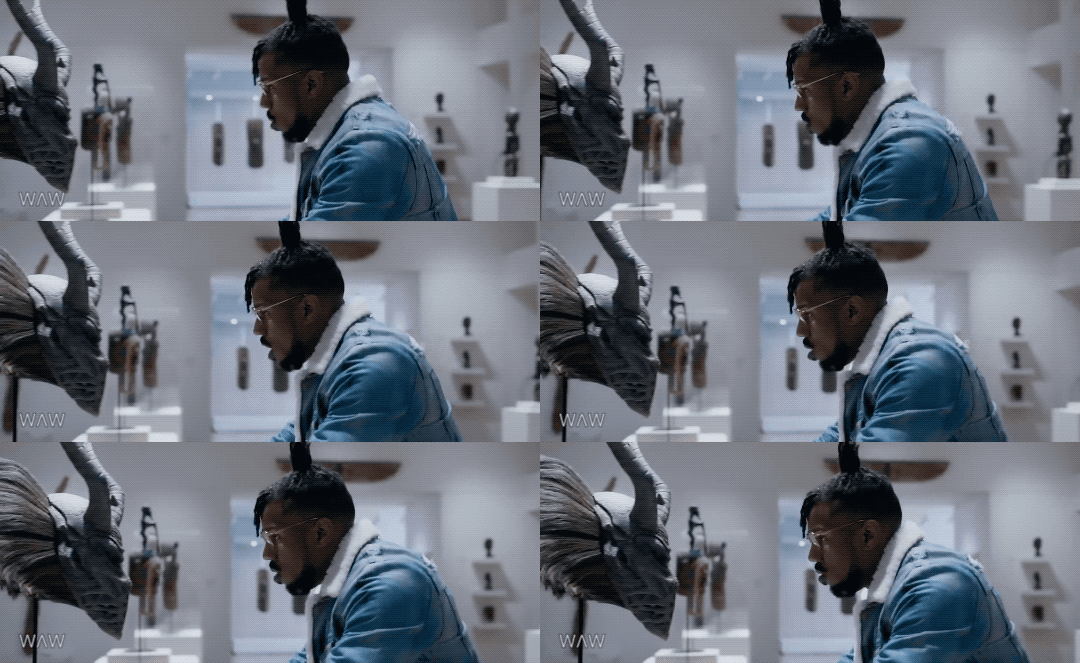
Killmonger: How do you think your ancestors got these? You think they paid a full price for it? Or did they take them like they took everything else?
I work in a museum- an old one- and during this scene I was nudging my brother the whole time. I clapped a little at that line. Museums need to rethink the way we curate things. If we aren’t elevating the heritage of those objects’ creators, if we aren’t telling their story, if we aren’t making those narratives accessible to the descendants and letting them lead, then what is even the point? Decolonize collections. Practice co-curation. Hire scholars of color, and make the collections accessible to visiting scholars. Involve the descendant community and elevate their voices, not the white colonial narrative.
And for goodness’ sakes, don’t run your museum like a jewellery shop. Have context. Honor the objects for their beauty, but remember that no object is as important as the people who created it.
Ummmm,, and like straight up, give things back? Indigenous communities in North America have campaigned for decades to have body parts, ceremonial items and sacred parts of our history returned to their communities.
Ofcourse, Hurd scholars of colour and think critically about your role. But like sometimes, you just have to give things back.
That’s repatriation (what I meant by “decolonize collections”) and it’s actually been federal law in America for almost thirty years. It’s been happening and will continue to happen, but it’s a LOT more complicated than just “give the stuff back.” Obviously you’re totally right- giving the stuff back is absolutely necessary.
But at the same time, giving ALL the old stuff back to Native groups doesn’t really work, either- for us OR for them. What happens to the stuff when it goes back? Do the modern Alaskan Athabascans really want the 1000+ baskets the museum I work at holds? (No, they don’t. We asked them. They definitely do not want those baskets back.) What about Native groups who don’t want remains back- the Navajo, for instance, believe that the remains of the dead are taboo objects, unclean and best left buried. And there are some Native groups who actually WANT their objects in museums. Not every object has a ritual context- sometimes a pot is just a pot. Even some ritual objects aren’t as spiritually important, and we’ve actually had people from different tribes come in and help rewrite language surrounding an object, or give instructions as to how it should be stored. Some groups really want us to display their cultural artifacts, because it reminds people that Native American cultures are alive and real.
One thing that works really well in a lot of cases is co-curation, which is when we commission and work with Native artists, leaders, and scholars to reframe the way we display objects. Like, recently, we asked Chris Pappan, who’s a Kanza artist, to come in and draw on the displays from the ‘30s. The juxtaposition of his art with the colonialist view of Native Americans has had a huge impact in visitor impressions- people go to that gallery now to learn and see what’s ACTUALLY happening today with Native Americans. This I think is how these institutions can use their power for good- elevating creator voices and letting them present their own past and own history. The Field does that a lot- we’ve had exhibitions from Rhonda Holy Bear, Bunky Echo-Hawk, and are continuing to work with Native Americans from many tribes to redesign and reframe the objects on display. We’re not doing this for social justice points- we’re doing this because the Field Museum gets something like 1.5+million visitors a year, and we owe it to the Native tribes we stole from to a.) tell their story b.) how they want it.
If you take all evidence of Native Americans out of the big natural history museums, you’re taking away representation- and education- and a lot of tribes actually don’t want that. What many groups want is the old colonial narratives to go away and be replaced with their own messaging and history. Native Americans are mythologized and what we did to them is sanitized in the US education system. I know that the person who responded is in Canada- and from what I hear, they’re even worse about destroying Native history and sanitizing what the colonists did (and continue to do) to them and their cultures. And this is where I think museums can actually HELP. People only care about things they’re familiar with. If the only image you have of a Native American is a racist football mascot, you’re not going to care about them as a culture- you’re not even going to see them as people. There’s a lot of white people who don’t believe in Native Americans. Like, they legit don’t think that there’s ANY Native groups left, and I know this because I’ve talked to these people at work. It’s baffling, how little Americans know about their own country’s behavior. And it’s totally a global problem- I could go on for days about what the British Museum Needs To Do With Those Fucking Marbles, Give Them Back You Cowards, You Have Enough Money To Ensure Their Care In Greece You’re Just Being Assholes- but I wanted to respond with a Native American context because of the person I’m replying to AND because… well, most Americans don’t know this, and they need to, because knowing about repatriation and why we do it is important.
Repatriation is so very vital, but it’s even more vital to listen to the Native American groups and ask them what they want to happen- as well as treat each tribe individually. We don’t hold onto Tlingit remains because the Navajo don’t want their remains back. Treating all tribes as identical is wrong- not as wrong as withholding their precious cultural traditions, relics, and remains- but if we’re even going to (as a museum industry) attempt to apologize for the atrocities we’ve sanctioned, the first thing we gotta do is ask people what they want.
And the next thing we gotta do is listen.
I’m starting to work in a Museum, and though my museum is about Natural Science something stuck le about all of this. The museum does not only exhibit but also safekeeps collections and in the introductory course we were given three keys to the basis of a museum: preservating, researching and exhibiting.
And one is worthless without the other. Our collections are meaningless if they aren’t available for investigation. It’s totally encouraged for scientists to come and use our collections. Granted, our collection mostly consists of dead animals, plants and fossils. And part of my own museum’s goal is orientated to reclaiming by mostly having our own collections as otherwise some of our best fossils are exhibited in museums in USA.
In our museum, all a scientists has to do is basically send an email to access the collection.
So what strikes me is that you point that one of the things to get better is “make the collections available to visiting scholars”. Is that not the case? Or is it specifically not available to scholars of color?
It REALLY varies from museum to museum! Some museums it’s really easy to get in- but others, it’s SO. MUCH. RED. TAPE. I had mine in mind when I was writing that, because collections access takes absolutely forever.
Anytime something is so precious that a culture wants it back but the museum wants it too, i bet you anything some artist would love the commission to duplicate it.
And sometimes that works out amazing.
The Field used to have this totem pole. There are many such poles in the museum, and others in museums around the world- but not all poles have the same significance- it depends on context. This pole, in particular, was a 26 foot tall pole that had been stolen from an “abandoned” Tlingit village- of course, the village wasn’t abandoned, and the people who lived there never consented to giving up their totem poles, and they rather wanted them back.
Anyways, the Field had one that was taken from the Cape Fox Tlingit back in 1899, and in 2001, we sent it home.
In 2002, the Cape Fox Tlingit gave the museum a log. A big one, a huge cedar log. They didn’t need to, but they did, and what the museum did with it was this:
A father-son team of Tlingit artisans- Nathan and Steven Jackson- were commissioned to design and create a new totem pole for the museum. They worked with the museum to create a totem pole that celebrated Tlingit traditions and the modern Tlingit people- a totem pole that combined ancient designs with modern ideas. It’s a gorgeous piece with an incredibly pertinent meaning- according to the Jacksons, the hybrid design illustrates the “refraction” or bending of traditional Tlingit culture that occurred during a turbulent history of cultural loss and recovery.
Which do you think tells you more about what it means to be Tlingit today?
listen i also hate those dumbass political cartoons about kids and their phones but at the same time you’re a fool if you flat out deny there are negative aspects to the way we communicate in the social media age
facebook and instagram strategically time your notifications after you post something to make you waste time scrolling. those two platforms also come to mind as being particularly performative (“look at this beautiful picture-ready thing i’m doing today”) although any social media encourages that. snapchat’s streak feature, as well as those stupid emojis next to people’s names, exist solely to suck you into using the app every day. twitter and instagram display your follower count, and facebook displays how many friends you have. tumblr cultivates a culture of oversharing, and although you can have one-on-one conversations on here, most “communication” takes the form of shouting from a soapbox. all of these things are related to the problem of privacy online, which many of us simply assume doesn’t exist and should therefore be tossed aside so that we can dissect and manufacture every detail of our selves and desires online. you can’t honestly tell me these things are of no concern for the way we understand ourselves and others, and our relationships to the world.
I love this post. Also note that social media (the Internet truly), in a way that TV hasn’t been able to achieve, allows advertisers to be more intimate and targeted than they’ve ever been before. Through platforms like Instagram and Facebook, we basically declare to them the things we desire, interact with most often, the places we go, etc…
All that information is scraped from us and used for all sorts of stuff. To get us to buy things, to get us to watch things, to sway our opinions on so many things.






 i'll apple your turnover