“Men’s indifference to learning about contraception and to taking any responsibility for it is a theme that emerges from many reports of projects that have attempted, and failed, to reach and educate men. One of the most successful programs of contraception education for men, a Planned Parenthood project in Chicago, abandoned its attempts to reach men over the age of twenty-five when it was found that these men simply would not participate… Instead, the project targeted a younger group, and as part of its research the project conducted a survey of over a thousand men aged fifteen to nineteen:These young men were asked whether they agreed with the statement “It’s okay to tell a girl you love her so that you can have sex with her.” Seven out of ten agreed that it’s okay.They were asked whether they agreed with the statement “A guy should use birth control whenever possible.” Eight out of ten disagreed and said a guy should not.And when asked, “If I got a girl pregnant, I would want her to have an abortion,” nearly nine out of ten said no, they would not want her to have an abortion.These teenage men agreed: Deception to obtain coital access is okay; male irresponsibility in contraception is okay; but abortion is not okay—“because it’s wrong.””
— John Stoltenberg, “The Fetus as Penis: Men’s Self-Interest and Abortion Rights” from Refusing to be a Man: Essays on Sex and Justice (via reading-blog)
The thing about how women in comics used to be drawn and sometimes are still drawn, you can only really understand the difference between an action girl being forced into unrealistic sexual, sensual positions, and an actual strong and well posed, empowering but still sexy female character, when you see what it looks like to have male characters depicted in overtly sensual poses
And I’m not talking about the Hawkeye Initiative or any given parody
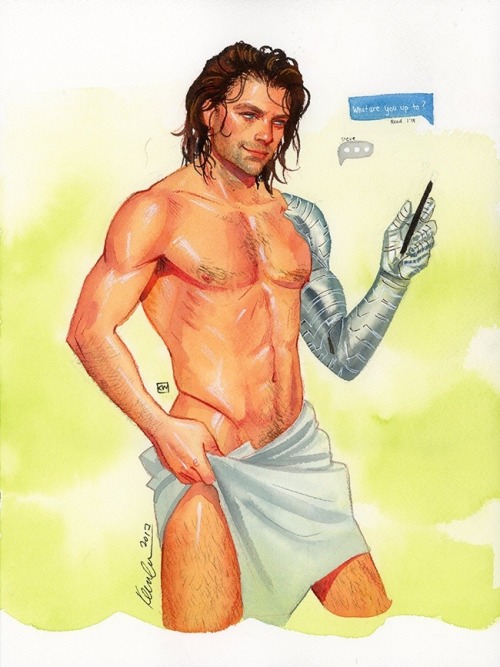
I actually want to draw a comparison using art by Kevin Wada
Kevin Wada is a proud part of the LGBTQ+ community and he has this unique ability to sexualize mainstream male heroes without it looking like a parody. He draws covers for multiple big comic companies and his style reminiscent of old fashion magazines, drawn largely in traditional watercolor, has made him a stalwart of the industry.
He also draws a lot of naked Bucky Barnes.
Anyway, I want to talk about how interesting his art is, the difference between his power poses and his sexy poses for male and female characters.
A typical power pose for a male comics character would look like this
Whereas every so often with female heroes you get something like this
Not all the time, of course, but it happens and it happens in the wrong places. You wouldn’t be posing like a cover model in the middle of a battle, you really wouldn’t.
But when it comes to Wada and male and female characters, the difference is pretty clear.
When he draws male characters, they more often look like this
Sensual, in a pose you wouldn’t usually see a big, muscular hero doing. If not that, then playful, sexy, for looking at, but nothing about their anatomy overly exaggerated
How he draws women is also very clearly different from many other artists, from sexy pose to power pose.
Still posing for the camera, still to be looked at, but very, very different from how we’ve seen female characters portrayed in mainstream comics in the past.
And I guess it’s really just a matter of variety? Objectification in art is a long time debate and appears everywhere always, but for all that we can argue about its impact on popular media, there are a few things I know for sure:
1) having a female character pose like a playboy cover girl in the middle of a battle scene is just Bad Art and y’all need to find better references
2) female power poses will never look quite as right as when they’re drawn by people who know the value of expressing personality through pose (it’s basic animation principles and some artists still need to learn it) and who actually know what a female character’s personality beyond “sexy”
3) Iron Man or Batman posing like they’re about to beat somebody up is 100% not the same as a fashion drawing by Kevin Wada where a Typical Beefy Action Guy gets to pose like a flirty pretty boy
4) the MCU films have figured out the value of pandering to female audiences by sexually objectifying all their male action heroes while simultaneously appealing to the male demographic’s action movie power fantasy. Quoting Chris Hemsworth and Taika Waititi: “I’m not a piece of meat” “Uh, yes you are.”
They definitely struck some kind of balance there.
Also, more important than this entire post: y’all should follow @kevinwada on Tumblr and give him love because his art is divine and his talent beyond words
We featured @kevinwada‘s Naked Snake last year and mentioned (as a couple times before) that if you really want to see the principles male gaze applied unironically to masculine characters, you gotta find pinup done by a male artist who’s into men. And Wada’s artwork is a great proof of that, without resorting to pandering exaggerations (which belong more to parody art).
~Ozzie
Some neckbeard was whining about “men are now women and women are now men” just because he saw a promo pic for ANT-MAN and WASP – the woman’s looking directly at the viewer and the man’s glancing over his shoulder. All the artist did was swap the traditional poses for male and female and All Gender Roles are Void It’s The Apocalypse OMG This is the Future Liberals Want.
Tumblr: why do misogynists like to invalidate strong female characters???????????
If we’re going to be fair here, the reason so many people get upset when a female character is called a Mary Sue is because that label is thrown around so haphazardly and so very often handed to characters who really don’t deserve to be labeled as such. The controversy of the term comes from its overuse and misuse.
The term can be used correctly, but it is too often misused by people who see a capable strong female character and have a gut instinct to burn the witch and return to their male hero power fantasy.
“So, there’s this girl. She’s tragically orphaned and richer than anyone on the planet. Every guy she meets falls in love with her, but in between torrid romances she rejects them all because she dedicated to what is Pure and Good. She has genius level intellect, Olympic-athelete level athletic ability and incredible good looks. She is consumed by terrible angst, but this only makes guys want her more. She has no superhuman abilities, yet she is more competent than her superhuman friends and defeats superhumans with ease. She has unshakably loyal friends and allies, despite the fact she treats them pretty badly. They fear and respect her, and defer to her orders. Everyone is obsessed with her, even her enemies are attracted to her. She can plan ahead for anything and she’s generally right with any conclusion she makes. People who defy her are inevitably wrong.
The problem isn’t that characters are unrealistic. Heroes often are unrealistic and it’s ok to criticize media.
However, female characters are criticized where male characters aren’t.
Everything in OP’s post could apply to Luke Skywalker (and definitely applies to Anakin) but those characters won’t be criticized the way Rey has been (even though everything Rey does in The Force Awakens is believable). We are more willingly to believe in a male chosen one who can just do amazing things because he’s the hero.
Boys can have wishfulment stories but girls can only have realistic stories.
Seeing any of these traits as a phenomenon about female characters, rather than poorly written characters in general, is in and of itself misogyny.
The very concept of Mary Sues, created when female characters were created to go toe-to-toe with white male characters whose extraordinary-ness was taken for granted, was a misogynistic creation.
Fandom extrapolates complex backgrounds for white male characters, and then refuses to do the work for female characters, but blames those characters for not having been developed by us the way white male characters were.
(A character created originally in a text by definition cannot BE a Mary Sue, which is supposed to be a self-insert, but it’s been
extrapolated to mean ‘any extraordinary woman,’ which is. An additional
problem. But I digress.)
“My female boss is mean to me at work” is not the same thing as centuries of institutionalized, systemic discrimination. If “beautiful women can get whatever they want,” then why haven’t we elected one president yet? “Sexism against both genders is wrong” betrays a fundamental misunderstanding of what sexism is. Any individual of any gender can be prejudiced or discriminate on a face-to-face level, but only one gender faces the glass ceiling, the ongoing, legalized regulation of their bodies, the significant wage gap for doing the same type of work, the deeply-engrained and consistently reinforced stereotypes about their being less aggressive, less capable and less intelligent, and countless other obstacles.
that dumb “Rules of the World Cup for Women” list made me livid and @sashayed had some good thoughts about it. I screencapped her tweetstorm so I can refer back to it when I feel anxious about my own way of caring about sports.
“If you criticize X in women but do not criticize X in men, then you do not have a problem with X, you have a problem with women. For X please insert words like ‘anger,’ ‘ambition,’ ‘loudness,’ ‘stubbornness,’ ‘coldness,’ ‘ruthlessness.’”
—Chimamanda Ngozie Adichie, Dear Ijeawele, or a Feminist Manifesto in Fifteen Suggestions
“genitalia associated with cis women are harshly stigmatized and policed as part of misogyny, which can lead to violence” and “not all women have vaginas and not everyone with a vagina is a woman” and “trans peoples’ bodies are harshly stigmatized and policed as part of transphobia, which can lead to violence” are not mutually exclusive factsx and in fact all of these things are very much interlinked, and should not be used as gotchas! against each other
Also, vaginas that belong to people who aren’t women (whether male, nonbinary, agender, etc.) are sites of gendered violence as well
I often hear people say that men are shamed for showing emotion (this is correct and I’m not denying it), whilst it’s considered acceptable or even positive for women to show emotion. This idea that women are expected to show emotion, or are praised for doing so, or gain any social capital that men don’t from expressing emotion is completely untrue.
Women’s emotions are utterly mocked, demeaned, disregarded and ultimately used to silence and dismiss us. People claim that women’s emotions make us irrational, inferior, and less capable of responsibility. Women are denied positions of power, due to the belief that their ‘emotions’ will get in the way. Women were subjected to medical abuse with diagnoses like ‘hysteria’ for displaying emotion. Our emotion is mocked, pathologized, and ultimately used to demean and oppress us.
‘Being allowed to show emotion’ is not a ‘privilege’ that women have over men.
This reminded me of a study I read about in Cordelia Fine’s book Delusions of Gender:
“Kristi Klein and Sara Hodges used an empathic accuracy test in which participants watched a video of a woman talking about her failure to get a high enough score on an exam to get into the graduate school she wanted to attend. When the feminine nature of the empathic accuracy test was highlighted by asking participants for sympathy ratings before the empathic accuracy test, women scored significantly better than men. But a second group of women and men went through exactly the same procedure but with one vital difference: they were offered money for doing well. Specifically, they earned $2 for every correct answer. This financial incentive levelled the performance of women and men, showing that when it literally ‘pays to understand’ male insensitivity is curiously easily overcome.“ (Emphasis mine.)
(An endnote also states that “Men also scored equivalently to women when the sympathy rating was requested after the empathic accuracy test.”)
The passage goes on to add
“You can also improve men’s performance by inviting them to see a greater social value in empathising ability. Cardiff University psychologists presented undergraduate men with a passage titled ‘What Women Want’. The text, complete with bogus references, then went on to explain that contrary to popular opinion ‘non-traditional men who are more in touch with their feminine side’ are regarded as more sexually desirable and interesting by women, not to mention more likely to leave bars and clubs in the company of one. Men who read this passage performed better on the empathic accuracy task than did control men (to whom the test was presented in a nothing-to-do-with-gender fashion) or men who had been told that the experiment was investigating their alleged intuitive inferiority.“
In other words: men aren’t necessarily worse at sensing and understanding others’ feelings than women are; it’s just that quite a few of them don’t feel the need to put for the effort unless it profits them in some way… and perhaps don’t want to show too much empathy, because doing so would make them feel less masculine/manly.



 i'll apple your turnover