You know how some people like to say that
physical media is dead and streaming is the future? Well, Apple is
doing a pretty good job right now of proving that theory well and truly
wrong.
Reports have started to emerge of Apple completely deleting films
from iTunes accounts even when they’ve been bought, not merely rented.
And when people complain about this, they’re receiving an astonishing
message from Apple telling them that iTunes is just a “store front,” and
so Apple isn’t to blame if a film studio decides it no longer wants to
make its titles available on iTunes.
Even worse, it seems that if bought film titles are removed from your
account you may not even be entitled to get a refund for them. When an
iTunes user in Canada complained to Apple that their initial offer of a
free $5.99 rental hardly seemed suitable recompense for him having three
bought films summarily removed from his account, Apple replied that
“our ability to offer refunds diminishes over time. Hence your purchases
doesn’t meet the conditions for a refund.”
The Canadian user was offered a further two free rentals as
compensation. But, of course, as well as being far less in monetary
terms than the films user had bought, having short-term rental rights to
a film is very different indeed from owning a film.
While I’m hearing from others who fortunately did get a refund for
their deleted films, the bottom line in all this is that Apple appears
to be openly saying that if you buy a film on iTunes, you don’t really
own it at all. It may only stick around in your iTunes account for as
long as the studio who really owns it decides it wants it to stick
around in your iTunes account.
The Canadian user suffering this issue was pointed to this page of Apple legalese in the response where he was told that he wasn’t entitled to compensation for his lost purchases.
I’m also starting to receive reports today of the recent return of
another major issue with iTunes movies: the downgrading of 4K HDR films
to HD. This started happening in 2017, just after the Apple TV 4K
launched, as reported here.
At that point Apple suggested that there was some sort of labeling
issue (where films said they were HD on their header page, but played as
4K) that they managed to (largely) fix. And it seems that the return of
this issue may still be responsible for some of the “lost” 4K movies
Apple TV 4K users are seeing now.
This doesn’t seem to explain all of the 4K to HD switches, though. It seems that some are down to Apple’s
original policy of offering free HD to 4K upgrades of films no longer
applying to titles bought in HD outside of iTunes. Say, via the
iTunes-compatible Movies Anywhere platform. Though I am recently hearing
from people saying that films bought on other iTunes-compatible
platforms in 4K are also now only appearing in HD on iTunes.
In fact, I have even been contacted just today by an iTunes user who
tells me that dozens of films he owns in iTunes — many of which were
actually bought in iTunes — have stepped back on his Apple TV 4K to HD,
having previously being available in 4K. This includes titles that are
still available in 4K on VUDU.
It’s worth noting that the specific incident of films being
completely deleted I refer to in this article happened in Canada; it’s
possible that iTunes users in the U.S. and elsewhere haven’t experienced
the same issue (yet…) due to differences in film rights between
different territories.
But actually these sorts of regional rights differences merely
underline the fundamental point Apple seems to be doing its best to
confirm right now: That the only way you can be sure you own anything is
if you’re physically holding it in your hand.
I’ve asked Apple for comment on these iTunes issues, and will provide
an update if they come back with anything worth sharing. In the
meantime, though, if you’ve experienced either films you bought
disappearing entirely from iTunes, or films that once appeared in 4K now
only appearing in HD, please let me know (with details, if possible, of
whether you bought the title from within iTunes or via another
compatible platform) via the Twitter account shown at the bottom of this
article.
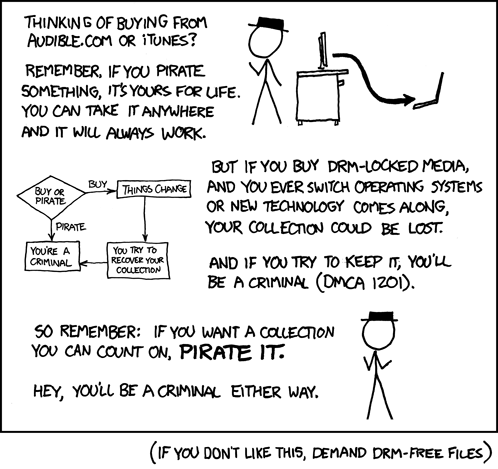
You don’t own anything that has DRM – not movies, not ebooks, nothing.
objective quality of a media (show/game/anime/etc) has almost zero meaning compared to: what you go in expecting, what you need emotionally in that period of your life, and how you see it through the lens of resonant thematic elements specific to you as an individual.
“Gay Migration fandom moves along lines of identity; that is, it comes to a show because someone said, “There’s lesbians here.” It regularly jumps across genre lines to do so, and very often, if it shows up in the middle of a show’s run, it does not bother to familiarize itself with previous seasons, core messages, pre-existing dynamics—in short, what makes that show tick. The pairing is all. As is the desired outcome: Some variant of “gets married and rides off into the sunset.” Which, we could all probably stand to see more of. However, given that ends-based approach, it makes sense that some frustrations around how queer stories are handled in that segment of fandom can be traced back to a fundamental misunderstanding—or total lack of understanding—about how different genres work. Their expectations are calibrated not by their sense of how a particular type of show might behave, or the kinds of topics they can expect it to address, or even if romantic relationships will be very important at all. Instead, their expectations are calibrated by their own regularly evolving idea of what gay stories are or should be, down to specific character beats and archetypes—which are often a function of a show’s genre, and not the disrespect of the writing staff. This in turn is shaped by experiences in previous fandoms, and heavily influenced by internal fanwank, negative interactions with production and writing staff on other shows, and other concurrent online arguments about gay culture and identity. In short, their expectations of the show are influenced by everything but the individual show itself.”
—
Genre and the Gay Migration | The Fandomentals (via marieduplessis)
Really? This sounds like BS. Everyone I know who jumps to a new show because it has a gay character starts binging the show,from the first episode. This sounds like someone trying to shift the blame to queer people, us not being happy with the shitty repsentation we get.
‘shut up and be happy we included you for a little bit, yes the character died,but it isn’t my fault, it just made sense to the story!!!You’re just still mad they killed your fave on that other show!’
Yes,I’m still mad!I’m mad about all of the characters that are importent to minorities that get killed off/disappears, who seldom is shown the respect they deserve, because rep IS different for us. People who see themselves everywhere in everything just.don’t.get.it.
We should be allowed to ask for better.
Agreed. Speaking from my own experience, I’ve binged shows because they had gay/lesbian/bisexual characters. Given how many people in fandom are not straight, this seems like passing the buck – “Oh, it’s not our writing that’s shitty. You just don’t know the genre! Why should we have to do better? You didn’t even watch the show!” So, yeah – sounds like crap to me, and making excuses for lazy writing.
okay so like
i get that y’all are angry but also: did you actually read the article? because even if you had a valid point against just this excerpt (which i don’t think you do), context still matters, and you seem to have missed all of the context of the article.
But we don’t need just one story. We need all of our stories. We are not monolithic in our experiences of our identity, and we are not monolithic in the stories we need.
And ultimately, the best way to negotiate that is to understand and maintain a language that allows us to express and define what we’re looking for, what we get out of our stories. Genre is one of those languages.
“we’re allowed to ask for better” yeah okay sure but also: that’s the whole point of the article? that queer peoples’ representation should be expanding beyond just its own subgenre into broader genres, where it’s no longer the sole focus of the media. that queer stories are human stories and should be told as human stories.
the whole point of the article is that queer stories should exist outside of just the three shelves of the queer section at the local bookstore and that they should be part of broader literary genres. and you know what? putting queer people in horror stories, and sci-fi stories, and cheesy romance stories, and fantasy stories, and pretentious “literary” stories where the protagonist escapes to the seaside and spends 350 pages mentally fellating themselves because the world doesn’t understand them, is important and also requires a functional integration of them into the genre and its associated requirements. that was the point of the article.
it’s not that bad or lazy writing shouldn’t be called out when it happens, because it should. it’s that as much as there are harmful tropes regarding queer characters that writers should avoid, there are unavoidable facets of genre that readers should be aware of when they consume pieces of that genre. as harmful as negative tropes about queer people are, so too is the polar opposite: avoiding possible negative associations or unhappy stories for queer characters within a genre where negative or unhappy things happen to everyone, simply because they are queer.
the advancement of queer people in media won’t come by elevating them to an untouchable status, but by advancing them to a place of equality with their straight counterparts. because queer stories are human stories, and human stories don’t always have happy endings. but people within the gay migration mentioned in the excerpt in the op aren’t looking for human stories, they’re looking for exclusively positive stories. to wit: the massive influx of queer fans into the supergirl fandom in season two when alex’s queer storyline came about who blew several self-righteous gaskets when alex and maggie split up over an extremely human and realistic reason. nobody died, nobody cheated, nobody did anything wrong; the just wanted different things, and that broke them up. a wholly respectable and respectful reason to end a queer relationship, handle one of the actors leaving the show, and still leave the door open both for the remaining actor to have other romantic storylines and for the leaving actor to return later on. and yet people were still bellowing about how it was homophobic and terrible and disrespectful, because the queer character was sad.
the point of this article was that equality of representation of queer people in media requires acknowledging (1) the potential downsides of telling queer stories as human stories, and (2) that as queer representation is making its most significant strides within genre fiction, acknowledgement of the tropes and standards of that genre are required in the functional understanding and appreciation of those genres.
you know a joke that never EVER gets old is when a character says smth like “I will NOT go to [place] and that is FINAL” and then it cuts to them in that place I eat that shit up every single time
Equally good variant: when the character says smth like “what’s the worse that could happen?” and it cuts to a scene where it’s so much worse than what they imagined


 i'll apple your turnover