You know how some people like to say that
physical media is dead and streaming is the future? Well, Apple is
doing a pretty good job right now of proving that theory well and truly
wrong.
Reports have started to emerge of Apple completely deleting films
from iTunes accounts even when they’ve been bought, not merely rented.
And when people complain about this, they’re receiving an astonishing
message from Apple telling them that iTunes is just a “store front,” and
so Apple isn’t to blame if a film studio decides it no longer wants to
make its titles available on iTunes.
Even worse, it seems that if bought film titles are removed from your
account you may not even be entitled to get a refund for them. When an
iTunes user in Canada complained to Apple that their initial offer of a
free $5.99 rental hardly seemed suitable recompense for him having three
bought films summarily removed from his account, Apple replied that
“our ability to offer refunds diminishes over time. Hence your purchases
doesn’t meet the conditions for a refund.”
The Canadian user was offered a further two free rentals as
compensation. But, of course, as well as being far less in monetary
terms than the films user had bought, having short-term rental rights to
a film is very different indeed from owning a film.
While I’m hearing from others who fortunately did get a refund for
their deleted films, the bottom line in all this is that Apple appears
to be openly saying that if you buy a film on iTunes, you don’t really
own it at all. It may only stick around in your iTunes account for as
long as the studio who really owns it decides it wants it to stick
around in your iTunes account.
The Canadian user suffering this issue was pointed to this page of Apple legalese in the response where he was told that he wasn’t entitled to compensation for his lost purchases.
I’m also starting to receive reports today of the recent return of
another major issue with iTunes movies: the downgrading of 4K HDR films
to HD. This started happening in 2017, just after the Apple TV 4K
launched, as reported here.
At that point Apple suggested that there was some sort of labeling
issue (where films said they were HD on their header page, but played as
4K) that they managed to (largely) fix. And it seems that the return of
this issue may still be responsible for some of the “lost” 4K movies
Apple TV 4K users are seeing now.
This doesn’t seem to explain all of the 4K to HD switches, though. It seems that some are down to Apple’s
original policy of offering free HD to 4K upgrades of films no longer
applying to titles bought in HD outside of iTunes. Say, via the
iTunes-compatible Movies Anywhere platform. Though I am recently hearing
from people saying that films bought on other iTunes-compatible
platforms in 4K are also now only appearing in HD on iTunes.
In fact, I have even been contacted just today by an iTunes user who
tells me that dozens of films he owns in iTunes — many of which were
actually bought in iTunes — have stepped back on his Apple TV 4K to HD,
having previously being available in 4K. This includes titles that are
still available in 4K on VUDU.
It’s worth noting that the specific incident of films being
completely deleted I refer to in this article happened in Canada; it’s
possible that iTunes users in the U.S. and elsewhere haven’t experienced
the same issue (yet…) due to differences in film rights between
different territories.
But actually these sorts of regional rights differences merely
underline the fundamental point Apple seems to be doing its best to
confirm right now: That the only way you can be sure you own anything is
if you’re physically holding it in your hand.
I’ve asked Apple for comment on these iTunes issues, and will provide
an update if they come back with anything worth sharing. In the
meantime, though, if you’ve experienced either films you bought
disappearing entirely from iTunes, or films that once appeared in 4K now
only appearing in HD, please let me know (with details, if possible, of
whether you bought the title from within iTunes or via another
compatible platform) via the Twitter account shown at the bottom of this
article.
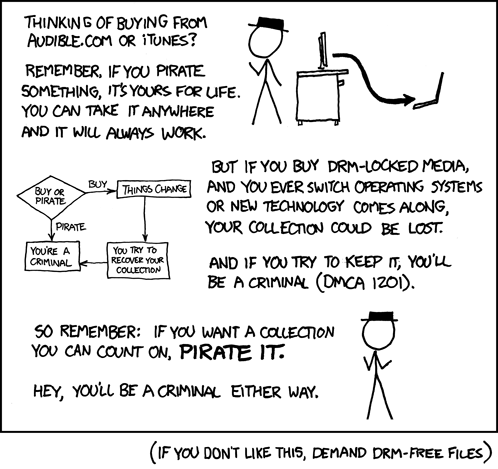
You don’t own anything that has DRM – not movies, not ebooks, nothing.
“Social media isn’t evil. There are neuroscientists in some of these companies, but for the most part I don’t think it was done maliciously. But advertising is the business model. And if advertising is the business model, our attention becomes the product. Two variables matter to the bottom line: the amount of users and the amount of time they spend on platform. And what gets measured gets optimized. So our phones have become slot machines. We scroll and scroll and scroll, and eventually we hit something that gives us a dopamine reward. It’s by design. Because slot machines make more money in the US than theme parks, baseball, and movies combined. Both Vegas and Silicon Valley know that our brains can be manipulated if presented with a certain set of choices. Obviously addictiveness isn’t the only feature of these platforms. They’ve empowered so many voices. I’d just love to live in a world where our most influential technology didn’t measure its success by the time it took from us.”
This is such an interesting take on anti-sjws and sjws in general.
Tl,dr: SJW is an overly broad term and is purposefully so. This allows conservatives to continuously move the dial on what “reasonable” is and to label anyone they deem “overly emotional/invested” as someone not worth listening to. Many “ SJWs” are just marginalized folks trying to speak out and their inability or refusal to fit in to the status quo is what conservatives mock ehen calling people SJWs
Mod C
After retweeting the thread on Twitter, the author contacted me to let me know it was put up as a blog post on their WordPress. It’s also easier to digest, too.
listen i also hate those dumbass political cartoons about kids and their phones but at the same time you’re a fool if you flat out deny there are negative aspects to the way we communicate in the social media age
facebook and instagram strategically time your notifications after you post something to make you waste time scrolling. those two platforms also come to mind as being particularly performative (“look at this beautiful picture-ready thing i’m doing today”) although any social media encourages that. snapchat’s streak feature, as well as those stupid emojis next to people’s names, exist solely to suck you into using the app every day. twitter and instagram display your follower count, and facebook displays how many friends you have. tumblr cultivates a culture of oversharing, and although you can have one-on-one conversations on here, most “communication” takes the form of shouting from a soapbox. all of these things are related to the problem of privacy online, which many of us simply assume doesn’t exist and should therefore be tossed aside so that we can dissect and manufacture every detail of our selves and desires online. you can’t honestly tell me these things are of no concern for the way we understand ourselves and others, and our relationships to the world.
I love this post. Also note that social media (the Internet truly), in a way that TV hasn’t been able to achieve, allows advertisers to be more intimate and targeted than they’ve ever been before. Through platforms like Instagram and Facebook, we basically declare to them the things we desire, interact with most often, the places we go, etc…
All that information is scraped from us and used for all sorts of stuff. To get us to buy things, to get us to watch things, to sway our opinions on so many things.
#remember when nobody put pictures of themselves on the internet?#i remember vividly the switch when younger fans would use real names and selfies and being extremely disturbed by it#it changed something fundamental in how we relate to each other and i’m not sure it’s all the way good (jonnyjacqobis)
I think kids on the internet these days–and by “kids” I mean anyone under 18 honestly–need to be re-taught about internet safety and keeping your personal life away from your internet life, for safety reasons. I’ve been noticing this a lot lately, but I’ve found that the younger generations just never learned about Internet safety and keeping your personal information… well, personal.
Listen. I am a 90s kid in my late 20s. Yes, I do list my age on my description, because I feel comfortable doing so. But lately, there’s been an alarming trend where you, the younger generations, expect us to cater to all of your needs and keep you safe. And more, even.
The internet is a big, scary place. People my age and older, and some a little younger, grew up with the internet. We grew up with the dial-up noise and “get off the internet so I can use the phone!” and being limited in the way we interacted with the internet because it was expensive and strange and modems were not a thing. We also grew up with massive internet safety campaigns and worried parents scared of the unknown. Scared of the predator on the other side of the screen. It was normal for parents to be worried and assume predator until proven otherwise.
As such, everyone in my generation and older grew up with a massive internet safety awareness. Don’t give out your personal information, don’t tell them where you live, your name, your age, where you study or what. Say nothing. Share nothing. Most of us have created for ourselves internet personas, much in the way that I am Saku on the internet but someone else in real life.
Yes, the line has blurred somewhat, and over time people have lost the alarm and concern that the internet caused in them. But most of us still remember what it was like back then. Most of us remember the safety rules, remember the techniques and tactics to tell if someone was or wasn’t telling the truth, remember the golden rule about not sharing personal information on the internet.
Because the internet back then was a big, scary place. And the internet now? It still is a big, scary place. It’s just more…. normal. More a part of our everyday lives that we all just sort of take for granted.
What you kids are missing now is that we, as the older generations on the internet, the generations that grew up with the internet, still remember what it was like back then. And we still abide by our internet safety rules.
You all may think that sharing your age on the internet is not a big deal, but it is. Whatever you post on the internet can be used against you, regardless of how “safe” you feel. And one way or another, we are not responsible for you or your internet experiences. We protected ourselves back then, we policed and monitored our own internet content and use, and so should you.
The internet is not yours, it’s all of ours. And we got here first, way before you were even born, in some cases. I’ve been on the internet since I was 9, and that’s well over a decade and a half ago. If anything, fandom spaces are made up primarily of adults. Who do you think writes the good content that you consume? Who do you think produces the best art and the best fics? Who do you think writes the well-written, hot, sexy smut you shouldn’t be reading at 3 in the morning?
When we got here, we all assumed that everyone was older than us on the internet. For some reason that’s changed, and now people assume that everyone’s younger, or their age. But we’re all still here. We’ve been here for the past 15, 20 years. Even longer.
There is nothing wrong with us. We don’t owe you anything. You make your own safety on the internet, and you are the one responsible for making sure you’re safe. That’s not on us, it’s on you.
If you’re uncomfortable talking to an adult on the internet, then you’re more than welcome to unfollow, or block, or whatever. But it’s not our responsibility that you do so. If you want to know something, ask.
Most importantly, we’re not all predators. Don’t shame or fault us for existing on the Internet. We were here before you, and we enjoy things just as you do. They aren’t yours, you don’t own them any more than we do. And we have a right to be here too, without having to bend over backwards for you just for existing.
I find it so weird that people post so much personal information nowadays.
When I first joined the internet in the late 90s, i was in my mid-teens. The big thing was ‘never tell anyone your name’ so I used my nickname. 20 years later… i still don’t use my real name online, and I’m used to being called Cassie that I get confused when someone uses my real name!
Shitty people lie, you kids know that, right? Like how many times have we heard the “He said he was a senior in high school dating a sophomore, but he was actually 28 years old,” story? Why would you possibly believe if someone has their age on their profile? And if it’s just as likely to be a lie as the truth, why does it matter if it’s there at all? I honestly don’t understand this.
This is actually so important, because I’m 16, and I haven’t seen internet safety campaigns since I was in lower primary (like reception, year 1, year 2) which was a decade ago, and it makes me wonder if they teach kids about internet safety anymore. We would get shown videos in ICT about people pretending to be young, and about cyber bullying, and I never hear about them anymore, but I don’t think my younger sister does either, and there seems to be an assumption that kids just know this because they’re given internet access from such a young age, but they’re still impressionable, and so are teenagers, and we get taught about revenge porn but not internet harassment and it can lead to young people being stalked or worse because they dont have it drilled into them that they shouldn’t trust strangers
While I definitely want to and will try to do everything I can to protect the experiences of kids online, it does worry me that the public internet safety campaigns of yore aren’t common anymore… hell, I wasn’t allowed to access the internet in my own room alone until I was 18 and while I definitely didn’t follow that rule (sorry parents) it made me wary of the waters I was wading into.
Also like one of the commenters mentioned, kids, just because someone listed their age and says all the right things doesn’t mean they’re not a predator. Often predators are really fucking good at looking like unproblematic harmless people.
Curate your own experience. Watch yourself. Don’t put everything online. Don’t trust someone just because they seem to have all their information upfront. If you sense something is off, get out, log off, and don’t be afraid to talk to a trusted adult if you need help. This is BASIC internet awareness.
listen i also hate those dumbass political cartoons about kids and their phones but at the same time you’re a fool if you flat out deny there are negative aspects to the way we communicate in the social media age
facebook and instagram strategically time your notifications after you post something to make you waste time scrolling. those two platforms also come to mind as being particularly performative (“look at this beautiful picture-ready thing i’m doing today”) although any social media encourages that. snapchat’s streak feature, as well as those stupid emojis next to people’s names, exist solely to suck you into using the app every day. twitter and instagram display your follower count, and facebook displays how many friends you have. tumblr cultivates a culture of oversharing, and although you can have one-on-one conversations on here, most “communication” takes the form of shouting from a soapbox. all of these things are related to the problem of privacy online, which many of us simply assume doesn’t exist and should therefore be tossed aside so that we can dissect and manufacture every detail of our selves and desires online. you can’t honestly tell me these things are of no concern for the way we understand ourselves and others, and our relationships to the world.
I love this post. Also note that social media (the Internet truly), in a way that TV hasn’t been able to achieve, allows advertisers to be more intimate and targeted than they’ve ever been before. Through platforms like Instagram and Facebook, we basically declare to them the things we desire, interact with most often, the places we go, etc…
All that information is scraped from us and used for all sorts of stuff. To get us to buy things, to get us to watch things, to sway our opinions on so many things.
Never ever turn off your phone: rethinking security culture in the era of big data analysis.
Back in the 80′s if you were a pissed off anarchist that wanted to burn down a building, you probably checked your home for listening devices and made a plan. If you were the same kind of pissed off anarchist in the late 90′s, you turned off your phone and encrypted your online traffic. In the 2020′s we’re gonna have to change our strategies once again. Intelligence gathering has adapted and so we must adapt too.
To get a head start at this, let’s look at how big data analysis is being used. To do this, we’ll need to talk about 3 things: metadata, patterns and networks. Those sound boring and complicated but I’m not a techy and I won’t bore you with tech language, I’ll keep it as easy as I can.
Metadata: In the context of online activity, ‘content’ means ‘the message you send’ and ‘metadata’ means ‘everything other than the content’. So, for example, if you send your friend a text about lunch, the content might be “Let’s go out for lunch” and the metadata might be “Message send at 01/04/2018 11.32 from phone 0478239055 to phone 079726823 using Signal”.
This information is registered by your phone even if the app encrypts your actual message. Your metadata is very badly protected by technology and very badly protected by the law. No matter which country you are in, most of your metadata if freely available to intelligence agencies regardless of whether you are a suspect in anything.
Patterns: Whether you realize it or not, your metadata has a pattern. If you have a daily job you might have a very consistent pattern, if you do not your pattern might be more flexible but you have a pattern. If someone wanted to know the rhythm of your day, they could very easily do so because your pattern is in the metadata.
For example: Maybe you use the wifi at your favourite bar on most Sunday nights until about midnight, you wake up around 10 AM and check your Signal, you use your public transport card to get to class every Monday afternoon and you spend on average 1 hour on Tumblr twice a day. All this is part of your pattern.
Networks: You have online networks. Your facebook friends, the people in your phone adress book, the dropbox you share with coworkers, everyone who bought online tickets to the same punk band you attended, the people using the same wifi points as you. Take your networks, combine them with other people’s networks, and clusters reveal themselves. Your work community, your family, your activist scene, etc.
If you are in an anarchist community that will probably be abundantly clear from all your minor network connections like going to the same band and knowing the same people as other anarchists. Even if you never liked an anarchist facebook page or pressed ‘going’ on an anarchist facebook event, your network is hard to hide.
Now, let’s say you commit a crime,
the kind that would result in some serious research. Let’s say that on Sunday night 3 AM, you are your friends go out and burn down a nazi’s house. (Of course I would never advice any of you to do such a thing.) It’s obvious that anarchists did it but there are no other clues. You use traditional style security culture: you burn your notes, you are careful not to communicate about your plans near technology and you do not leave physical traces.
But because you commited the crime that night, your metadata will vary strongly from your usual rhythm: you stay at your usual bar until 2 AM to wait for your friends, you do not wake up at 10 AM in the morning so you do not check your Signal or Tumblr until 1 PM. You do not go to class. Your metadata pattern is very different from your usual pattern. The metadata patterns of your friends are different too. If one of you is clumsy, they might generate a super suspicious metadata signal like a phone being switched off at 2.30 AM and activated at 4AM. You wouldn’t be the first.
If I wanted to solve this crime using data analysis, what I would do is:
let a piece of software run a pattern analysis of the local anarchist scene to generate the 300 people most connected to the anarchist scene.
let a second piece of software analyse the metadata patterns of those 300 people over the last months and identify the biggest metadata variations around Sunday night as well as very suspicious metadata activity
Illiminate pattern variations with an obvious cause or an obvious alibi (people who are on vacation, people who are in the hospital, people who lost their job, etc).
Do indepth research into the ones that remain.
Which is how, out of a massive amount of people that I couldn’t possible all listen to at the same time, I could quickly identify a few to monitor closely. This is how I could find and catch you.
So, now what?
If traditional security culture doesn’t protect us as well as it used to, how do we adapt? Well, I don’t have all the answers but for a start, I’d say: know your network + know your pattern.
In the case of the example above: leave the bar at midnight, return home and put your phone on your bedside table. Check the apps you check before going to bed and set your alarm to 10AM. Return to the bar without your phone. Wake up at 10AM and check your Signal. Drag yourself to class or ask a comrade to make the trip with your travel card and do not use technology in your home while the comrade is taking your travel card to class. Stick to your pattern. Never ever turn off your phone.
You might also be able to manipulate your network but that seems much harder to do. Not having a smartphone and dropping out of all social activity online is a big commitment. Knowing your data pattern and making sure your data pattern doesn’t look out of the ordinary? Much less commitment.
Some of the old rules will still apply: don’t talk about a crime around devices with microphones, don’t brag after a succesful action, etc. Other rules, like ‘turn off your phone when planning an illegal act’ need to change because their metada looks too out of the ordinary. No one switches off their phone anymore. We look suspicious as fuck when we do.
This is just one idea on how we could update our security culture. There are probably other people with other, better ideas about updating our security culture. If we start the conversation, we may get somewhere.
Finally: we need to keep adapting.
As technology changes, more information is becoming available, including data we have very little control over. Smart-tv’s and ads in public spaces that listen to every word we say and the tone of our voice when we say it are examples. Data analysis projects are currently using license plate reading software on security footage to map the travel patterns of cars. A lot suggests they may soon be ready to do the same with face recognition, at which point the presence of our face in public space becomes part of our metadata. More information means more accurate data analysis. Our metadata may soon be too vast annd too complex to completely map and mirror. Which means we will need to adapt our counter measures if you want to hide something.
How do we keep it all under the radar? I don’t know. But let’s try to figure this shit out. These are some first thoughts about what security culture should look like in the age of modern big data analysis and I’d be very happy for any insights from comrades that have some thoughts on this.
Also: feel free to distribute and rework these words without credit.
Anarchists, anticapitalists, antifascists, antiracists and ecoactivists are all criminalized for existing. The systems that maintain injustice know that we are the biggest threat to their existence. They will do to us whatever they can get away with. Dig into security culture. Stay safe so you can stay dangerous.
hey guys so i get asked a lot on my posts whether or not it’s okay to reblog something and the answer is of course if I don’t specifically state to not reblog something, then it’s fine.
but this worries me bc I now realize there’s a culture of people believing it’s like…….reasonable to put in their about page “don’t reblog anything without asking, don’t follow without asking.”
and I know in a perfect world everyone would respect that. I certainly respect that. And I don’t want to sound like some jerk “just tellin’ it like it is,” or a paranoid mom when chat rooms were first invented but,
this is a public blogging site. it’s not social media. it wasn’t designed to be social media. it was deigned for public presentation and consumption. it’s why we JUST got a dm feature after years of people complaining. and why your site can’t be private unless it’s locked. things like blocking features etc. are useless because, well, this isn’t a private space, for anyone.
even if the blocking feature actually kept a user from your blog, they could just log out to read it. or if only logged-in users can see your blog, they can make another tumblr. they can make 50 new emails and 50 new tumblrs.
it won’t matter. because this space is Not Private.
I don’t want to upset anyone, but any regular person with FIVE minutes of spare time can bypass ANYTHING but a locked, truly private blog, and like. That’s not going to change any time soon or probably at all.
So while I wish nobody had to worry about stuff? This is a public site.
Don’t post things you don’t want people to have access to.
ESPECIALLY if these things put you in danger (from abusers, from stalkers, from some jerk you know reads your stuff).
I really wish this weren’t an issue, but y’all NEED to think before you post! I sound like a 1999 computer class teacher, but don’t put all your personal lives and business out there!
i wish tumblr hadn’t watered down words like ableism, TERF, and gaslighting. like i really do absolutely hate those of you who changed those words to basically all mean “person on the internet being mean to me”

 i'll apple your turnover