You know, this scene is so powerful to me that sometimes I forget that not everyone who watches it will understand its significance, or will have seen Casablanca. So, because this scene means so much to me, I hope it’s okay if I take a minute to explain what’s going on here for anyone who’s feeling left out.
Casablanca takes place in, well, Casablanca, the largest city in (neutral) Morocco in 1941, at Rick’s American Cafe (Rick is Humphrey Bogart’s character you see there). In 1941, America was also still neutral, and Rick’s establishment is open to everyone: Nazi German officials, officials from Vichy (occupied) France, and refugees from all across Europe desperate to escape the German war engine. A neutral cafe in a netural country is probably the only place you’d have seen a cross-section like this in 1941, only six months after the fall of France.
So, the scene opens with Rick arguing with Laszlo, who is a Czech Resistance fighter fleeing from the Nazis (if you’re wondering what they’re arguing about: Rick has illegal transit papers which would allow Laszlo and his wife, Ilsa, to escape to America, so he could continue raising support against the Germans. Rick refuses to sell because he’s in love with Laszlo’s wife). They’re interrupted by that cadre of German officers singing Die Wacht am Rhein: a German patriotic hymn which was adopted with great verve by the Nazi regime, and which is particularly steeped in anti-French history. This depresses the hell out of everybody at the club, and infuriates Laszlo, who storms downstairs and orders the house band to play La Marseillaise: the national anthem of France.
Wait, but when I say “it’s the national anthem of France,” I don’t want you to think of your national anthem, okay? Wherever you’re from. Because France’s anthem isn’t talking about some glorious long-ago battle, or France’s beautiful hills and countrysides. La Marseillaise is FUCKING BRUTAL. Here’s a translation of what they’re singing:
Arise, children of the Fatherland! The day of glory has arrived! Against us, tyranny raises its bloody banner. Do you hear, in the countryside, the roar of those ferocious soldiers? They’re coming to your land to cut the throats of your women and children!
To arms, citizens! Form your battalions! Let’s march, let’s march! Let their impure blood water our fields!
BRUTAL, like I said. DEFIANT, in these circumstances. And the entire cafe stands up and sings it passionately, drowning out the Germans. The Germans who are, in 1941, still terrifyingly ascendant, and seemingly invincible.
“Vive la France! Vive la France!” the crowd cries when it’s over. France has already been defeated, the German war machine roars on, and the people still refuse to give up hope.
But here’s the real kicker, for me: Casablanca came out in 1942. None of this was ‘history’ to the people who first saw it. Real refugees from the Nazis, afraid for their lives, watched this movie and took heart. These were current events when this aired. Victory over Germany was still far from certain. The hope it gave to people then was as desperately needed as it has been at any time in history.
God I love this scene.
not only did refugees see this movie, real refugees made this movie. most of the european cast members wound up in hollywood after fleeing the nazis and wound up.
paul heinreid, who played laszlo the resistance leader, was a famous austrian actor; he was so anti-hitler that he was named anenemy of the reich.ugarte, the petty thief who stole the illegal transit papers laszlo and victor are arguing about? was played by peter lorre, a jewish refugee. carl, the head waiter? played by s.z. sakall, a hungarian-jewwhose three sisters died in the holocaust.
even the main nazi character was played by a german refugee: conrad veidt, who starred in one of the first sympathetic films about gay men and who fled the nazis with his jewish wife.
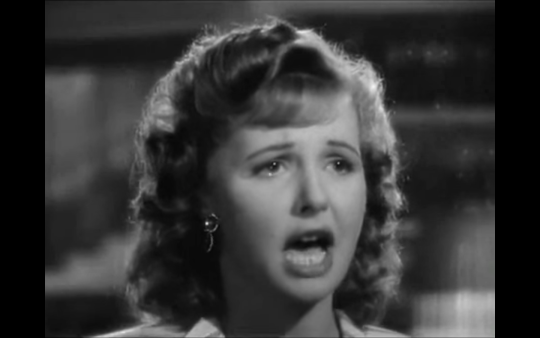
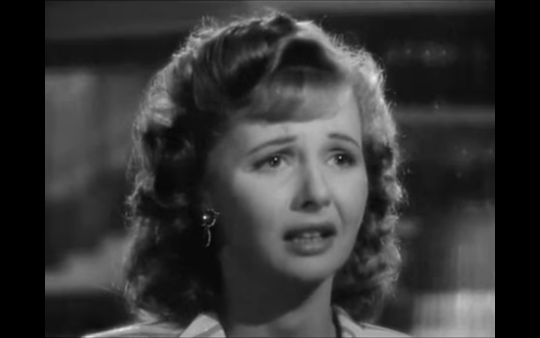
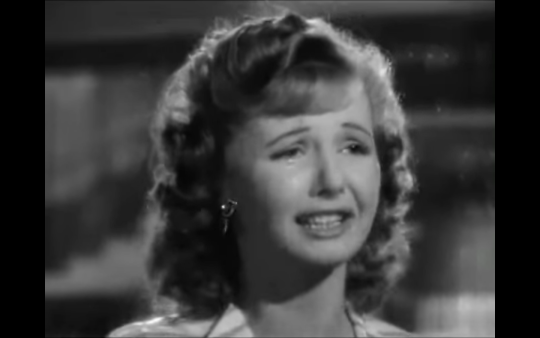
there’s one person in this scene that deserves special mention. did you notice the woman at the bar, on the verge of tears as she belts out la marseillaise? she’s yvonne, rick’s ex-girlfriend in the film. in real life, the actress’s name is madeleine lebeau and she basically lived the plot of this film: she and her jewish husband fled paris ahead of the germans in 1940. her husband, macel dalio, is also in the film, playing the guy working the roulette table. after they occupied paris, the nazis used his face on posters to represent a “typical jew.” madeleine and marcel managed to get to lisbon (the goal of all the characters in casablanca), and boarded a ship to the americas… but then they were stranded for two months when it turned out their visa papers were forgeries. they eventually entered the US after securing temporary canadian visas. marcel dalio’s entire family died in concentration camps.
go back and rewatch the clip. watch madeleine lebeau’s face.
casablanca is a classic, full of classic acting performances. but in this moment, madeleine lebeau isn’t acting. this isn’t yvonne the jilted lover onscreen. this is madeleine lebeau, singing “la marseillaise” after she and her husband fled france for their lives. this is a real-life refugee, her real agony and loss and hope and resilience, preserved in the midst of one of the greatest films of all time.
I remember when I first saw Casablanca, and being struck by this scene, and that was without knowing the history behind it or all that Madeleine Lebeau – and so many more refugees- had suffered.
Do yourself a solid and watch this film. Watch this scene. And most of all, remember refugees, the ones who lived then and especially the ones who live now.
miss me with that ‘weapon accuracy’ shit. im shooting everything. im laying down cover fire. im shooting the walls. im shooting my teammates. im shooting myself. my accuracy is 100% yall just dont know what im aiming at
I didn’t even read the rest because I’m still laughing at “miss me with that ‘weapon accuracy’ shit” like I’ve never read a more perfect phrase in my life
Fun fact: during the Revolutionary War, the British HATED American soldiers’ fighting methods. Why? Because Americans aimed. We’ve all heard of the battle of Bunker Hill and how the soldiers were instructed not to shoot until they saw the whites of the enemies’ eyes, but did you know that the British military’s battle plan was essentially to spray as many musket balls as they could all over the enemy? Troops were told to just aim in the general direction of the opposing army and shoot, and the British thought that Americans aiming their weapons was a savage and uncivilized form of combat.
The British sound like me when I play Overwatch and the enemy hitscan players kill me more than once
the american army had been trained by a german guy who added the ‘aim’ in ‘ready, aim, fire’, and literally wrote a book about ‘how to be better at soldiering then the brittish who think its all about pressed uniforms and standing in neat lines’
the other side of aiming- they thought it was unfair that half the american soldiers would intentionally try and hit the brittish officers, who had distinctive uniforms and were often sitting on a horse so they were stupid easy to pick out of a crowd. quite probably the most obvious thing you could do in a fight
#how the fuck did britain conquer 97% of the world
This isn’t entirely accurate.
First it presents the practical differences in the use of muskets and rifles as a tactical choice, which it wasn’t. The British Army primarily used muskets. So did every gunpowder army. Muskets were smoothbore, and smoothbore firearms aren’t terribly accurate by modern standards. This wasn’t a big deal, of course, because war in Europe had been built around massed formations grinding away in melee combat for centuries at that point, so the “obvious” fix for inaccuracy –to march your soldiers up close and have them fire en masse into the enemy to minimize the chance of misses– was extremely obvious.
Rifles already existed and were MUCH more accurate and longer ranged, but there were a lot of problems with them, problems that were particularly dire for widespread production and use. To begin with they were MUCH more expensive to make and required specialized equipment. We take rifling for granted now, but you had to have specialized lathes to apply the rifling, you had to do it with steel soft enough to be lathed but strong&thick enough not to explode on firing(and, ideally, multiple firings) which made them heavier, and the machine tools of the time were limited, meaning there wasn’t alot of standardization, which presented problems not only for maintenance and production, but also for firing.
For a firearm to effectively fire a round(and also not explode), the barrel needs to “fit” the round tight enough not to allow too much gas from the detonating powder to flow around it, but not so tight that the round can’t escape the barrel(either jam/fouling it, or blowing it up in your face). That’s easy to do with smoothbores: you make your rounds(called “rounds” cuz they’re round) by pouring molten lead into molds, the mold gives you a standardized shape for the rounds, and you can use that shape to standardize the diameter of your barrels. With rifles it isn’t so easy because the interior is grooved and, like I said, very little standardized machine-tools. Getting the right balance is tougher, and if you thin the barrel too much during rifling, it blows up in some poor schmuck’s face.
So Rifles were not only more expensive, and slower/more difficult to load, they were also more finicky; more liable to jam, foul, or blow up in your face, especially if you were relying on some manufacturer to make them on contract in an era of zero quality control, which is what the British Army would have had to do. So it didn’t make sense -economically or tactically- for the British Empire to arm its soldiers with rifled firearms; it’d be too expensive, it be more dangerous in the massed-rank warfare of the time, and the slow rate of fire would leave those soldiers dangerously exposed on the front lines. And, given the dirty, smoky powder of the day, the added range wouldn’t matter much since you typically couldn’t see much after a volley or two.
All of this applied to the American Colonials as well. The vast majority of colonial units were also armed with smoothbore muskets, and the Brown Bess in particular(because that’s what British gunmakers made, that’s what colonial governments made easily available to citizens for purchase, and so -required to own a firearm for militia service- that’s what most colonial citizens “owned”[which is another issue]). BUT! Plenty of colonials -particularly in less developed “frontier” regions like Vermont- also did lots of hunting, and when you hunt you really need to hit what you’re shooting at the first time. Rifles were a sound investment for people who hunted.
So, when the revolution started, you had all these people(esp in the far north and along the frontier) who owned reliable rifles, knew how to maintain them in the rough, were practiced shooters, and often had some experience in sanctioned(or not) campaigns to massacre or torment the people they were stealing “America” from. These hunters were quickly organized(or in the case of “units” like the Green Mountain Boys, organized themselves) into “sharpshooter” irregulars who were INCREDIBLY effective at both harassing massed British formations from cover(which there was a lot of in the colonies) during marches, and executing British officers(who HAD to make themselves extremely visible to give commands on deafening, smoke-clogged battlefields) during formal engagements.
Obviously hunters existed in Britain too, AND plenty of colonials supported the crown, so why didn’t THEY have sharpshooter detachments? Well they did; BUT at the time they were only poorly integrated into the organization of the British army, and British commanders didn’t like to use them. Why not is a complex question. First, to put it bluntly, they thought that sort of deliberate murderousness was something you reserved for non-whites and the Irish. Second, this was a class society, and class-hierarchs tend not to encourage the idea of deliberately killing your social “betters”. Third THEY were the ones who would be getting shot at by the other side if they encouraged that sort of thing by their own troops. So the Brits didn’t really make much, or very effective, use of sharpshooters doing the American Colonial campaign(even though they had during the French and Indian War killing natives and massacring their communities).
The Colonials didn’t share or respect those qualms; they were democratic in their tactics as well as their politics, even as they shared their blase racism justifying the extermination of non-whites. So the accuracy of the colonial troops wasn’t the result of “better” training than the British that gave more attention to aim and accuracy(how could they be better trained: the Brits were professional soldiers and they were, mostly, raw volunteers) but the significant presence of, and willingness to use, sharpshooters to thin out British ranks at range and, more importantly, pick off British officers from the relative safety behind their own ranks of mass-shooters.
“In the spring of 1940, when the Nazis overran France from the north, much of its Jewish population tried to escape the country towards the south. In order to cross the border, they needed visas to Spain and Portugal, and together with a flood of other refugees, tens of thousands of Jews besieged the Portuguese consulate in Bordeaux in a desperate attempt to get that life-saving piece of paper. The Portuguese government forbade its consuls in France to issue visas without prior approval from the Foreign Ministry, but the consul in Bordeaux, Aristides de Sousa Mendes, decided to disregard the order, throwing to the wind a thirty-year diplomatic career. As Nazi tanks were closing in on Bordeaux, Sousa Mendes and his team worked around the clock for ten days and nights, barely stopping to sleep, just issuing visas and stamping pieces of paper. Sousa Mendes issued thousands of visas before collapsing from exhaustion.
The Portuguese government—which had little desire to accept any of these refugees—sent agents to escort the disobedient consul back home, and fired him from the foreign office. Yet officials who cared little for the plight of human beings nevertheless had a deep reverence for documents, and the visas Sousa Mendes issued against orders were respected by French, Spanish and Portuguese bureaucrats alike, spiriting up to 30,000 people out of the Nazi death trap. Sousa Mendes, armed with little more than a rubber stamp, was responsible for the largest rescue operation by a single individual during the Holocaust.”
—Homo Deus: A Brief History of Tomorrow by Yuval Noah Harari
Listen, in the build-up to the Civil War, one of the most powerful political forces in the United States was a trend toward moderation that advocated for a moderate amount of slavery, and they saw the abolitionists who wanted zero slavery to be “just as bad” as the planters and fire-eaters who wanted slavery everywhere. This is the “house divided” that Lincoln was talking about; a movement that “rejected extremism on both sides” so that we would have medium slavery.
As it is, so it ever was.
Reading what people wrote about slavery back then had a big impact on me. It was all too familiar how it was justified.
And liberals are perpetually trying to justify this stance with, “Oh, that was just the way things were back then, don’tcha know,”
and I’m just staring at them like
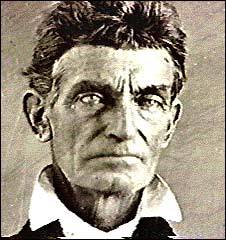
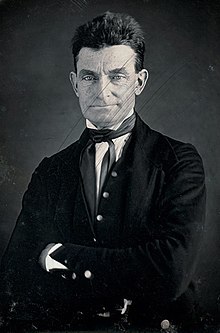
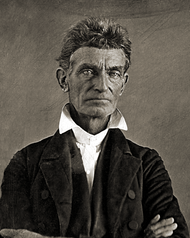
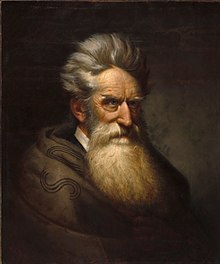
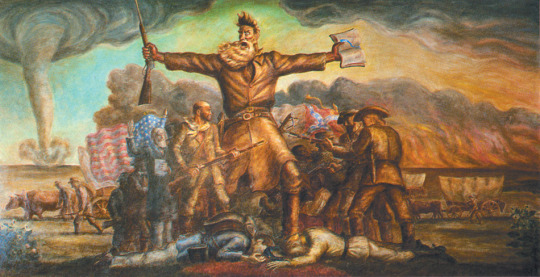
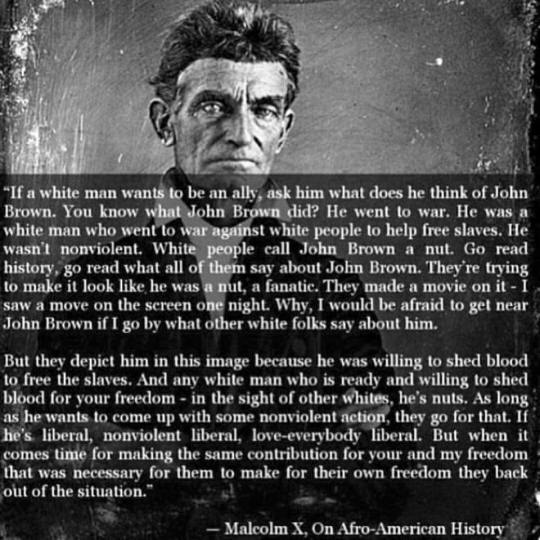
“John Brown having none of your shit” needs to be used more often as a reaction image on this site.
Every single depiction of the man looked like a meme template, even
Worth keeping in mind: when John Kelly said the civil war was started over a “lack of compromise,” he’s trying not to admit, “the South refused to compromise on the idea that slavery should be legal everywhere.”
The abolitionists were not a strong, solid majority. They were the extremists, the people saying “burn it all down” was better than a partial fix. And most white people (y’know, the only people who could vote) were content with “we could have SOME slavery, just… there should be limits.”
The South refused to accept limits. That’s the “lack of compromise” that kicked off the Civil War.
When some asshole Nazi wannabe tells you “look, both sides have some valid opinions; we should have more compromise,” know that what he really means is, “YOU should compromise; I should have the right to be as vicious as I want to anyone I wish.” And the people actually advocating for compromise? Again, they mean, “the bigots have been a big part of our history and we need to keep making them feel welcome. Their targets need to accept the gains they’ve gotten, and shut up about actually getting equality.”
So fuck compromise. Compromise only works when you’re starting from equal positions.
“So archontic literature and women’s writing, at least in the English language, have been linked for at least four hundred years, and from the first, the act of women entering the archives of male-authored texts and adding their own entries to those archives has generated conflict. Wroth, who was Sidney’s niece, received sharp criticism for writing the Urania from fellow noble Sir Edward Denny, who lambasted her for producing a romance, a type of work unseemly for a woman – the only appropriate genres for women writers being, according to Denny, translations of scripture and other devotional material. Wroth responded to Denny by parodying a poem that Denny had written to censure her. She adopted his rhyme scheme, including the exact rhyming words, and defended herself archly, demonstrating that a female writer could freely enter and add to any male-authored archive she wished, and that such archontic activity could be a successful technique for critiquing the style or message of the male writer’s writing.”
—
Derecho, A. (2006). Archontic literature: A definition, a history, and several theories of fan fiction. Fan fiction and fan communities in the age of the internet, 61-78.
In this paper, Derecho is interested in fanfiction as an art form rather than simply a social phenomenon, which was the predominant approach in fan studies at the time. Theorising how fanfiction works, she coins the term “archontic literature”. This is partly an attempt to move away from value-laden words such as “derivative” or “appropriative”. “Archontic” refers to the idea of an archive, which is ever-expanding, and where the addition of any new work alters the entire archive. Derecho also uses “originary” (rather than “original” or “source”) for a work which may serve as inspiration for fanfiction. Conceptualising fanfiction in this way allows for a less hierarchical view of the relationship between fanfiction and the works it is based on. Derecho argues that fanfiction is part of a wider genre of archontic literature – works based and building on other existing works. She traces a history of archontic writing, showing how it has often been used as a tool of social and cultural critique by minority and marginalised groups. She gives a number of examples including women’s writing from the 17th century, and more recently postcolonial and ethnic American literature such as Alice Randall’s The Wind Done Gone.
I honestly always find the term ‘spinster’ as referring to an elderly, never-married woman as funny because you know what?
Wool was a huge industry in Europe in the middle ages. It was hugely in demand, particularly broadcloth, and was a valuable trade good. A great deal of wool was owned by monasteries and landed gentry who owned the land.
And, well, the only way to spin wool into yarn to make broadcloth was by hand.
This was viewed as a feminine occupation, and below the dignity of the monks and male gentry that largely ran the trade.
So what did they do?
They hired women to spin it. And, turns out, this was a stable job that paid very well. Well enough that it was one of the few viable economic options considered ‘respectable’ outside of marriage for a woman. A spinster could earn quite a tidy salary for her art, and maintain full control over her own money, no husband required.
So, naturally, women who had little interest in marriage or men? Grabbed this opportunity with both hands and ran with it. Of course, most people didn’t get this, because All Women Want Is Husbands, Right?
So when people say ‘spinster’ as in ‘spinster aunt’, they are TRYING to conjure up an image of a little old lady who is lonely and bitter.
But what I HEAR are the smiles and laughter of a million women as they earned their own money in their own homes and controlled their own fortunes and lived life on their own terms, and damn what society expected of them.
this map is fascinating for a variety of reasons but the particular part of it that made me fall down a wikihole was the Cucuteni–Trypillian culture, which I was not familiar with. they seem pretty cool for a variety of reasons but what caught my eye is that they’d build a city, literally the largest city in the world they would build, and then they’d live there for about sixty years, and then they’d burn the fucker down. Why? Nobody knows. They’d move somewhere else and do the whole thing over, and then maybe move back and rebuild the first city identically on the same foundations. In one place they did that thirteen times.
this is some SCP type shit. what was chasing them. what happened in these cities that they needed burning down over and over
…what
right????? also i forgot my favorite part: we can’t get buildings to burn down this way. we’ve tried, nobody has actually managed to set a fire that leaves the same kind of rubble. it is not…traditional…fire



 i'll apple your turnover