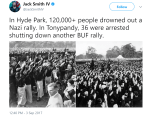
i love how he says “older jews” were against it but “british antifa” went against them, as if old jews were particularly against antifascism & as if the majority of british antifa fighting the BUF weren’t london jews ??? what the fuck
Seriously, way to gloss over the fact that the march was meant to terrorise the large Jewish population living in the East End and that the Battle of Cable Street was mostly orchestrated by a leftist Jewish collective known as the Jewish People’s Council. You can read more about them here.
I also think that you can’t paint Jewish resistance to fascism without also acknowledging that they were literally putting their and their families lives on the line. For Jews it’s always a question of whether to fight or to keep our heads down because history (yes before the Holocaust) has shown us time and time again that it can always get worse.
The original thread on twitter, doesn’t gloss over that by the way. I don’t know why the OP decided to include “older Jews” but none of the following (link to the full thread):
#tbt that time two brothers bought their own planes, learnt to fly them and disguised them as soviet planes so they wouldn’t be questioned and then flew into east germany to rescue their third brother from a park and recorded the entire operation and got away with it
no but legit this is one of my favourite stories from the 20th century it just sums up human ingenuity and how walls just don’t fucking work when people will do anything to cross them
the first brother and a friend paddled over the Elbe on inflatable mattresses in the middle of the night to escape the east. they got picked up by a Wessi police officer, who said something like “bit cold for swimming, ey boys?” and the brother says “not when you’re trying to leave the East.” because all East Germans were automatically citizens of the West too, they were taken into town and established themselves there.
the second brother scoped out a particularly dark stretch of the wall. He escaped over it to the west by getting into a high building and shooting an arrow with a steel cable attached over to another building in the west. He then ziplined over. In response to his escape, the Stasi and the Wall designers built another guard tower in the middle of the stretch so no one else could pull the same stunt.
the two brothers met up and heard that their who was still in East Germany also wanted out. So, they learnt to fly planes and disguised them as soviet planes. This was so, if the border guards saw them, they wouldn’t fire on them – they’d have to ring up the Kremlin and ascertain whether they were actual soviet planes on an organised fly-by. they flew into East Germany at dawn (recording it all on camera because you’ve got to do it for the vine even before vine exists), landed in a park where their brother was hiding in the bushes, loaded him onto one of the planes and flew out of East Germany, laughing all the way.
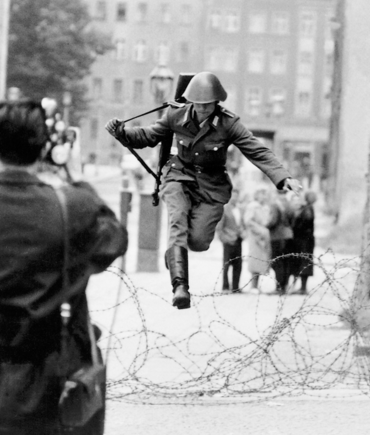
other great moments include – the guy who broke out of the GDR by driving a very low-slung sportscar under a barrier, the family who built two hot air balloons with their bare hands, the guy who managed to windsurf out of East Germany, the man who stole a tank (my hero), the people who removed the petrol tanks from cars so people could squeeze into the gap where the tank should have been, and of course, one of the most famous photos of the 20th century, with Eastern border guard, conrad schumann noping the fuck out of there when he was meant to be on duty guarding the wall when it was under construction in 1961
shortly after william the conquerer came to power he initiated something known as ‘the doomsday book’- he sent envoys to survey his new lands to record the properties he now controlled so they could pay accurate taxes. every acre of field, every mill, livestock, buildings and their relative size- all would be recorded to determine the wealth of each settlement so a percentage could be expected as rent. for an example of what this book meant; the previous king was aware of and collected taxes from about 20 grain mills in england, william’s audit shot that number above 200. you dont know the meaning of ‘pedantic’ untill you start reading about medieval grain mills, theres a church that paved its floor with confiscated ‘illegal’ millstones to ensure that the town had to get its flour from the church’s official mill and one war simply about stealing the same millstone back and fourth for quite a few decades
of course word of these envoys traveled faster then they did, virtually every town they came to had time to claim they had far less taxable wealth then they actually did have by the time the audit arrived. in one of the more over the top cases an entire village pretended to have caught insanity- when the taxmen arrived they saw screaming laughing idiots with underwear on their heads so they left as fast as they could considering at the time insanity was thought to be literally contagious. it would be over five years before anyone tried to audit that town again. its safe to assume a large number of other villages also had sudden cases of strange diseases, mysteriously disappearing cows, or very large shrubberies and haybales shaped like buildings and you dont need to look over that hill either. thats not even touching how many small communities just plain didnt technically exist because they were too small, somewhere weird, or in legal limbo of who owned it
of course when the feudal part of feudalism started moving its gears you found that the local lord of that village was unlikely to divulge the exact amount of rents they could collect to THEIR lord either, knowing that the more they admitted to receiving the more they were expected to hand over. this was not exclusive to england either, the more you learn about feudalism the more you have to ask how all these minor lords out in the boonies kept having the money and soldiers to do all the political intrigue bullshit, the answer is also tax evasion. each village kept claiming it had fewer people living in shittier houses with less land and fewer livestock then they actually had, and each local lord kept claiming they were receiving less rents then they actually took so were also adverse to an accurate audit.
their knowledge of tax loopholes also extended to finding out that clergymen were either exempt from tax or received a far lower rate of tax, so proving you qualified as a clergyman was an endeavor that paid dividends. specifically to prove you were clergy you proved that you could read and write enough Latin to satisfy an official, so you could spend some money to hire someone to tutor you enough Latin to fake it. its estimated that due to this fully ten percent of medieval english households wrote ‘clergy’ on their tax forms.
another and even more extreme example was the peasants revolt of 1381, london was swarmed by the unwashed masses from all sides instigated by an official trying to collect (a lot of) unpaid poll taxes, an angry mob driving a teenaged king Richard II to retreat to a boat in the river, and culminating with 1500 peasants being executed by an emergency militia. this doesn’t sound like a huge success untill you dig into some of the details- peasants from a large number of villages all arrived at london at the same time, leaving dedicated forces specifically to stop ships from acessing london to break the siege, the peasants executed a select number of court officials and started burning paperwork- but systematically only burning the ones detailing who owned plots of land, debt records, and a few criminal records. the peasants who besieged london and scared the king into the river had successfully purged a whole lot of debts and reclaimed a lot of land in one very ballsy and highly coordinated move that relied on them being seen as illiterate dirt farmers with no ulterior motives besides pitchfork mob riot and trying to kiss the queen mother while they touch everything in the tower of london with their grimy hands
found it. this is… this is amazing. I did a BA in Medieval British History and we never, ever, once considered this. Not once. At a major Canadian university.
I don’t think most people realize how terrifying the Moon Landings were. They look back at it, and see this great achievement in human spaceflight but don’t grasp the gravity of the situation. (No pun intended)
OP mentions Michael Collins, who is often forgotten. He was the third member of the Apollo 11 mission, who manned the Command Module whilst the other two landed with the Lander Module. People might hear that and thing he got the short end of the stick, but honestly… I’d argue the opposite. At 20:17:40 UTC on Sunday July 20 1969 the Landing Module touched down on the Moon. Neil Armstrong and Buzz Aldren spent 21 hours, 36 minutes on the surface of the Moon before beginning ascent to rendezvous with Michael Collins in the Command Module.
This is where things get unnerving. The thruster used on the Lunar Ascent Propulsion System used a hypergolic fuel, which is a fuel that spontaneously ignites when the fuel and oxidizer meet. Hypergolic fuels are useful for when spacecrafts need reliable ignition or repeated ignitions, however they’re nasty things. The specific fuel used for this thruster was a mixture of Aerozine 50 and Dinitrogen tetroxide. These are incredibly toxic, and more importantly incredibly corrosive. In fact, they are so corrosive that once you fire an engine you essentially have to completely rebuild it in order to reuse it. This means that the engine on the Lunar Ascent Propulsion System had never been fired before.
That engine was their bridge home. If it failed, they would be stranded on the surface of the Moon. As mentioned the Moon Landing lasted roughly 22 hours. For twenty two hours the two astronauts were on the moon, completely unsure if the never-before fired thruster would even fire up. Completely unsure if they’d be able to go home.
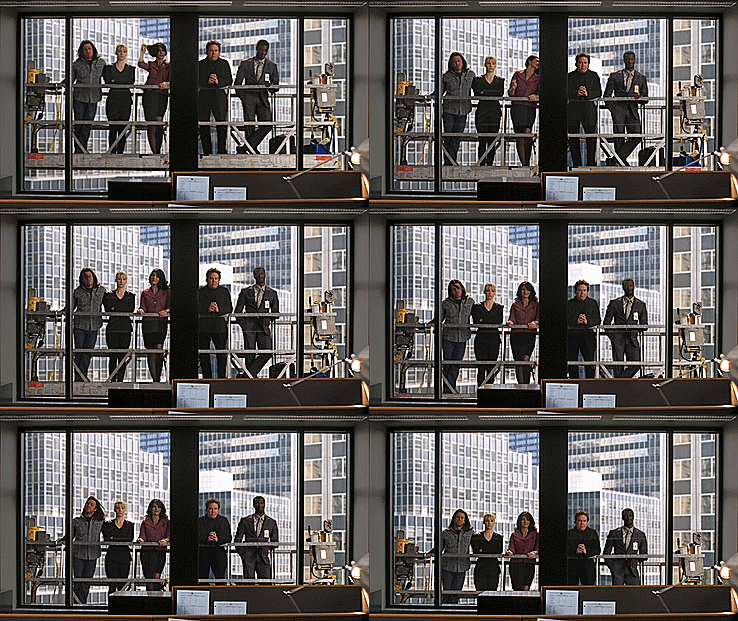
This picture shows the entirety of the human race on January 21st, 1969. All of it except the man who took it, that is. Micheal Collins stayed back on the Command Module during the mission to await Aldrin and Armstrong’s return… or potential lack thereof. This earned him the title “The Loneliest Man in the Universe”. For about 50 minutes for each orbit around the Moon Collins would be out of contact with the earth. That means for about 50 minutes during each orbit he’d have no way to contact any other human, completely alone over 230,000 miles from earth. For roughly 50 minutes during each orbit Collins had no clue whether his fellow astronauts were still alive, and them not returning was a very real possibility. Orders were in place that if the other two could not return to the command module that Collins would return alone.
This wasn’t just some disaster protocol either. This was a very real possibility. Both the astronauts, and NASA were very much prepared for it to happen. So much so that Richard Nixon, the president at the time, had a speech prepared if it were to happen. It doesn’t sugar coat it. It starts off
“Fate has ordained that the men who went to the moon to explore in peace will stay on the moon to rest in peace. These brave men, Neil Armstrong and Edwin Aldrin, know that there is no hope for their recovery.“
If that isn’t bone chilling, then I’m not really sure what is. People often romanticize space exploration, but back then, and even today, well… this is the reality of it. All of that is what astronauts go through.
it’s hilarious to me when people call historical fashions that men hated oppressive
like in BuzzFeed’s Women Wear Hoop Skirts For A Day While Being Exaggeratedly Bad At Doing Everything In Them video, one woman comments that she’s being “oppressed by the patriarchy.” if you’ve read anything Victorian man ever said about hoop skirts, you know that’s pretty much the exact opposite of the truth
thing is, hoop skirts evolved as liberating garment for women. before them, to achieve roughly conical skirt fullness, they had to wear many layers of petticoats (some stiffened with horsehair braid or other kinds of cord). the cage crinoline made their outfits instantly lighter and easier to move in
it also enabled skirts to get waaaaay bigger. and, as you see in the late 1860s, 1870s, and mid-late 1880s, to take on even less natural shapes. we jokingly call bustles fake butts, but trust me- nobody saw them that way. it was just skirts doing weird, exciting Skirt Things that women had tons of fun with
men, obviously, loathed the whole affair
(1864)
(1850s. gods, if only crinolines were huge enough to keep men from getting too close)
(no date given, but also, this is 100% impossible)
(also undated, but the ruffles make me think 1850s)
it was also something that women of all social classes- maids and society ladies, enslaved women and free women of color -all wore at one point or another. interesting bit of unexpected equalization there
and when bustles came in, guess what? men hated those, too
(1880s)
(probably also 1880s? the ladies are being compared to beetles and snails. in case that was unclear)
(1870s, I think? the bustle itself looks early 1870s but the tight fit of the actual gown looks later)
hoops and bustles weren’t tools of the patriarchy. they were items 1 and 2 on the 19th century’s “Fashion Trends Women Love That Men Hate” lists, with bonus built-in personal space enforcement
Gonna add something as someone who’s worn a lot of period stuff for theatre:
The reason you suck at doing things in a hoop skirt is because you’re not used to doing things in a hoop skirt.
The first time I got in a Colonial-aristocracy dress I felt like I couldn’t breathe. The construction didn’t actually allow me to raise my arms all the way over my head (yes, that’s period-accurate). We had one dresser to every two women, because the only things we could put on ourselves were our tights, shifts, and first crinoline. Someone else had to lace our corsets, slip on our extra crinolines, hold our arms to balance us while a second person actually put the dresses on us like we were dolls, and do up our shoes–which we could not put on ourselves because we needed to be able to balance when the dress went on. My entire costume was almost 40 pounds (I should mention here that many of the dresses were made entirely of upholstery fabric), and I actually did not have the biggest dress in the show.
We wore our costumes for two weeks of rehearsal, which is quite a lot in university theatre. The first night we were all in dress, most of the ladies went propless because we were holding up our skirts to try and get a feel for both balance and where our feet were in comparison to where it looked like they should be. I actually fell off the stage.
By opening night? We were square-dancing in the damn things. We had one scene where our leading man needed to whistle, but he didn’t know how and I was the only one in the cast loud enough to be heard whistling from under the stage, so I was also commando-crawling underneath him at full speed trying to match his stage position–while still in the dress. And petticoats. And corset. Someone took my shoes off for that scene so I could use my toes to propel myself and I laid on a sheet so I wouldn’t get the dress dirty, but that was it–I was going full Solid Snake in a space about 18″ high, wearing a dress that covered me from collarbones to floor and weighed as much as a five-year-old child. And it worked beautifully.
These women knew how to wear these clothes. It’s a lot less “restrictive” when it’s old hat.
I have worn hoop skirts a lot, especially in summer. I still wear hoop skirts if I’m going to be at an event where I will probably be under stage lights. (For example, Vampire Ball.)
I can ride public transportation while wearing them. I can take a taxi while wearing them. I can go on rides at Disneyland while wearing them. Because I’ve practiced wearing them and twisting the rigid-but-flexible skirt bones so I can sit on them and not buffet other people with my skirts.
Hoop skirts are awesome.
Hoop skirts are also air conditioning. If you ever go to reenactments in the South, particularly in summer, you’ll notice a lot of ladies gently swaying in their big 1860s skirts – because it fans all the sweaty bits. You’ll be much cooler in a polished cotton gown with full sleeves, ruffles, and hoopskirt than in a riding jacket and trousers, let me promise you! (This is part of the reason many enslaved women also enthusiastically preferred larger skirts – they had more to do than sit in the shade, but they’d get a bit of a breeze from the hoops’ movement as they were walking.)
They’re also – and I can’t emphasize enough how important this is – really easy to pee in. If you’re in split-crotch drawers (which, until at least the 1890s, you were), you can take an easy promenade a few feet away from the gents and then squat down and pee in pretty much total privacy. It gives so much freedom in travel when it’s not a problem to pee most anywhere.
People also don’t realize that corsets themselves were a HUGE HUGE IMPROVEMENT over previous support-garment styles – and if you have large breasts that don’t naturally float freely above your ribcage (which some people’s do! but it’s not that common), corsets are often an improvement over modern bras.
They hold up the breasts from underneath, taking the weight of them off your back. Most historical corset styles don’t have shoulder straps, so you’re not bearing the weight of your breast there, either, and you can raise your arms as far as your dress’s shoulder line allows (which is the actually restrictive bit – in my 1830s dress, literally all I can do is work in my lap, but in my 1890s dress I can paddle a kayak or draw a longbow with no trouble. Both in a full corset). They support your back and reduce the physical effort it takes to not slouch, helping avoid back pain. They’re rigid enough that you don’t usually have to adjust your clothing to keep it where it belongs. They’re flexible – if you’re having a bloaty PMS day you just … don’t lace it as tightly, and if your back muscles are sore you can lace it a little tighter. And you can undo a cup (or, y’know, not have breast cups) to nurse a baby without losing any of the structural integrity of the garment.
I do educational/historical dressing and people are really insistent, like, “The corset was invented by a man, wasn’t it?” “Actually, women were at the forefront of changing undergarment styles throughout the 19th century!” “But it’s true that it was invented by a man.”
Uh, well, it’s hard to say who “invented” the style but it’s very likely that women’s dressmakers mostly innovated women’s corsets and men’s tailors mostly innovated men’s corsets, honey. Because those exist too.
Also? These fashions are about taking up space. They’re about being loud and visible and saying HERE I AM. About saying “I’m so rich, I need someone to help me dress every morning.” And about saying, “I am not solely here for male consumption”–there’s a reason so many cartoons lampooning women’s fashion are about how hard those ladies are to kiss, and how impossible it’d be to have a quick fuck in them. (Which it actually isn’t, but that’s beside the point)
Historical women’s fashions aren’t 100% unproblematic and absolutely wonderful. They make stark class distinctions incredibly visible, because you simply cannot wear some of these dresses and keep them maintained without a private staff to do a ton of work for you. They upheld a standard of femininity a lot of women were excluded from. They limited women’s and girls’ participation in sports and athletics.
Anyway, if you read marriage certificates from church records, a full 85% of first marriages for young women were around 18-19 years old. The rest skewed higher, into the early twenties, with only a few being below that age and only one in a thousand was younger than 16.
The age of puberty has declined over the centuries as girls get better nutrition, as well, so throughout the middle ages the age at which a girl could expect her first period was around 16, where modern girls often get it much younger.
The idea that women in earlier ages were married and mothers in their early teens is a myth. Marriages of children were usually only between noble families, and made for political reasons, or creepy old bastards who wanted a child-wife and could get away with it because they were rich and powerful. They often would point to the fact that the Roman elite did the same thing as justification. The Romans, of course, would point to the Greeks doing the same thing as justification, the Greeks pointed at the Assyrians, and so on back through the ages.
It was considered disgusting by normal people then and still is.
This myth is still brought out and touted by sick fuckers. Know it for what it is; a falsehood.
And EVEN among the nobility marriages at such a young age were a much rarer occasion than those apologists would make you believe.
Let’s look an an egregious example, Henry the bloody VIII:
First marriage:
He was 18, Katharine of Aragon was 23.
Second marriage:
He was 40/41, Anne Boleyn, depending on which theory you believe, was anywhere between 24 to 32.
Third marriage:
He was 44, Jane Seymour was 28.
Fourth marriage:
He was 48, Anne of Cleves was 25
Fifth marriage:
He was 48, Catherine Howard, depending on which source you believe, was between 17-22. And yes, people at the time actually were squicked out by this age difference. And rightly so.
Sixth marriage:
He was 51, Catherine Parr was 31.
Even the most notorious LECHER and WIFE MURDERER in history did not marry teenagers in at least 5 if not 6 out of 6 marriages.
And here’s another Tudor tidbit, both Henry VII and VIII knew how traumatic and damaging it is for women marrying/having children too young. Henry VII’s mother was married at 12 and gave birth to Henry VII at 13. It caused so much damage and trauma that she never had another child after him despite being married three times.
So yes CUT THAT SHIT OUT. Teenage girls are NOT adults and anyone preying on them is pure evil.
YOU
I LIKE YOU
And as for the marriage of Elizabeth Woodville to King Edward IV, she was 27 at the time. He? Was 22.
She had been married before, and did marry young…at the age of sixteen or seventeen, to Sir John Gray, who was about five years her senior.
@systlin This is good information, but do you have a source for the information about how most marriages back in the day were not actually usually from a younger age? I tried Googling it but I can only find things talking about modern day issues.
Well, if you don’t want to spend months crawling through digitized copies of marriage records preserved in church archives from the 12th through 18th centuries from England, Italy, Germany, France, ect (which you can do, and it will show you I’m right) you can go read
“
Medieval Households” by David Herlihy, Harvard University Press, 1985. He did the archive crawling for you.
Also
Peter Laslett’s book “The World We Have Lost”, where he details over a thousand marriage certificates, and he dug through many more in the writing of the work.
Wait. I am spanish. Do they actually think henry/enrique VII married fucking katherin/catalina de Aragón as a teenager?
You know we see films about this in school and every one is pretty much adult there, both fisically and in the story.
There’s this…really weird trend in a lot of pseudo-European fantasy/ ‘historical’ books to have girls marry like…really young, to vastly older dudes. Like at about 13, getting married off to like 30 year olds. And then say “Well that’s what it was like back then.”
(Sideyes G.R.R.M)
And…no. No it wasn’t. That’s gross. England was creeped TF out when Henry VIII married Catherine Howard when she was between 17 and 22 and he was 48 as stated above, and rightly so.
All of this is excellent, and there is one thing I would add:
When you DID have these super-young marriages between nobility, it was more or less the same thing we do today when we scream “DIBS!” over who gets the TV remote. You might have a 13-year-old lord marrying a 14-year-old girl, but they weren’t expected to actually act as husband and wife, not yet. He had schooling to finish, she had to learn how to run a household. The union was purely political and not to be consummated until later–you know, at a point when they were 18 or 19 and she could carry a child without dying of it and he could actually support a wife.
I think one of the major causes of many misconceptions like this is because people have been basing their preceptions on life in the past off of works of FICTION written in the past. When I was studying Early Modern literature in undergrad, this topic was brought up regarding the presence of sexual abuse. There were many plays and what not that implied things such as this, however the scene in the play WAS CONSIDERED SHOCKING to people back then too. It would be like someone 500 years from now watching some grimdark noire mopey antihero cop drama in a city of sin, and then thinking that it demonstrates what the everyday life of today’s world is. No one in this thread is saying things like that NEVER happened back then, it was just… not as common as historical fiction and fiction written 500 years ago might have you believe. As OP mentioned, historical documents from the time have far fewer child marriages and sexual abuse than literary works from the time do.
As someone who originally trained as a social historian of the Medieval Period, I have some things to add in support of the main point. Most people dramatically underestimate the economic importance of Medieval women and their level of agency. Part of the problem here is when modern people think of medieval people they are imagining the upper end of the nobility and not the rest of society.
Your average low end farming family could not survive without women’s labour. Yes, there was gender separation of labour. Yes, the men did the bulk of the grain farming, outside of peak times like planting and harvest, but unless you were very well off, you generally didn’t live on that. The women had primary responsibility for the chickens, ducks, or geese the family owned, and thus the eggs, feathers, and meat. (Egg money is nothing to sneeze at and was often the main source of protein unless you were very well off). They grew vegetables, and if she was lucky she might sell the excess. Her hands were always busy, and not just with the tasks you expect like cooking, mending, child care, etc.. As she walked, as she rested, as she went about her day, if her hands would have otherwise been free, she was spinning thread with a hand distaff. (You can see them tucked in the belts of peasant women in art of the era). Unless her husband was a weaver, most of that thread was for sale to the folks making clothe as men didn’t spin. Depending where she lived and the ages of her children, she might have primary responsibility for the families sheep and thus takes part in sheering and carding. (Sheep were important and there are plenty of court cases of women stealing loose wool or even shearing other people’s sheep.) She might gather firewood, nuts, fruit, or rushes, again depending on geography. She might own and harvest fruit trees and thus make things out of that fruit. She might keep bees and sell honey. She might make and sell cheese if they had cows, sheep, or goats. Just as her husband might have part time work as a carpenter or other skilled craft when the fields didn’t need him, she might do piece work for a craftsman or be a brewer of ale, cider, or perry (depending on geography). Ale doesn’t keep so women in a village took it in turn to brew batches, the water not being potable on it’s own, so everyone needed some form of alcohol they could water down to drink. The women’s labour and the money she bought in kept the family alive between the pay outs for the men as well as being utterly essential on a day to day survival level.
Something similar goes on in towns and cities. The husband might be a craftsman or merchant, but trust me, so is his wife and she has the right to carry on the trade after his death.
Also, unless there was a lot of money, goods, lands, and/or titles involved, people generally got a say in who they married. No really. Keep in mind that the average age of first marriage for a yeoman was late teens or early twenties (depending when and where), but the average age of first marriage for the working poor was more like 27-29. The average age of death for men in both those categories was 35. with women, if you survived your first few child births you might live to see grandchildren.
Do the math there. Odds are if your father was a small farmer, he’s been dead for some time before you gather enough goods to be marrying a man. For sure your mother (and grandmother and/or step father if you have them) likely has opinions, but you can have a valid marriage by having sex after saying yes to a proposal or exchanging vows in the present (I thee wed), unless you live in Italy, where you likely need a notary. You do not need clergy as church weddings don’t exist until the Reformation. For sure, it’s better if you publish banns three Sundays running in case someone remembers you are too closely related, but it’s not a legal requirement. Who exactly can stop you if you are both determined?
So the less money, goods, lands, and power your family has, the more likely you are to be choosing your partner. There is an exception in that unfree folk can be required to remarry, but they are give time and plenty of warning before a partner would be picked for them. It happened a lot less than you’d think. If you were born free and had enough money to hire help as needed whether for farm or shop or other business, there was no requirement of remarriage at all. You could pick a partner or choose to stay single. Do the math again on death rates. It’s pretty common to marry more than once. Maybe the first wife died in childbirth. The widower needs the work and income a wife brings in and that’s double if the baby survives. Maybe the second wife has wide hips, but he dies from a work related injury when she’s still young. She could sure use a man’s labour around the farm or shop. Let’s say he dies in a fight or drowns in a ditch. She’s been doing well. Her children are old enough to help with the farm or shop, she picks a pretty youth for his looks instead of his economic value. You get marriages for love and lust as well as economics just like you get now and May/December cuts both ways.
A lot of our ideas about how people lived in the past tends to get viewed through a Victorian or early Hollywood lens, but that tends to be particularly extreme as far was writing out women’s agency and contribution as well as white washing populations in our histories, films, and therefore our minds eyes.
Real life is more complicated than that.
BTW, there are plenty of women at the top end of the scale who showed plenty of agency and who wielded political and economic power. I’ve seen people argue that the were exceptions, but I think they were part of a whole society that had a tradition of strong women living on just as they always had sermons and homilies admonishing them to be otherwise to the contrary. There’s also a whole other thing going on with the Pope trying to centralized power from the thirteenth century on being vigorously resisted by powerful abbesses and other holy women. Yes, they eventually mostly lost, but it took so many centuries because there were such strong traditions of those women having political power.
Boss post! To add to that, many historians have theorised that modern gender roles evolved alongside industrialisation, when there was suddenly a conceptual division between work/public spaces, and home/private spaces. The factory became the place of work, where previously work happened at home. Gender became entangled in this division, with women becoming associated with the home, and men with public spaces. It might be assumable, therefore, that women had (have?) greater freedoms in agrarian societies; or, at least, had (have?) different demands placed on them with regard to their gender.
(Please note that the above historical reading is profoundly Eurocentric, and not universally applicable. At the same time, when I say that the factory became the place of work, I mean it in conceptual sense, not a literal sense. Not everyone worked in the factory, but there is a lot of literature about how the institution of the factory, as a symbol of industrialisation, reshaped the way people thought about labour.)
I am broadly of that opinion. You can see upper class women being encouraged to be less useful as the piecework system grows and spreads. You can see that spread to the middle class around when the early factory system gears up. By mid-19th century that domestic sphere vs, public sphere is full swing for everyone who can afford it and those who can’t are explicitly looked down on and treated as lesser. You can see the class system slowly calcify from the 17th century on.
Grain of salt that I get less accurate between 1605-French Revolution or thereabouts. I’ve periodically studied early modern stuff, but it’s more piecemeal.
I too was confining my remarks to Medieval Europe because 1. That was my specialty. 2. A lot of English language fantasy literature is based on Medieval Europe, often badly and more based on misapprehension than what real lives were like.
I am very grateful that progress is occurring and more traditions are influencing people’s writing. I hate that so much of the fantasy writing of my childhood was so narrow.
Wanna reblog this because for a long time I’ve had this vague knowledge in my head that society in the past wasn’t how people are always assuming it was (SERIOUSLY VICTORIANS, THANKS FOR DICKING WITH HOW WE VIEW EVERYTHING HISTORICAL). I get fed up with people who complain about fantasy stuff, claiming “historical accuracy” to whine about ethnic diversity and gender equality and other cool stuff that lets everyone join in the fun, and then I get sad because the first defence is always “it’s fantasy, so that doesn’t matter.”
I mean, that’s a good and valid defence, but here you have it; proof fucking positive that historical accuracy shows that equality and diversity are not new ideas and if anything BELONG in historical fiction. As far as I can tell, most people in the past were too bloody busy to get all ruffled up about that stuff; they had prejudices, but from what little I know the lines historically drawn in the sand were in slightly different places and for different reasons. (You can’t trust them furrigners. It’s all pixies and devil-worship over there).
So next time someone tells you that something isn’t “historically accurate” because it’s not racist/sexist/any other form of bigotry for that matter-ist enough for their liking, tell them to shut the hell up because they clearly know far less about history than they do about being an asshole.
Part of me thinks “Surely this isn’t true” but another part of me is like “This is not the weirdest thing I’ve ever heard”
This is 100% true. Allen v. Burbage (1602) and its outcome has been well documented. Burbage found a loophole in the lease of Allen’s land that said that, while Allen had the right to no longer lease his land to the theatre troupe, the theatre troupe had ownership of the structure (the theatre). This new document discovery just confirms that Shakespeare was absolutely irrefutably involved, as previous documents about the court case didn’t name him. But we’ve always known about this (his theatre company while he was part of it, etc.).