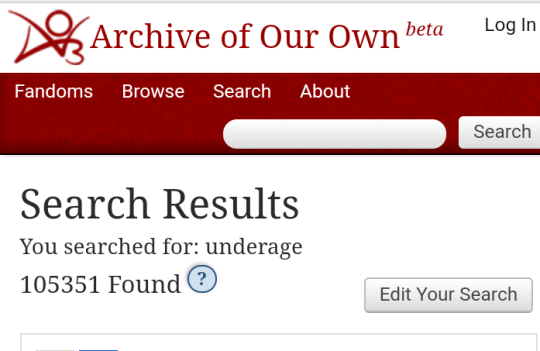
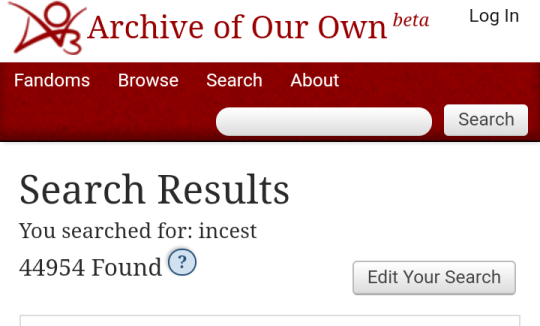
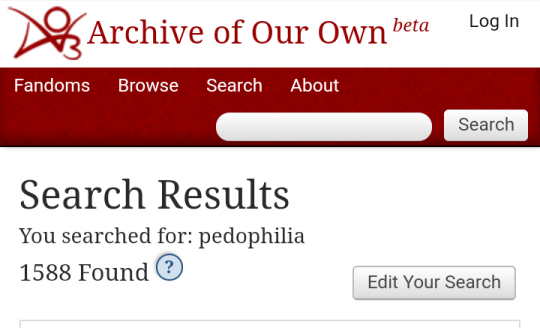
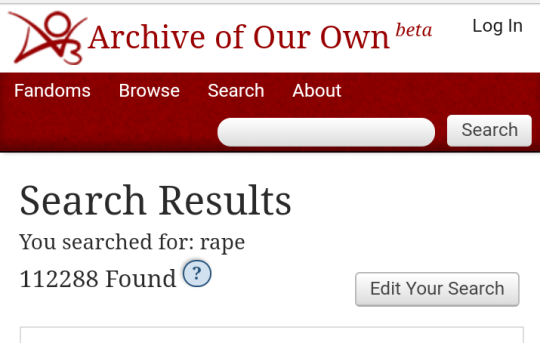
So. I will be tagging this for all the things, and putting a lot of things under a readmore in a bit, but first, I’ve been seeing some angry discussion about things tagged with child sex and/or abuse on AO3 and other hosting places and I have a perspective that isn’t a reader, isn’t a writer, and it relates to my own abuse history.
You… do realise that people tag works as containing rape/paedophilia/incest when the stories are explicitly about those things being bad, and not just because they’re writing dark themes for reasons that you personally disapprove of, right? That tags merely state the presence of a thing without explaining how it’s dealt with in the narrative, and that stories do not have to be morally instructional and perfect and pure in order to be allowed to exist?
Like. You might as well walk into a bookshop and stamp BLOCKED FOR BADWRONG CONTENT on every book in the Song of Ice and Fire series, half of Shakespeare, every YA novel about rape recovery, every adult novel about rape recovery, every biography of someone who has suffered from rape, incest or paedophilia and been brave enough to write about it, every book of Greek, Egyptian and Norse myths, the fucking Bible – just a truly massive percentage of the entire global literary canon,because there is literally no way to remove each and every reference to these themes otherwise.
Do you know why schools and libraries are pressured to ban books like I Know Why the Caged Bird Sings, To Kill a Mockingbird and Laurie Halse Andersen’s Speak? Because dumbass, scaremongering adults think that letting teens read about rape or racism or sexual violence or queerness or half a dozen other topics they think are Bad Things will lead to them down a path of Vice.
What happens to characters in stories, no matter how graphic or awful, is not the same as that act occurring to a real human person in real life, nor does reading or writing such works indicate endorsement of those acts. This is why a story which features paedophilia, regardless of whether it’s written as overtly sexual content or as a damning condemnation of the act, is not the same as child pornography by any legal definition: because no actual children are harmed. Are you personally still allowed to be angry and disgusted about the public availability of the former type of stories, even in instances where the writers are themselves victims of child abuse trying to process their trauma? Yes! You’re under no moral obligation to like any kind of content! But are you correct in asserting that the creation of such stories is illegal and hurting somebody in exactly the same way that a real abuser hurting a real child would be? No! Because fictional characters are not real people, and whatever our motives for creating or engaging with a particular thing, monkey see = monkey approve is not how it fucking works.
Have you ever watched an episode of CSI? Congratulations! By your own logic, you’re pro rape and murder. Ever watched an episode of Hannibal? Congratulations! By your own logic, you endorse cannibalism, Stockholm Syndrome and serial killing. Ever watched a historical drama where a young girl gets married to a much older man? Congratulations! By your own logic, you endorse child brides. And on, and on, and on.
I say again: you are allowed to be critical of particular works and/or the recurrence of certain themes across a particular medium. But arguing that an entire literary platform needs to end because some stories there contain Bad Things makes as much sense as banning the works of Octavia Butler or Sherman Alexie from school libraries because of their content. Which is – spoiler alert – a really bad idea.
“That needs to come from someone with a relationship with the author who can have the kinds of conversations with them that need to be had.”
I feel like this is an important point. Not only because it’s generally accepted that people probably aren’t going to accept concrit if they’re not ready for concrit in the first place, but also because for the concrit to useful they have to accept that the person giving it to them is a) qualified to give it and b) doing it out of a genuine desire to improve the writing and not for some other ulterior reason. With all the anti-ship and anti-kink things going around nowadays, I’d be very hesitant to bring up anything like this unless you are very certain that it is “problematic” and that you have the ability to word it in such a way that the author can see your point without brushing off your words as the ravings of someone who just doesn’t like what they read.
To be honest, if someone suddenly popped into my comment box with “this is problematic” my first assumption would be that this person is on a crusade against whatever upset them in the tags (I’d seriously doubt that they even read it). That’s just the culture we’ve created in fandom, unfortunately. People often go on witch hunts based off of vague information that they themselves don’t understand or haven’t bothered to look into.
Now, if someone was specific and said “I believe you should tag this noncon/dubcon because there are uneven power dynamics apparent in this relationship that make it difficult to determine the actual level of consent between Char A & Char B, for example…” that’s something else entirely and something I would stop to consider.
It shows that the reader has in fact read the story in question and isn’t just out to attack anyone who happened to have posted Char A/Char B that day, and it gives a specific reason why.
A comment that I (ironically) received just two days ago went like this:
That’s the sort of thing I wouldn’t say in a comment. That needs to come from someone with a relationship with the author who can have the kinds of conversations with them that need to be had.
That said, if you’ve noticed something I’d encourage you to reach out (from a place of love). Better to come from someone who has concerns and wants the writer to improve than for the writer to see their work panned on a blog post or an anti-rec list. But even then, a tumblr ask/message or a twitter DM or something would be the better place for it. Comments are too public on AO3.
Anyone else have some advice here? I’ve never encountered this myself.
This was well written with only a few normal grammar errors! I liked it and love how well you tagged everything!! 🙂 Only thing I might also tag is a sub-drop like tag and/or something about Sherlock safe wording. Just to cover all your bases! That was the only part that made me uncomfortable. Otherwise I liked it!! 🙂
Also love the aftercare, that you have it and that he has both boys!! 🙂
Personally, when receiving such a comment, I’d probably end up either tagging it as requested (as I did in the case above) or explaining my reasoning for not tagging/tagging it something else, such as “uneven power dynamics.” In the case of noncon/dubcon, I might even go back in and write a few lines here and there that make the consent more apparent if I don’t want to change the tags.
And I think that’s an important point too – it’s much better to say “I think you should tag this as x,y,z” than “I think you need to rewrite this.” Tagging lets the readers know the author is aware of the problematic elements – and that there are problematic elements in the first place, in case the readers aren’t aware either – without saying to the author “your writing is bad and you should feel bad enough to rewrite it.” Especially since there are writers who purposefully write things they know are problematic. If you see those kind of fics, and they are tagged appropriately, move on. The author knows what’s up, the readers know what’s up, everything is as it should be.
Ultimately, at the end of the day, this is all just my personal opinion. I’m certain there are other authors who’d just roll their eyes and go “I’m not changing anything, this is obviously a love story” and at that point it’s best to just move on. You can’t force someone to see their writing the same way as you see it. The most you can do is politely provide your side of the argument and then let the author decide how to handle it from there.
thank you so much for this thoughtful addition. I’m also very open to changing my tags because sometimes there are things I write about that I don’t know the “standard” tags for. Plus, I want people to know going into a fic if something will potentially upset them. It’s still their choice to read it, but they’ll have the heads up to prepare for it that way.
person: hey mischief how do you keep your fandom experience positive
me, barricaded behind a layer of mutuals who post stuff i like, buried under a horde of blacklisted tags and blocked blogs, looking at my laptop through a solar eclipse viewer and wearing giant fluffy earmuffs, one of which i gingerly lift away from my head: what?
Hey y’all, when someone makes a snappy one liner claim about a content creator without providing a source, it’s a pretty good indication they’re full of shit! If you question the claim and see those goal posts start dancing, that another good indication they’re full of shit!
Anyway, now is a good time to bring this back
Scarleteen also posted a great article on evaluating sources and developing critical thinking skills. Next time you see someone shout “Yeah but [X] is a [Thing]!” in notes or retweets, ask them where they got that info then go track it down and look at the source yourself.
Yeah, and ff.n used to SPECIFICALLY encourage criticism in the review box before you start typing. I forget the exact language, but it was something like, “As well as telling the author how much you enjoyed their work, you could also give some advice on how to improve their writing.” I’m sure they were trying to build a sense of community and discussion amongst writers and readers, but what it ended up being was a lot of entitled children telling the writers on the site what they wanted to see and how to do it. It definitely contributed to the culture on the site back about ten years ago when ff.n was huge, where a lot of writers would ask for input and specifically follow it, kinda like Homestuck before it became Homestuck.
I’m glad they changed it. Now it just says “Type your review in this box.”
In my experience this is also partially indicative of a culture change in fandom too? I feel like people are a lot more accepting these days of “fic for fic’s sake” and there’s been an evolution in fandom culture where criticism is only given if specifically requested, because it’s understoodthat many writers are just writing for fun and not out of a desire to improve or expand on writing skills. The default these days seems to be “say something nice or say nothing at all,” and sometimes it even dips into “giving unasked for criticism is downright rude.” You even see this these days for little things: plenty of friend-writers of mine have gotten asks recently that are specifically checking if it’s okay to even point out things like a typo or a spelling error that got missed.
Back in the day, the comment format of “point out something good, and something that could be fixed” was a lot more commonplace. Or the ‘critique sandwich’ — something well handled, something to work on, finish with something well handled. Feedback was an expectation, and the opposite actually occurred: not wanting critiques or suggestions for how to do better was considered lazy, or only wanting good comments was considered attention seeking or ego-stoking. Sometimes people took it too far with their criticisms, but just as often they didn’t. I know I sure got some upsetting reviews back in the day, but I also got a lot of people pointing out little bits and pieces that I could fix and improve on. Even if I didn’t agree, it still made me think about why I made some of the writing choices that I did.
It’s a fascinating bit of cultural evolution and culture clash, actually. One of those things where language and communication evolved somewhere along the way and caught us off guard. Because I actually do see some older people in fandoms expressing shock when even a (well meant, not mean, or well written) critique is taken poorly by a writer or an artist. For example, I had a friend recently who offered some (legitimate) constructive criticism to an artist and was shocked when the artist was furious and offended with that. And on the flip-side, I know I’m always baffled when readers (hesitantly, shyly) point out a typo or a mixed up word that I missed in my editing, like it’s some great breach of etiquette and highly offensive to me to point out that I made a mistake. (It’s not, for the record).
And I feel like AO3 happened to roll along at the time that shift happened, but I don’t think it’s solely responsible. In fact, my guess is that it’s the opposite, and the culture change strongly influenced AO3.
Of course, sometimes people use “criticism” to be an asshole. And those guys should just knock it right off already.
This reflects on what I’ve experienced, and I know that really works out for a lot of people who write fic. Personally it kinda bums me out, because I like hearing about reasonable critiques (and typos, fuck knows I make a ton of those).
I would actually suggest that AO3s timing wasn’t coincidental. The ‘have a deep discussion about the fic and discussing the craft’ was a huge part of Livejournal culture. That was back in the days when you could scroll past a fic and find a mount of large comments discussing particular elements or characterizations between readers and the authors.
Then Strikethrough happened and AO3 followed after, but the culture of LJ fandom has died out. Tumblr is indicative of that cultural change, I think – you wouldn’t get the popularity on LJ that you can get on Tumblr, or at least not as much as quickly. Back in the day, having a friends list of 100 or so people was a huge deal, and bonefide BNF status.
Nowadays, we’re much less isolated and much less centralized, which also makes fanworks much more public. It opens you up to a lot more undue criticism and vitriol for the same works, and makes it so it’s harder to narrow what you consume, even if accidentally. (IE you have to follow very specific curated tumblrs to completely avoid content you don’t care about, and even then it’s iffy).
Combined with how much more populous and mainstream (ish) fandom/fanfic has become, it’s not a surprise the culture has changed. Not only have we lost LJ’s culture and community/discussion designed formatting, but you can’t be sure the people seeing your writing are people who have chosen to/enjoy that specific content, so you don’t know the mentality they’re coming from. That’s also FF.net’s problem, since it was so huge and so centralized. History repeats itself.
Petition to start calling Tumblr the Pit of Voles 2.0
Excellent thoughts, both of you, and completely accurate. The problem with ff.n culture was that it was far too focused on the consumer. The writers couldn’t respond to reviews individually, but had to make long, rambling author’s notes. (Sometimes entire chapters were author’s notes, gah I hated that.) It wasn’t a conversation on the story itself. Though there was give and take, it was very much about keeping your readers happy so you would keep getting those sweet, sweet reviews.
Of all the fandom cultures I’ve experienced, LJ was by far my favorite. The nesting comments meant that you COULD have conversations on fics, and you did. Lots of people did! It was an amazing way to form relationships and have discussions. And the nested comments were on every post, not just fics like in AO3, so you could write an episode reaction or a meta, then discuss it in the comments with your friends. AO3 tried to bring that over by making the comment system similar to LJ, and I have had AWESOME conversations in the comments on fics (it’s how I got to write for the Dream, Seam ‘verse), but by and large it didn’t quite translate.
If I could put it in a nutshell, I would say ff.n culture was about serving the readers, AO3 culture is about protecting the writers, and LJ culture was about having discussions about everything and anything with everyone you came in contact with. Heck, LJ had huge anon communities where you could go anonymous and just bitch about the fandom and things without revealing who you were. It was like anon hate on tumblr, except not sent directly to your inbox, so you could avoid it if you wanted.
And tumblr culture is about gaining as many followers as possible and trying to keep your fandom “pure.” Very fame and morality driven.
Tumblr: why do misogynists like to invalidate strong female characters???????????
If we’re going to be fair here, the reason so many people get upset when a female character is called a Mary Sue is because that label is thrown around so haphazardly and so very often handed to characters who really don’t deserve to be labeled as such. The controversy of the term comes from its overuse and misuse.
The term can be used correctly, but it is too often misused by people who see a capable strong female character and have a gut instinct to burn the witch and return to their male hero power fantasy.
“So, there’s this girl. She’s tragically orphaned and richer than anyone on the planet. Every guy she meets falls in love with her, but in between torrid romances she rejects them all because she dedicated to what is Pure and Good. She has genius level intellect, Olympic-athelete level athletic ability and incredible good looks. She is consumed by terrible angst, but this only makes guys want her more. She has no superhuman abilities, yet she is more competent than her superhuman friends and defeats superhumans with ease. She has unshakably loyal friends and allies, despite the fact she treats them pretty badly. They fear and respect her, and defer to her orders. Everyone is obsessed with her, even her enemies are attracted to her. She can plan ahead for anything and she’s generally right with any conclusion she makes. People who defy her are inevitably wrong.
The problem isn’t that characters are unrealistic. Heroes often are unrealistic and it’s ok to criticize media.
However, female characters are criticized where male characters aren’t.
Everything in OP’s post could apply to Luke Skywalker (and definitely applies to Anakin) but those characters won’t be criticized the way Rey has been (even though everything Rey does in The Force Awakens is believable). We are more willingly to believe in a male chosen one who can just do amazing things because he’s the hero.
Boys can have wishfulment stories but girls can only have realistic stories.
Seeing any of these traits as a phenomenon about female characters, rather than poorly written characters in general, is in and of itself misogyny.
The very concept of Mary Sues, created when female characters were created to go toe-to-toe with white male characters whose extraordinary-ness was taken for granted, was a misogynistic creation.
Fandom extrapolates complex backgrounds for white male characters, and then refuses to do the work for female characters, but blames those characters for not having been developed by us the way white male characters were.
(A character created originally in a text by definition cannot BE a Mary Sue, which is supposed to be a self-insert, but it’s been
extrapolated to mean ‘any extraordinary woman,’ which is. An additional
problem. But I digress.)
I began working on this last summer. Like many veteran fanfiction authors, I lament the decline in commenting that I’ve seen in my fandom, the Tolkien fandom. I’m also a humanities teacher, so I spend a good part of my day teaching young people how to write, and one lesson I’ve learned the hard way is that each type of writing involves unique skills that have to be learned. And commenting is a unique form of writing and one that comes with added stresses around social expectations and public performance. My research on the Tolkien fanfic community confirms this: Many people want to comment, but they simply don’t know what to say.
As a teacher of writing, I often use
sentence starters or mentor sentences. The writer uses these to jumpstart their thinking and writing, until they become comfortable enough to begin working independently. “101 Comment Starters” is built around this research-based strategy of teaching writing.
Some of the comment starters are simple enough that they can be merely copied and pasted. Others require filling in some blanks or providing some elaboration. In some cases, a because can be dropped if the reader isn’t comfortable providing that level of elaboration yet. In other cases, a more experienced commenter can add the because and elaborate more on their comment.
They also differ in their level of praise. They range from simple statements of how the author made the reader feel to compliments around an aspect of the author’s writing or their work in general. I’ve tried to limit words like really, very, and so as much as possible, except when it made the comment feel wooden. You’re welcome, of course, to add those words in if you feel they more accurately help capture how a story impacted you.
If you’re just starting to comment, please keep in mind that the vast majority of authors will love to hear from you! They don’t care how long or elaborate your comment is. They don’t care if your English is perfect or if you’re a little awkward. They just want to know that you’re reading and enjoying their work.
Finally, please feel free to reblog and share and add your own comment starters!
Browsing the Shuri tag on tumblr is the most fascinating thing for me, because I have watched virtually all of the black female characters I love either be ignored or despised.
So, watching the rare rise of a character like Shuri and seeing how fandom interacts and imagines a black girl it actually deems “lovable”?
…It is as fascinating as it is revealing. The righteous anger at even the smallest hints that she could experience love or desire. I even read a post from someone who claimed to be triggered at the possibility that Shuri could be crass or cuss.
Checking that tag provides a nice little window into how society interrogates and limits a young black girl even when deemed acceptable/beloved as originally presented in-character. …And it’s nothing new.
Some background on where my head on this is…
Back in the 1980′s there were two popular young black characters on TV whose popularity among white audiences and the qualities they zeroed in on, remind me a lot of how white fandom tends to package it’s “love and protection” of Shuri. Those characters are Arnold and Webster on the TV shows Different Strokes and Webster.
In those shows, the black characters’ main traits were sassiness, cleverness, cuteness, and quippiness. They had catchphrases that white audiences loved, they were intelligent and often they put white characters in their place or taught them something, but in the end, they were ultimately under the care and control of white families and certain boundaries were never crossed.
It always safe.
This “safety” was embodied by the neutering of the breadth and depth of emotion and experiences these characters got to have on their shows. Everything was limited to a child-like context. It was a method of whiteness protecting itself from these characters, but framed as protecting these black kids (sound familiar?). It’s a stellar example of the often passive-aggressive “polite” racism of whiteness, a common thread made so by their need to avoid getting that racist label; to keep that veneer of benevolence, even from acknowledgement within their own selves.
It was such an important factor in these characters’ popularity, whether subconsciously or with that intent, that two actors with dwarfism portrayed these characters. Thus, these characters never aged. They were forever dolls under the subordinate care of whiteness. Limited to funny quips, sweet hugs, a forever cute exterior, and safe sass. These shows never had to deal with the full complexities wrapped up in inevitable growth and maturity. There was no puberty, no real anger nor desire, just faux anger, canned audience laughter reactions, and childlike crushes.
“What you talkin’ bout, Willis?” was the “WHAT ARE THOSE?!” of that day and age.
In a nutshell, they never had to deal with these characters’ growth into full experiences humanity has to offer. So, I’m saying that the condition of white fandom’s rare love and embrace of a black girl is to not be fully human.
So many posts and comments about Shuri reflect a strange preemptive insistence that anything that strains beyond a child-like view of her somehow diminishes her. When it actuality that child-like view just provides a safe context for them to envision her.
Shuri is most popularly seen as a giddy, clever teen, who smiles a lot and roasts her brother. …But she’s more than that. She’s next in line for the throne and thus has been trained to rule the most advanced country on the planet(!). She is responsible for the design of the entire technological infrastructure of Wakanda. Do not mistake a fun-loving personality or being a typical sibling for a lack of maturity or responsibility, when the situation calls for it.
Mind you, all of this was demonstrated in Black Panther. She guided Ross to shoot down weapons carriers (with people inside, driving them) while on the battlefield herself, fighting for her life. She had enough presence of mind to take the other suit for her own use, since she believed her brother dead.
I do believe this character being portrayed by actress who is small-framed, styled semi-androgynously out-of-character, and dark-skinned, are qualities that I believe make it easier for fandom to keep her “safe” in their eyes. …Keep her childlike and emotionally neutered. Since all of these qualities in the same person, have been rare to non-existent representation-wise in mainstream pop culture up to now.
The conditions for their love, which will turn sour on a dime (I’m already seeing signs of that in the tag) is that she remains that meme they fell in love with.
Remain the wide-eyed innocent doll they perceive with jokey/assist/~*friend*~ interactions with the rest of the MCU. They want to see her talk to Tony, Bruce, and Peter, but don’t be too mean or too smart! ~*They are equals. :))))*~
This passive-aggressive preciousness with which especially white female fandom handles Shuri, the insistent eye-twitchy flinch of her being “A CHILD!” is not “love”, it’s protecting themselves from the emotional distance they would feel, if she were a woman.
I can predict how fandom’s “love” will shift as the character of Shuri evolves and grows over time, given Wanda who also started as a teen in her first appearance in the MCU, and it won’t be pretty.
…But I hope that with some active self-interrogation, perhaps more people will question the real place their so-called protective limits come from.



 i'll apple your turnover