I saw some #discourse go by about how adults shouldn’t be in fandom writing about younger characters because it’s uncomfortable and gross to younger people to have adults ‘thinking about them’ in romantic/sexual terms.
1, This is not a restriction that any writers in any other venue have to deal with, wtf, or the entire YA genre would be banished; 2, Excuse you, children of Tumblr, no one is thinking about you.
If other people in fandom are older than you, by definition, they have been your age. When fans write about younger characters, we’re not peering through a keyhole at young people now and creeping on them.
We are drawing on our own experiences, thoughts, feelings and memories of what it was like when we were that age.
No one has the right to ask older writers to cut themselves off from their own past just because young’uns don’t want to acknowledge that people in their 30s, 40s, 50s, 60s, 70s, 80s, 90s, all of them, were also young once. I’m 41, but I remember vividly what it was like to be 14. If I write a high school AU, it’s about my high school experience, even if I were to set it in the present day and decorate it with some (probably comically out of touch) Stuff The Kids Are Into Now. If I write a high school AU with sex, it’s because I remember that too! I’m not thinking about kids today, why would I– I have my own experiences to draw on. And honestly, sometimes there are things about being young that you don’t really understand until you’re much older and have some perspective– and that’s worth writing about.
If someone is genuinely a creeper, you’ll know, because they’ll ask you questions about you. But people who aren’t even directly interacting with you, who are just expressing themselves in fiction, are not a threat to you, and it’s not creepy for them to draw on their own experiences and their own past to write about younger characters.
OMG THIS
I’m honestly so frustrated with the rallying cry of these brats being “I don’t want someone getting off on me/my trauma/my sexuality” bc who the fuck are you? what flavor of narcissistic do you have to be to become convinced that the writing of someone who has never met you and has zero interest in meeting you is obviously about you specifically, I don’t fucking get it!
antis, this is not about you. none of this has ever been about you. I know it’s hard to process, the possibility that something might be entirely unconnected and unrelated to your shit life, but try to understand. you are not, in fact, the center of everyone’s universe. you, as an individual, are largely irrelevant to most people whose work you consume. just because it resembles you does not mean it is you. if you have trouble comprehending this, maybe inform a parent or guardian so someone more capable can take responsibility for your media consumption.
baffling how much of this site is just conservative protestantism with a gay hat
you know what i’m in just enough of a bad mood that i’m ready to nail my grievances to the church door so let’s fucking go
black and white morality wherein anyone who doesn’t believe/think/live exactly as I do is a dirty sinner Problematic and probably a predatory monster
everyone is a sinnerProblematic but true believerspeople who activist the right way according to my worldview are still better than everyone else, and I will act in accordance to this belief in my own superiority to let everyone else know I’m better than them because I found Jesusam the most woke
casual and fucking omnipresent equations of womanhood with softness/goodness/purity/nurturing to remind every woman who isn’t/doesn’t want to be any of those things that they’re doing it wrong
aggressive desexualization (particularly of women’s sexuality, to the point where it may as well not exist at all) accompanied by pastels [not a criticism directed ace ppl having a right to sex-free content and spaces but specifically targeted at a wider problem resulting from the previous point]
YOU’RE VALID AND JESUS LOVES YOU and neither of these platitudes achieves a goddamn thing
historical context is for people who care about nuance and we don’t have time for either (see: black and white morality)
lots of slogans and quotes and nice little soundbites to memorize but does anybody actually study the source material with a critical eye to make their own informed analysis
the answer is no
I’ve been to bible study groups don’t @ me I know what the fuck I’m talking about
Good Christians™ Nice Gays™
don’t fraternize with/let themselves be influenced by non-Christians those terrible queers
all the media one consumes must be ideologically pure or it will surely harm the children
it is Our Sacred Duty to protect the children from Everything, thus ensuring their innocence/purity/etc until such time as they are idk probably 25 years old
literally just “think of the children” moral panic y’all can fuckin miss me with that
people who don’t conform to the dominant thinking WILL be excommunicated/driven from the social group, and any wrong treatment they suffer will be seen as a justified consequence of their wrong thinking
I Saw Goody Proctor With The Devil And She Had A Bad Steven Universe Headcanon
Thank you for breaking it down like that because so many of us have been saying it but to see a play by play breakdown comparison is just…Thank you.
not to sound like a baby boomer or some other bullshit but the internet really has given children access to things they absolutely should not see. i just heard my ten year old brother make a daddy joke. this really has to stop.
like i’m not joking. i’m like. just so angry i can’t articulate it right now but i’m so upset, especially with adults/older teenagers who egg children on in making jokes far beyond their age because they think it’s funny.
Not only that, but they look up their favorite shows and see porn of their favorite characters
^ This point is crucial. This is not as simply avoided as “don’t like don’t read/watch” disclaimers advise and there is not adequate safeguarding against children accessing sexually explicit material even so much as third-party websites that require a user to agree that they are over the age of 18.
~ * WHICH IS THE RESPONSIBILITY OF PARENTS. * ~
Not J-Random-Person-On-Tumblr-or-Ao3-or-YouTube. The child’s parents.
And I am saying this as a) a parent involved in assorted fandoms with b) two children of various ages who are c) also involved in assorted age-appropriate fannish activities. We fan together. I critique and edit my eldest son’s Transformers/Loud House fanfic. I help my youngest son design some of his Pixel-stuff skins. We decided mutually which YouTubers they were allowed to watch. We play games together, read many of the same comics, buy each other Funko Pops and Nerf weapons, squee over many of the same fannish things – not all, but many, because I have grown up things that I’m interested in and they have not-grown-up-things that they’re interested in and there the twain does not meet. Because I’m their mother and it’s my responsibility to monitor what they get into and up to online as much as it’s my responsibility to make sure they don’t play in the middle of a four-way highway.
It is not the responsibility of random strangers on the internet to monitor your child’s online activities. It’s just not. And it’s not even remotely reasonable to expect them to do so.
Parental content filters are a thing. Use them.Don’t buy your children M-Rated video games and then clutch your pearls about it. Pay attention to what they’re reading, drawing, watching, and doing online. This is literally your job as a parent.
And also? Don’t act like someone else is doing something wrong by being an adult on the internet. Because they’re not and behaving like an adult in adult-oriented fandom spaces is only to be expected. 18+ Only warnings exist for a reason. M-Ratings exist for a reason. Do Not Interact If You’re A Minor warnings exist for a reason. And it’s not the fault of the adults who employ them properly if a minor chooses to ignore them. That child’s parents should be monitoring their activities and teaching them to respect those boundaries.
everyone on earth gets to stan 1 irredeemable fictional murderboy with a
vaguely sad backstory. but you only get 1. if you exceed that limit the
cia takes you out. and thats how fandom discourse works.
A post just crossed my dash that put the worst taste in my mouth. I don’t want to reblog it, but I do want to address the contents because I think the subject is super important.
The post basically boiled down to: fanfic writers are thin-skinned babies “these days” because no one can take constructive criticism. In “my day” we all sent page-long critiques like the dedicated heroes we were! It made us better writers! Moreover, if I didn’t like something, I told the writer all about it! It was my job!
Hold up, what?
I’ve been posting fanfic online since 1998. Twenty years. Pre-archives. And “in my day” we had betas if we wanted/needed/asked for them (whose critiques didn’t have an audience). We said “concrit welcome” if we actually wanted constructive criticism. We did not show up unannounced to point out a work’s flaws because that is rude. Look, I am an editor. People pay me real money to edit things for them. I would rather cut off my own fingers than burst into someone’s comments and start “critiquing” their work without being asked first.
Here’s something that needs to be addressed: fanfiction is real writing, yes, but it is, by its nature as something that isn’t monetized, a hobby. As in, a thing people do for fun. A thing that hopefully brings both authors and readers joy! The story an author posts is a gift; how dare anyone rip a gift apart in front of the gift-giver and all the other party attendees? How entitled and ungrateful can you be? Fandom is not a frigging battleground where authors learn to harden themselves for war. It’s a hobby. Done out of love and enthusiasm.
Yes, some fanfiction writers (certainly not all!!) aspire to be original fiction writers. They may use fanfiction as a training ground. They may want or benefit from constructive criticism. Still, they have to ask. They have to start the conversation. I know (think?) it’s harder to find betas these days, but it’s always worth asking around if real critique is what you want. Put “concrit welcome and even begged for” in the author’s notes and hope someone takes you up on it.
Some fanfiction writers with original fiction aspirations still don’t want criticism about their fic. Fic may be their fun-writing outlet. It may be about instant gratification (and there’s nothing wrong with that; we’re not in the business of denying ourselves pleasure out of some moral superiority here. It’s fandom). It may be the place where they post to get around their fears of showing things to others. It may be the place they take risks they wouldn’t in their original work because the stakes are lower. When you work on your original writing all day, every day—often putting that work through far more vigorous and exhausting paces than fanfic sees—the last thing you want is someone showing up during your time off to point out a frigging comma splice or shift in POV.
The point is unless someone asks for critique, you don’t know what’s going on with them. Maybe fic is the only fun thing they have in their lives. Maybe they’re writing in a different language. Maybe they are 14. Or 82. Maybe they’ve never written fiction of any kind before and this is their baby step forward. Maybe fic is just escapism. Maybe they are depressed or anxious as hell and criticism is going to push them over an edge. Fandom belongs to everyone. Not just people deemed “good” or “perfect” or “permitted” or “thick-skinned.” People don’t need to be saved from grammar mistakes or poor turns of phrase or even plotholes so wide a semi could drive through them. Authors sure as hell don’t need to be told when a reader just doesn’t like something. There is no fandom police force in charge of perfection. If critique is so important to you, advertise your willingness to beta. If you do not like a story or think it’s “bad” hit the freaking back button.
Unsolicited criticism is not helpful. Maybe you just catch someone off-guard and startle them. At worst, you may totally shatter someone’s self-esteem while they are partaking in a hobby they 100% do for fun—and not in pursuit of some unattainable perfection.
Don’t ruin a stranger’s day or week or hobby because you “know better” and somehow think you need to prove it. You don’t.
A friend and I were scowling over that same post last night, and this is a much kinder response than the one that I started writing. I love and agree with 100% of what you’ve said here, but I’d like to go a step farther, because I think that fandom’s general evolution away from negative feedback is about more than just our amateur status. I always see the assumption in the pro-unsolicited-criticism camp that negative criticism is somehow the only thing that can ever help a writer improve, and I’ve always found that idea to be absolute horseshit. Hearing things that people liked about my work isn’t some kind of newfangled emotional safety feature that’s keeping my fandom babyhood intact, it’s genuinely helpful to me as a writer. Not only in the sense that it feels nice and makes me motivated to write more, but in the sense that it gives me specific information about how a reader responded to my work which I can then use to do an even more enjoyable job of engaging my fellow fans for fun the next time I write something. Friendly positive comments ARE constructive criticism!!
Also (and I’d love to get your perspective on this as an editor?) I’ve found that negative criticism tends to be very work-specific. It’s stuff like “don’t do this particular thing at this particular time,” or “I didn’t like that this specific character said this specific thing,” etc. That can be incredibly useful during the editing phase because it helps me polish a specific piece of writing. I can’t say enough good stuff about literally every editor and beta reader I’ve ever worked with, because each one of them made the stories they worked on stronger and more enjoyable, and they certainly didn’t limit themselves to unquestioning praise in their feedback.
Once I’ve posted (or published) a story, though, I am done editing it. I’m done fixing it, I’m done adjusting it, I’m probably done even thinking about it for at least a week. I mean, sure, if you spot a giant typo, fine, let me know, but someone telling me they didn’t like the pacing or that the characterization was all wrong or that my sentence structure didn’t fit the genre or whatever is absolutely useless, both to that particular work and to my writing as a whole. The thing is done. It’s built. Unless I have unwittingly perpetuated some kind of miserable bigotry or whatever, I am moving on to the next thing, which is very likely to be an entirely different thing. I’m genuinely sorry if a reader didn’t enjoy it, but for the love of the little baby jesus in the hay, why are they still wasting time on something they didn’t like when there’s an entire internet of other things out there for them to discover???
For whatever reason, positive notes about things I did right in a story are much easier for me to carry forward and apply to whatever I might work on next. Knowing that someone liked a scene or an idea or even a particular line tells me that all the various technical things I did to make that part of the story happen were successfully deployed. Knowing what I did right for readers lets me do it again, lets me build on it, lets me ponder new directions that I might go with whatever the thing was, even if I’m doing that in a completely different story or piece of writing.
So yeah, negative feedback on completed fic or published work that’s disguised as “constructive criticism” isn’t just kind of asshole-ish and antithetical to everything that fandom means to most of us, it also tends to be genuinely unhelpful in … basically every way. Especially when you compare it to how helpful a positive comment of the same duration and detail would have been, both to the writer’s relationship with their hobby and to their growth as an artist.
THIS IS SUCH A GREAT ADDITION TO MY POST! MAX KUDOS. I agree with (and love) everything you’ve said 100%.
I think something most people don’t realize is that an editor’s (and beta’s) job isn’t to tear a work to shreds; it shouldn’t revolve around negativity at all. Ideally, an editor works with an author to yes, fix errors, but mostly to read, observe, analyze, and ask questions the author (who is so close to the work) might not have thought about. The editor is trying to preemptively ask the questions a confused reader might ask, so the reader never has to ask them. Those answers then help the author clarify, polish, and further build their work into something even better. Absolutely work-specific.
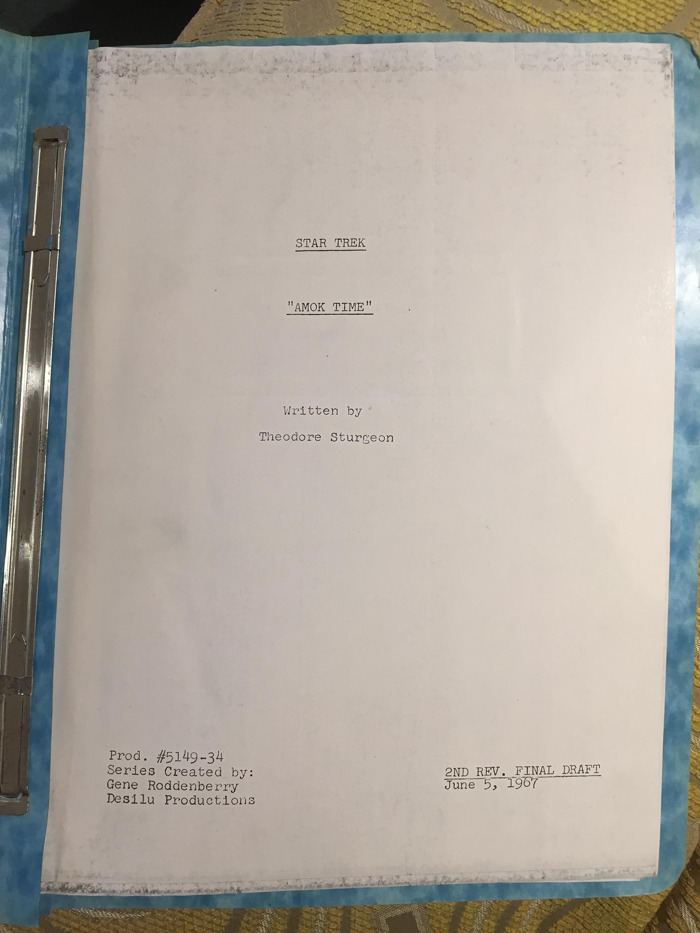
so my grandma died recently, and my parents have been dealing with the quantities of Stuff accumulated over the course of her and my grandpa’s lives, which could be interesting on its own as a family matter, but, well, grandpa was a science fiction writer, and they knew a lot of science fiction writers, which means a lot of the stuff is classic sci-fi and fantasy. books, artwork, that kind of thing. what i had not realized, but perhaps should have predicted, was that knowing a lot of science fiction writers in the ‘60s meant that they knew people who had written for this one TV show in the ‘60s that some science fiction writers worked on, and these people liked to share stuff.
what i’m saying is that i have now held in my hands one of the original, physical scripts for the star trek episode “amok time”.
it was like holding a piece of history. my own hands, carefully cradling the origin of sex pollen and fuck or die. a work whose influence went far behind what the writer could have expected–sacred, almost, in its way. who knows how much spawned from this episode? how much fanfiction would never have existed were it not for this holy text? indeed, the very concept of slash itself? an artifact, a priceless relic, sitting on my parents’ couch.
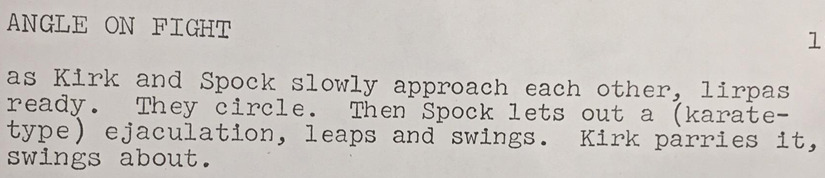
i haven’t seen the entirety of the episode itself, so i don’t know if there are any real differences between the script and what was aired, but i had to skim it anyway–and i did find something that is perhaps worth mentioning, whether or not this actually counts as canon. but hey, hard to get more canon than an Actual Official Script, right?
VULCANS BLUSH YELLOW, BITCHES, IT’S CANON
also, this:
thanks for specifying “karate-type”, theodore sturgeon. coulda gotten confusing, that.
anyway, it was a deeply surreal experience and i’m pretty sure the script is getting donated someplace with a lot of the other stuff, but man, my grandparents were cool
Tumblr: why do misogynists like to invalidate strong female characters???????????
If we’re going to be fair here, the reason so many people get upset when a female character is called a Mary Sue is because that label is thrown around so haphazardly and so very often handed to characters who really don’t deserve to be labeled as such. The controversy of the term comes from its overuse and misuse.
The term can be used correctly, but it is too often misused by people who see a capable strong female character and have a gut instinct to burn the witch and return to their male hero power fantasy.
“So, there’s this girl. She’s tragically orphaned and richer than anyone on the planet. Every guy she meets falls in love with her, but in between torrid romances she rejects them all because she dedicated to what is Pure and Good. She has genius level intellect, Olympic-athelete level athletic ability and incredible good looks. She is consumed by terrible angst, but this only makes guys want her more. She has no superhuman abilities, yet she is more competent than her superhuman friends and defeats superhumans with ease. She has unshakably loyal friends and allies, despite the fact she treats them pretty badly. They fear and respect her, and defer to her orders. Everyone is obsessed with her, even her enemies are attracted to her. She can plan ahead for anything and she’s generally right with any conclusion she makes. People who defy her are inevitably wrong.
The problem isn’t that characters are unrealistic. Heroes often are unrealistic and it’s ok to criticize media.
However, female characters are criticized where male characters aren’t.
Everything in OP’s post could apply to Luke Skywalker (and definitely applies to Anakin) but those characters won’t be criticized the way Rey has been (even though everything Rey does in The Force Awakens is believable). We are more willingly to believe in a male chosen one who can just do amazing things because he’s the hero.
Boys can have wishfulment stories but girls can only have realistic stories.
^^^^
So, there’s this interesting thing where a certain degree of saturation in stories will train the audience to just accept stuff that’d normally strike them as bizarre or unrealistic, and move on without questioning it. It’s sort of like ‘willing suspension of disbelief’, except that phrasing doesn’t really encapsulate it precisely. It’s more like… commonality breeds acceptance.
For example, a humble young boy who rises to prominence and becomes a hero is such a standard piece of storytelling, that virtually no one ever sits down to watch a movie and actually goes ‘well, but, this is just a young farm lad – surely he can’t do a single thing to help stop the Forces of Evil!’ People in the movie might do that. But unless the audience is very, very young, or has somehow managed to avoid most books, movies, songs, comics, television shows, and oral traditions for the whole of their life, they’re going to sit down and think ‘ah yes, here’s our guy’.
Even though, in real life, it actually IS still pretty far-fetched for Ye Humble Village Lad to turn out to be the only thing standing between mankind and destruction.
The interesting thing, though, is that if you change enough elements of what is so common as to be thoughtlessly accepted, the image you present will no longer resemble the familiar narrative. Even if, below the surface, the other components are exactly the same.
This, along with the above-mentioned misogyny, is another contributing factor to the Mary Sue thing.
Because there are fewer female heroes who are just unabashed power fantasies, embodying unlikely rises to success or mastery of untold skills, if you take a very typical story that stars a dude and swap him out for a lady, the elements once rendered invisible by familiarity, are now noticeable again. The audience is jolted out of complacency, and begins to think more critically about what they’re being asked to believe. (You can accomplish the same thing with other demographics, too, i.e. putting characters of colour in roles typically given to white actors, or having LGBT+ characters with the same abundance as straight ones, and so on and so forth.)
So even people who like to think of themselves as totally fair and unprejudiced can end up enforcing double-standards in entertainment. Because if you don’t catch yourself, you will not even realize that you managed to sit through three Iron Man movies without ever questioning the premise of Tony Stark’s genius, but somehow Shuri in Black Panther just struck you as ‘unrealistic’.
Look no shade but I do get a little salty when people say there’s not enough non-shipping fic when anyone who’s ever tried to write gen knows you have to be twice as good and write twice as much to get anyone to care about it
I honestly was not prepped for the raw truth of this post and it fucking clocked me across the jaw. The lack of interest in genfic is genuinely quite…upsetting? Like, I’ve literally had fics which I’m high-key proud of and I’ve found myself HAVING to include a subtle shippy ‘element’ just to try and ensure that people actually…read it. The alternative? Total tumbleweed.
Which is really depressing because there’s more to the characters involved than who they’re fucking and I think people miss out on a lot of good content by JUST looking at the ship tag and nothing else. So many good artists, lost to the void 😔 saddens me xx


 i'll apple your turnover