Also I know halflings can’t in canon have babies w/ like any race that won’t just produce a halfling (Dragons/dryads/celestials/fiends can, but that’s just making aasimar/tieflings/sorcerers)
But consider: Halflings are like the CORGIS of fantasy races, so if another race has a kid with a halfling, they just look like a half sized version of the other parent
GIVE ME VISUALS YOU COWARDS.
G*d you’re so right
I’m so running with this. Imagine… Tabaxi Halflings trying to pass themselves off as a large cat.
“What do you mean ‘too big’? I’m a Maine Coon, clearly”
lmao my current character is half halfing and half orc. She’s two and a half feet of rage and is always ready to throw down. Her last name is Kneecrusher, bc that’s all she can reach.
Context: The half elf paladin communicated with the worshipped angel of the land for my character, and found out I’m the angel’s daughter. The paladin has already been shipped with a npc and me.
Angel (dm): Soo, you can hang up
(Everyone laughs)
Paladin: I can’t control that.
Paladin: You hang up first
(Everyone loses their shit as they go back and forth)
Angel: Alright, I’ll hang up (love you)
Paladin: (WHY DO I HAVE SO MANY SHIPS?)
Playing 5th edition for the first time and feeling overwhelmed? Here’s a quick glimpse into the classes.
Barbarian
Fundamentally: It’s like when you step on a Lego in the middle of the night and for a moment your capacity for rational thought is eclipsed by the fact that the entire world must tremble before the unfathomable depths of your wrath. Only with fewer Legos and more swords and stuff.
Mechanically: You can go into a rage in battle that diminishes the damage you take and increases the damage you deal. A lot of your fighting is based on high-risk, high-reward strategies, intimidation, and instinct rather than careful calculation.
Bard
Fundamentally: The words you speak change the shape of the minds around you. You’ve taken motivational speaking to a whole new level. You can also insult someone so hard they die from it.
Mechanically: Your day-to-day repertoire of spells stays the same (once you’ve learned a spell, it tends to stick in your head) and also pulls from a lot of different specializations. You can also inspire your allies, mess with your enemies’ morale, and, yes, insult someone so hard they die from it.
Cleric
Fundamentally: You’re pretty tight with some sort of higher power who’s granted you abilities commensurate with their sphere of influence. You might be a warm and fuzzy beacon of light and love, you might heal the sick, or you might make swarms of insects descend on your screaming foes. God stuff, you know?
Mechanically: You have access to a huge number of spells but don’t know them all off by heart, so every morning you spend some time in prayer and contemplation to make sure a few of them are ready at your fingertips when you need them most.
Druid
Fundamentally: You can turn into animals and control a lot of powerful magic that’s tied in with nature and the elements. You also may have read too many Animorphs books as a kid.
Mechanically: Much like clerics, you have a huge number of spells potentially at your disposal but have to concentrate each morning on picking out which ones you’ll pack with you. You can also, you know, turn into animals. That’s a thing.
Fighter
Fundamentally: You probably watch a lot of action movies and wince every time a character pulls off an amazing fight despite not having any experience or training. You’ve worked very hard to learn strategy, tactics, and precision, and when the stars align, the whole battlefield is yours to control.
Mechanically: Depending on your specialty, you’ll have a variety of abilities to make combat go a little more smoothly for you and your friends: taunting enemies so they focus on the right people, shielding your squishier allies, or just doling out an absurd amount of hurt.
Monk
Fundamentally: You think people get a little weird about their swords; you’ve never needed more than just your fists and maybe a good stick. You’re highly trained and absurdly dexterous: if someone tries to pull a coin out from behind your ear, they’ll probably find themselves with a rabbit in their hand instead and no idea what happened.
Mechanically: You’re so quick that you can snatch arrows out of mid-air. You’re also very centered on precise, devastating strikes, and have a store of ki points that allow you to do special attacks/defenses.
Paladin
Fundamentally: While clerics are generally a little more buddy-buddy or reverential with their divine patrons, yours is something more of an… employer. You know how it is when you’re on the clock: sometimes you gotta do your best to be the good you want to see in the world, and sometimes you gotta swear to enact vengeance for ancient wrongs. It’s a living.
Mechanically: Your singularly goal-oriented abilities are a blend between magic and more traditional combat, and you can frequently use magic spells to imbue weaponry with divine power. You also have an impressive ability to suss out both strong good and strong evil.
Ranger
Fundamentally: You know the wilderness pretty darn well (and probably complain about weekend hikers a lot). Your idea of a good time is being dropped in the woods without a map and having to puzzle your way out, preferably while hunting a few monstrosities along the way…
Mechanically: Your experience and survival instincts will serve you especially well in particular regions (a favored terrain you select) and against particular enemies (a favored type you select). You pick up a bit of magic here and there, mainly to help yourself and your friends make it through the wilderness unscathed.
Rogue
Fundamentally: You’re a very sneaky person who figures the best battle is the one that you ensure is over before it even gets a chance to start… mostly because you know if you get cornered you’ll probably get squashed like a bug. It’s probably a good thing that you’re so stealthy you practically vanish into another dimension.
Mechanically: You get huge bonuses and incentives for attacking first or when an opponent is distracted. You’re also notoriously quick-fingered and can be assured that if something ever goes missing, every eye in the room is going to be looking at you. Whoops.
Sorcerer
Fundamentally: You’ve got some powerful magical abilities that just sort of… happen, and your control over them is a little shaky at best. But it’s fine, it’s all good, you’ve got it handled. That tree was always on fire, right?
Mechanically: You learn a limited selection of powerful spells that are always at your disposal, and also gain access to a pool of Sorcery Points that will let you further manipulate your magic as you get more and more comfortable with your spellcasting.
Warlock
Fundamentally: Some incredibly shifty and absurdly powerful ancient being decided you seemed kind of neat, so they were all, “Hey, how would you like to have some seriously freaky magic in exchange for making a sorta dodgy pact with me?” and you were all, “alksdjflgk???” because hey, otherworldly and unfathomable, and they were all, “Cool, have fun,” and now you can kill things with your brain.
Mechanically: You have an extremely limited number of very powerful spells, but your spellcasting recharges very quickly, since the channel between you and the source of your magical abilities is pretty darn open. You also made a pact with something strange and a little bit unknowable. What could go wrong?
Wizard
Fundamentally: You’re the kind of person who got all A’s in school but also studied their ass off to do it. It’s like you read Harry Potter so many times that you managed to will magic into existence. You’re probably going to drag the party to every used bookstore on the planet.
Mechanically: You have a spellbook that contains every spell you know. Every day, you have to study up on a handful of these spells that you want to have immediately at your fingertips. You can add to the spellbook by finding more spells out in the world and copying them down using fancy-ass stationery.
Tieflings are capable of having grey skin, orange eyes, black hair and horns of a colour that’s not specified but definitely includes orange. What you do with this infomation is up to you.
I’m gonna use this information to break your god damn beautiful nose OP
bc one of our players had to miss tonight we’re playing a session as an ep of fantasy cutthroat kitchen (cutthroat dungeon)
hickory crit failed on her dish and served the judge an “eggs benedict” that was an unopened bag of english muffins smeared with butter on a plate with a raw egg and some slices of ham with a cup of milk dumped over the whole thing
Tips for using fumbles/critical failures in your tabletop game:
1. Don’t. Critical failures are typically appropriate only for explicitly comedic games. This isn’t to say that funny things can’t happen in any game – certainly they can! – but by employing critical failures, you end up with a game where the rules themselves mandate a certain minimum level of slapstick bullshit, regardless of circumstance. It doesn’t hurt to consider whether that’s actually the kind of game you want to run.
(Note that comedy doesn’t just mean Looney Tunes. A dystopian bureaucracy milieu where people die horribly for making mistakes on paperwork is also a comedy game – for certain values of comedy! – so critical failures may be appropriate there. This guideline isn’t intended to restrict, but to encourage you to think about the rules in terms of what style of play you’re trying to foster.)
2. Respect player agency. A common error of novice GMs is to use critical failures as an excuse to hijack players’ characters and have them do things they’d never do voluntarily simply because it would be funny. An example I see frequently is “you fumbled your First Aid roll, so instead you stab your patient in the face with a knife”; that’s good for a cheap laugh, but unless the tone of your game is straight up Looney Tunes, it’s not a reasonable outcome of simply being very bad at first aid. Bad dice rolls represent errors in performance and judgement, not random demonic possession.
(Obviously narrative context is important here; “my character is possessed by a minor demon that forces her to do something pointlessly evil every time she rolls a fumble” and “my character is a literal space alien who often harms people unwittingly because she doesn’t understand how humans work” might both make the face-stabbing thing acceptable, because now it reasonably proceeds from established characterisation. Those are outliers, though.)
3. Keep the magnitude of fumbles commensurate with what was attempted. Inadvertently starting a war by critically failing a Subterfuge check to lie to the King may be reasonable; inadvertently starting a war by critically failing a Streetwise check to gather rumours in a tavern typically won’t be. Barring exceptional circumstances, players should have a reasonably good idea of what’s at stake whenever they pick up the dice, and disproportionately harsh critical failures make it impossible ever to know what’s at stake.
This also applies across classes of activities. If the typical result of fumbling an attack roll is “you pull a muscle” and the typical result of fumbling an Athletics roll is “you slip, break your neck and die instantly”, the message you’re sending to your players is that you’d prefer them to resolve their problems with fistfights rather than footraces in your game – which is a problem if that’s not the style of play you’d intended to encourage.
4. Don’t foreclose: redirect. A critical failure that simply blows the players’ plans out of the water and renders whatever they were trying to achieve impossible is bad not because it’s unfair, but because it’s boring. Blocking is poor improv, and it doesn’t become less bad just because the dice gave you an excuse. A good fumble simply creates complications that need to be addressed, or shuts down the players’ current approach while creating or highlighting a different route to the same goal.
(This is especially important to keep in mind when your players’ plans require more than one roll. Even if the odds of critically failing any one roll are very low, the likelihood that at least one of a long series of rolls will turn up a fumble is very high. If any one fumble renders the whole plan impossible, nothing will ever get done. Most tabletop RPGs are strongly informed by heist fiction, so take your cues from capers: disasters and opportunities are the same thing.)
I’m finally watching The Steam of Many Eyes with my man Clint and y’all? He is genuinely so bad at the mechanics of the game he’s been playing for years god bless what the fuck
Clint McElroy’s literal first move in this game: “I cast Insect Plague.” He does not know what level spell it is or if he is allowed to do it or exactly what it does. Ashley Johnson gently assists him read his card.
Mark Hulmes allows this man to just get away with this. Sam Riegel who is wearing a custom made Matt Mercer face shirt has the audacity to say that this spell might be “a bit extreme.” I would personally die for every person involved in this exchange.
Anyone reading this who wants to get into D&D but has never played or only played a little: if you ever worry people might not want to play with you, remember that Clint McElroy is this bad at D&D and WOTC still invited him to play it live on the internet.
Truly and genuinely inspiring, you can have played for years and still not know what a d20 is and all that means is Ashley Johnson will help you while people cheer
“I created this thing over two years ago as a
joke item. One of my players became convinced that I was trying to
trick them, and that it was a real Deck of Many Things. His paranoia
spread, and the party nearly killed each other over it. After some
impromptu group therapy, they decided to leave the Deck be and never
speak of it again.
So now you get to use it. Have fun!”
Deck of Certain Things
Wondrous Item, Legendary
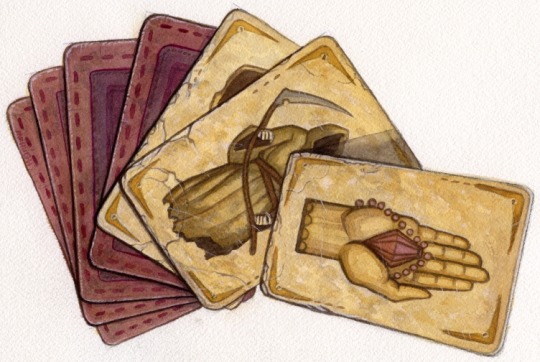
A set of 10 cards that come in a small box. “Deck of Certain Things” has been crudely carved into the box’s lid in Common.
Before
you draw a card, you must declare how many cards you intend to draw and
then draw them randomly (you can use a d10 to simulate the deck). Any
cards drawn in excess of this number have no effect. Otherwise, as soon
as you draw a card from the deck, its magic takes effect. Each card must
be drawn no more than 1 hour after the previous draw. If you fail to
draw the chosen number, the remaining cards fly from the deck and take
effect all at once. Once a card is drawn it cannot reappear.
Once all 10 cards have been drawn, a pair of Gloves of Thievery appear in the deck box, along with a note thanking the Deck’s owner for the fun.
The cards are decorated with shoddy-looking artwork, seemingly scribbled with crayon. They are:
Acorn: 3d8 terrified squirrels are transported to your location from elsewhere on the material plane.
Fireworks: Your weapon explodes into a shower of brightly-colored glitter. It reforms in 1 hour.
Prospector: A wooden chest containing 10,000 pieces of counterfeit gold drops at your feet. The coins show a winking jester on both sides.
Liar: For the next 1d12 hours, telling a lie causes your trousers to ignite, dealing 1d6 points of fire damage.
Honey Jar: Summons
a friendly sentient bear named Sigmund, who acts as an apothecary,
selling the party potions from his backpack. He vanishes after 1d20
minutes.
Wallflower: You instantly succeed on all Insight checks for 24 hours, but fail all Intimidation checks.
Invitation: An imp appears in a burst of smoke, kicks you in the shins, then vanishes.
Nightmare: All items worn on your person, with the exception of undergarments, turn invisible for 1d4 hours.
Quill: A
flameskull appears in front of you, delivers a heartfelt soliloquy,
then explodes in a pillar of green flame. All creatures within 5 feet
must make a Dexterity saving throw or take 2d10 fire damage.
Infant: For
the next hour your voice is replaced with the shrill cries of a baby.
You are unable to communicate through speech or cast spells with a
verbal component.

 i'll apple your turnover