A Beauty and the Beast AU where Belle realizing she loves Beast isn’t at some dramatic climactic event but during some randome everyday moment. Like, she’s filing her nails and just kinda glances up at him and he’s like doing something just as dull and it just kinda dawns on her that she loves him but she doesn’t voice it cause she isn’t exactly ready to confront thoes emotions and what they mean so she goes back to filing her nails but then is starts raining glitter and Beast is defying gravity in a glowing ball of light and the castle is changing back and everyone becomes human again. Then everyone is left in silent moment of shock and confusion and Belle, being completely unaware of what it takes to break the curse, is just staring around in horror while everyone freshly humanized comes running into whatever room she and Beast were in (probably the library) expecting to see something other than human Beast in a heap on the ground and Belle across the room in a chair frozen in shock and confusion and everyone just kinda looks at each other for a couple of seconds not realy sure what to say cause nobody is entirely sure what happened other than the curse was broken. Then Beast finaly gets up and looks around and realizes what this means and looks at Belle and is just like “you love me?” And Belle is just like “wat?”
ALTERNATELY: Belle falls in love slowly. As a result, Beast turns back into a human slowly. She overhears him singing in the shower (it’s amazing how old pipes echo) and realizes it’s that song she was trying to teach herself on the piano (okay, that the piano was teaching her). It’s sweet and mundane, and lovely. Meanwhile, in the bathroom, Beast is humming nervously as he looks at the fur clogging the drain. He thought at least he’d be free of male pattern balding since he’s cursed! Later, Belle gets a cold, and Beast brings her soup and sandwiches, and she curses at him because how dare he have such a hearty immune system, and he chuckles and leaves it. After he’s gone, she notices he cut the grilled cheese on the diagonal, crusts off, exactly right. Beast, downstairs, trips and falls, because the sudden lack of toe-claws threw off his balance.
And so on and so forth, so slowly she doesn’t really see it, she just assumes her memories were colored by her fear. Until one day, as he goes out to tend his roses, she yells “Bye, love you!” and when he comes back in, all excited, she nearly beans him with an encyclopedia, because “WHAT THE FUCK, WHO ARE YOU?” and Beast is just “You seriously didn’t notice me turning back into a human? You are so smart… and SO DUMB, I BEEN NEARLY DYING EVERY TIME, WHY DO I LOVE YOU, YOU BEAUTIFUL DISASTER WOMAN!”
Disclaimer: I am not a musician–I learned to play piano mainly by ear, never learned to read music properly, and don’t really know how to analyze music in a professional manner.
However, I do know some things about music, and those things include the fact that music–without words–can be used to tell a story or to aid a story, and the latter iswhat I’ll be discussing here.
There’s several different recurring themes in the music of Coco, and I’m not just talking about “Remember Me.” One is the one you hear during “Much Needed Advice” that’s also played when Miguel crosses the bridge. Characters have their own themes as well–Pepita has a loud, blaring fanfare of trumpets whenever she takes center stage.
And as you can probably guess, Héctor has a theme, too.
(Skip to 0:57.)
This shady little leitmotif is what introduces us to Héctor, and it makes itself clear whenever he’s doing something related to his “conman” persona. We hear it first when he’s trying to sneak across the bridge, when he’s trying to bribe the corrections officer, and several times when he’s scheming with Miguel.
This aids the story in the way it presents Héctor to the viewers. He first shows himself as a shady conman, running from security, trying to illegally cross a bridge, bribing officials, and even working a little kid into his schemes, so he can cross the bridge for unknown reasons.
And his leitmotif emphasizes that. It’s shady, slinky, and untrustworthy, much like Héctor himself.
And its main instrument is a guitar.
An out of tune guitar.
But it doesn’t play every time Héctor appears. In fact, it’s only heard in, oh, maybe a third of the movie or so. Guess when we stop hearing this theme?
Yeah. This shady theme of his is never heard again after the visit to Shantytown, when Héctor must pick up a guitar for the first time in a long time.
But, wait! Does that mean Héctor doesn’t have a theme anymore, after that leitmotif disappears from the soundtrack?
Well… yes and no.
When Héctor’s conman persona theme stops playing, we stop seeing that part of him, mostly (I mean, there’s the bit where he sneaks into Ernesto’s party, but that’s about it). But his conman persona isn’t all there is to him.
When I said that Héctor’s shady leitmotif is what introduces us to his character? That was a lie.
Because we hear Héctor’s true theme much earlier in the film…
…long before we realize who it really belongs to.
(Skip to 0:23.)
The very first song we hear in the film introduces us to Héctor’s true self: a father that loves his his family.
But we don’t really see that after the prologue, because Héctor left, and never returned. In fact, unless I’m missing something, I’m pretty sure that leitmotif doesn’t come back until late in the movie…
…during Héctor’s flashback, when he tries to go home…
…during the cenote scene, when he’s revealed to be Coco’s father…
…during the rooftop scene, when he apologizes to Imelda…
…and during the sunrise scene, as he gives Miguel his final blessing.
All moments tied to Héctor showing his love for his family.
Oh, and the instrument that tends to be used for this leitmotif?
I still think Moana deserved an Oscar for this part
To me, the moral of Moana is that only women can help other women heal from male violence.
The movie starts with the idea that the male god who wronged Te Fiti must be the one to heal her. This seems to make a certain sort of intuitive sense in that I think we all believe that if you do something wrong you should try to make it right. But how does he try to right it? Through more violence. Of course that failed.
It was only when another woman, Moana, saw past the “demon of earth and fire” that the traumatized Te Fiti had become (what a good metaphor for trauma, right?) and met her with love instead of violence that she was able to heal. Note that they do the forehead press before Moana restores the heart, while Te Fiti is still Te Kā. Moana doesn’t wait for her beautiful island goddess to appear in all her green splendor before greeting and treating her as someone deserving of love.
Moana is only able to restore the heart because Te Kā reveals her vulnerability and allows Moana to touch her there. Maui and his male violence could only ever have resulted in more ruin.
This is a touching anaylisis but it’s extremely racist as
not only have you completely ignored the whole point of Maui’s character, but
have managed to incriminate a man of color on a tumblr wide scale.
First of all, Maui’s character does not represent male
violence—it represent human greed. Maui did not take the heart because he is a
man, and Te-Fiti is a woman. He took it because the humans asked him to. The humans asked Maui to do everything for them,
not caring how greedy or selfish their requests were and in the end it was Maui
who suffered for it. Maui is supposed to show the flaw of humanity.
This has nothing to do with sexism, it has everything to do
with the fact that Maui gave and gave to the humans who could never stop being
greedy. Moana giving the heart back wasn’t supposed to be her “making up” for
the male violence that Maui represents. It was her making up for the greed she
and her people represent. It was touching however because yes it was an
important moment between two women, but you missed the point and you’ve come off
racist and very disrespectful to a culture at that.
Yes, Moana is an empowering movie for women, especially
women of color. But the last thing this is about is Maui being an abuser/rapist
or whatever. That is not the point of Maui’s character.
And to assume so is racist. You are a white woman completely
dehumanizing a man of color and ruining his image because of how you see him. And other white girls here
on tumblr have happily picked up that image and interpretation and rolled with
it. Maui’s character is now seen as an abuser or as someone who is violently
because of white girls here on tumblr—which it doesn’t surprise me. (an in a
historical context this is even MORE racist because white women would always
make Maui’s people out to be savages and abusers etc., simply because of the
color of their skin and their culture so yea, this is bad).
You can see the morality of the movie however you want, but
do not be disrespectful toward a character and in this case a culture.
@i-want-cheese Please don’t write this off as another “butthurt comment” or
“male guilt”, because this is really messed up. I see how you’re brushing off
some other people’s comments and I honestly hope that you don’t see mine the
same way because this is an issue I think you need to face/realize. You are
being racist and brushing it off isn’t going to change that.
the
@visibilityofcolor THANK YOU FOR THIS. As a Polynesian woman, reading that post and other replies painting Maui and even Tui as aggressive and violent men had me feeling some type of way, especially since White people have always regarded Polynesian men in such a manner.
I’ve thought about replying because I’m tired of seeing these kind of “Moana is a feminist movie” posts collect hundreds of notes despite the fact that these posts always conveniently fail to mention Pasifika people, but it always stressed me out, so thank you.
As an aside, Maui taking Te Fiti’s heart and Moana restoring it was symbolic of environmental preservation. Because the people who inspired Moana–Pasifika people, not just Polynesian–are always affected first when the environment is threatened. Our way of life is greatly influenced by the ocean and we believe that if you take care of the ocean, she will take care of you.
You’re very welcome.
This is insight for me as well (as I wasn’t aware that the movie also came fro the culture of the Pasifika people), and does give a very important perspective. I do agree with you, this movie is about environmental restoration, not some white fem bullshit.
I tried over and over again to explain to I-want-cheese about how she was being racist, but she responded by blocking me and other poc who called her out (even other polynesian people). People to this day are still trying to explain that she is being racist and culturally insensitive but she ignores us.
I’ve made a few posts about this, hoping that people realize how problematic it is to agree with i-want-cheese. Explaining to her racist white ass that this was problematic was like explaining to a bird. She wouldn’t listen and neither would have of her racist friends.
Sorry you’ve had to see this on your dash every so often, but I’m glad my portion of the post is starting to get around. (reblogged to the wrong blog at first lols)
dang reblogging this as a correction for the very first reblog. this why feminist analysis always needs to be intersectional
My heart just cried
the portrayal of Maui is super important here, the disney crew put a LOT of effort into getting him right because he IS a crucial figure to an entire culture- basically a cross between a central religious figure and superman so handling him poorly would be catastrophically disrespectful
there are basically only two parts of Mauis legend that they flub- they only tell half of the story of when he was abandoned as a baby, and they skip over that stealing the heart of
Te-Fiti
so he could give it to humanity was the legend in which he dies
yes, canonically Maui dies in his quest to give gifts to humanity, its an important element of why Maui is such a profound character, not just ‘man who hurt someone’ strawman
it gets worse when you discover the OTHER legend they fudged, the story of his birth, reinforces this.
Mauis mother had several (Hawaiians only say three, new zealand says five) sons, all named Maui, so when she had ANOTHER son she named him Maui as well, but then cast him into the sea for there was no way she could support another son. the gods did not save Maui, as Moana says, instead they return him to his mother and say she must give him a chance. to which his mother states that for her to take care of him this infant must remove the roof from her house by throwing spears at it.
that is the story of Maui the skillful, abandoned as an infant and then immediately told that he must PROVE his worth, after which all he ever does is prove his worth
his brothers mocked him for being a poor fisherman, he crafts a fishook
from a jawbone and proceeds to raise new islands from the sea
the sky is so low the trees bend, maui raises it for everyone, then fills the new sky with wind
the sun flies so quickly there is not enough time in the day to do the
labors for everyone, maui has to lay traps for each of the suns many
feet, chase after it as it was slowed, and then threaten to chop its
legs off if it would not slow down
he then due to the complaints
of the now longer dark night creates the moon and is upset his creation
will not please humanity for it does not make sufficient light, then
shows it to the sun so that it may learn how to be bright
maui
was credited with having invented as gifts for humanity the outrigger
canoe, stone tools, and seaworthy boats that had no mast or sails. he was credited
with inventing tattoos as a gift to dogs, however
humanity is still not content so maui descends to the land of the dead to ask the secret of creating fire from the grandmother, who kept it hidden in her fingernails. he dropped the fingernail in the water as he tried to return to the land of the living, came back for another, dropped it as well, and went through all ten fingers and toenails untill he had to then interrogate birds the grandmother had shared the secret with to tell him how
a monstrous eel tried to put the moves on his wife, and again maui had to prove his worth to reclaim her by breaking the monster eel’s spine, shoving him into the ground to create the first coconut tree, the single most useful thing for polynesian life, as a gift to humanity yet again
Maui, as a mythological figure, did nothing but give from the day he was born. he gave humans tools, land, fire, boats, light, the wind, everything except life itself and he even tried to give them that- and it killed him, he was bitten in two
a crucial part of Maui as a legend is that he failed, its literally part of the point, also that he was driven to prove himself endlessly to the (during his life) ungrateful.
do not try and drag Maui, its disrespectful on a level i cant express
thank the man, you asshole
Moana succeeded where he failed, for she saw that she did not have to prove herself. the whole movie up untill then she was trying to put on a brave face (there was literally a cut song ‘warrior face’ where maui teaches her Haka), shout her courage, announce to the world at large that she WILL do the thing and fix the world and be the hero, just like Maui
its easy to miss, she stopped trying to prove who she was to anyone, there was nobody she needed to prove herself TO
she just WAS herself, and that brought her peace
Oh man…this is why it’s so important to hear the perspectives of the peoples actually represented. When I was reading through this, the first part seemed to make a lot of sense on the surface, but I could *never* have imagined how racist that perspective was. It makes so much more sense now. Thank you to the folks in this thread who were willing to take the time to share their perspective so that oblivious folks like me could do a little more to chip away at our own internalized racism.
One of my fave things about the Hector/Imelda relationship is that like… it’s honestly so unexpected at first that the audience easily believes Imelda was actually married to Ernesto!
I mean here’s Ernesto de la Cruz, this charismatic, go-getter type of person, all smiles and charm and someone we’re told to like from the beginning, and when we meet Imelda she’s strong-willed and has this air of sophistication and class about her, a true matriarch of the family, and it’s like ‘oh yeah, I can see how these two personalities would’ve come together but then had a falling out.’ He’s the type who would leave for his dreams, and she’s the type who would never forgive him.
But then you realize she’s married to HECTOR: this strong, lovely, no-nonsense woman was the wife of this kooky tattered scarecrow of a man who was almost as thin in life as he is in death, and it’s just like ‘… them? Really??’
And then they start interacting and you find out how these misunderstandings have harmed their relationship, but underneath it all they still love each other so so much and turns out the two of them together are nothing short of adorable and it’s like ‘how could I have ever thought differently??’
Also it’s great to see how Imelda reacts to the man we and Miguel *thought* she was married to: repeatedly bashing him with her boot.
There’s this great line in the novelization where she remarks disgustedly that De La Cruz has no respect for women, and I think that’s part of why she and Hector work so well together- even when she’s been holding a grudge against him for years, he is nothing but respect and love for her.
Miguel is right. The first time I watched it, I expected a later scene where Miguel was proven wrong or shown the error of his ways—one where it’s firmly established that adults might make rules that don’t make sense, but they have their reasons and it’s best to abide by their wishes.
But no. That doesn’t happen. Instead, we see that Imelda’s insistence on the music ban, and her refusal to reconsider, indirectly (or perhaps directly) land Miguel in even greater danger, as he wouldn’t have gone after de la Cruz were it not for Imelda insisting he give up music forever. The happy ending comes not when Miguel agrees to give up music to please his family, but when he defies the ban to save Héctor and restore Mama Coco’s memories.
I can’t tell you how many kid’s movies I’ve seen that would have taken “Family comes first” to mean “The adults’ wishes are paramount even if they’re unreasonable.” It would have been so easy to have Miguel simply go along with what Imelda wanted, but Pixar instead gave us a story where a child’s decision to contest an unfair rule is what eventually restores a broken family.
is powerful. some of the most effective patterns I can remember off the top of my head:
– repetition in threes
remember me as a story point with changing meaning (ernesto, héctor + coco, miguel + coco; there are of course many other renditions playing in the background, plus the moment where ernesto, miguel, and his party guests sing it together, not to mention the weirdly commercial credits sequence)
coco speaks of her papa three times (once to ask if he’s coming, once while pointing at his headless photo and setting off miguel’s notion that he’s de la cruz, once to share his stories with the family)
imelda gives miguel three blessings, although the second one is aborted by ernesto, and the third is shared with héctor
there are three generations of dead Riveras: imelda and her brothers; julio and rosita; and victoria
there are three deaths: the first is illustrated by héctor’s death in the flashback; the second, the burial, is never seen in the film but implied by the cemetery; and the third, final death
héctor dresses as frida kahlo on three separate occasions: to cross the bridge, to gain entry to ernesto’s party, and to sneak with the family onto the spectacular stage. where did he get the second costume – did he steal it back from the authorities or convince céci to lend him a new one?
miguel falls three times from increasing heights: once when he slips into ernesto’s pool, once when security throws him into the cenote, once when ernesto throws him towards the pavement several stories down. twice he lands in water; the third time, héctor’s photo lands in water
héctor plays three different songs on three different guitars for three different audiences (chicharrón’s guitar for juanita, a backstage guitar for la llorona, his skull guitar for proud corazon). miguel also plays three different guitars: his makeshift one, chicharrón’s guitar, and héctor’s guitar
miguel is validated as an artist three times, first by frida, then héctor, then ernesto
clips from Ernesto’s films are shown on four separate occasions, but there is a difference in kind: the films are shown on screens and for on-screen audiences only three of those times. (once when miguel is playing along with the clips in his hide-away with dante, once when he is playing along before (and with) ernesto in front of the party audience, once when héctor confronts ernesto and play becomes all too real.) by contrast, the first time we see clips, the screen is our own (i.e. the movie screen itself, with only us as audience), hinting at miguel’s inability to distinguish fiction/projection from reality (and how he will ironically learn this difference precisely because he assumes the poisoning scene in the film was real)
there are three big grito moments, the one during warm-up (héctor accepting miguel’s wish and trying to help), the ones onstage during poco loco (miguel listening to that advice), and the ones in the cenote expressing their pride in being family. this last one is loud enough that it arguably leads dante to where they are
there are three references to the shining
– repetition in twos
ernesto is crushed twice by a bell (what is the significance of the bell? it’s a musical instrument with sacred and symbolic importance, but …?)
ernesto takes a guitar from a rivera twice: once after poisoning héctor, once by tossing away the guitar on miguel’s back in the pool
ernesto flies twice: one in a film, once thanks to pepita
imelda sings la llorona twice and for very different reasons. if one counts the mariachi singers who are silenced by abuelita, the song is technically played three times
héctor brings two shot glasses into chicharrón’s shack and leaves one empty, one full. his murder also involved two shot glasses, his own empty …
in the torn photo, héctor’s belt is engraved with two crossed guitars – there’s something going on here with la cruz (cross) as a word, the theme of crossing the bridge but also ernesto’s name, maybe even being double-crossed …
we see two bridge crossings: the one with miguel, and the one with coco and héctor
many forms of projection are repeated: the poisoning scene in ernesto’s film is seen twice; frida’s pre-show art is seen twice, once unfinished in rehearsal, once in full glory onstage; there are two flashbacks, etc.
… and I know I’m missing a ton, additions and improvements most welcome!
By now, you’ve probably heard Coco is one of the most well researched films about Mexico and its culture. There are many small details that make it feel like Mexico: the stone roads in a small town, the traditional embroidery patterns in the shirts of Miguel’s female relatives, an uncle wearing a soccer team shirt, even a bowl of limes in a stand of aguas frescas. Of course, the looks of papel picado, day of the dead altars, and cemeteries are also well represented. The clothes of the relatives Miguel sees in the world of the dead is accurate to their eras. While these are a nice touch, you’re ultimately not missing out on anything by not spotting them, so in this post I wanted to talk about the more culturally based details that show the most research and you might not understand if you’re not very well acquainted with Mexican culture:
Names and pronouns
1. Coco
This one is the most straightforward, so let’s start with the name of the movie. While the protagonist is called Miguel, we soon learn that Coco is his great grandmother. “Coco” is what we call a woman called “Socorro” (lit. “help” – it’s a very traditional name that’s considered old fashioned).
The Rivera family calls her “Mamá Coco,” which means “Mother Coco.” They also call Imelda “Mamá Imelda,” and so on. Calling your grandparents “mamá” or “papá” instead of “abuelita” and “abuelito” is a thing you can do, though I can’t say how common it is.
In the Spanish version of the film, Miguel’s grandmother, Elena, talks to Mamá Coco with “usted” (I didn’t notice other instances, but they might be there). Spanish has a formal and an informal version of singular “you:” “usted” for formal, “tú” for informal. The verb conjugation also changes depending on which one you use. It is used differently all through the Spanish speaking world, but in Mexico, other than older people you respect (like a teacher), you can talk to older family members with “usted,” which means respect rather than the distance the formality might imply. Nowadays, it has fallen out of use: as someone born in the 90s, my grandparents talked to their parents almost exclusively with “usted;” out of my parents, my mother talked to hers with “usted” and my father with “tú;” I speak to my parents with “tú.” I have cousins on my mother’s side that talk to their parents with “usted,” but I would say that makes them a minority nowadays.
Traditions and beliefs
2. Crossing to the world of the dead on a bridge of marigolds
If you paid very close attention, you might have noticed two children scattering marigold petals on the ground and their mother telling them not to scatter them, but to make a bridge so the dead could cross over. It was easy to miss, but that’s actually something we believe!
There are several types of flowers you can place in a day of the dead altar, but the one you can’t do without is the yellow marigold. Its petals are scattered all around the altar, and at the very front, you’ll form a path surrounded with candles. The bright yellow will help the dead properly make their way to the altar, and the candles surrounding the path will light their way.
3. Crossing to the world of the dead with a xoloitzcuintli
Several prehispanic cultures had a similar concept of the underworld as many other cultures around the world, in which there was a river they had to cross to get there. For both the Aztecs/Mexicas and the Mayas, a xoloitzcuintli would guide their souls so they could cross the river safely and arrive to Mictlan (Mexicas) or Xibalba (Mayas). To achieve this, a xoloitzcuintli would be sacrificed and buried with its owner. Day of the dead altars can have a xoloitzcuintli figure so that the dead can make it back safely as well.
4. Being thrown into a cenote
My screenshot isn’t the best but at some point, Miguel is thrown into a big pit with water. That’s not just any random pit, but a cenote.
Cenotes are naturally ocurring sinkholes caused by the collapse of limestone. The word “cenote” has Maya etymology, as cenotes are commonly found in the Yucatán peninsula, where they (still!) live. In old times, they would sacrifice animals and people as tributes to the gods, and also throw ceramic objects and jewelry as part of the tribute.
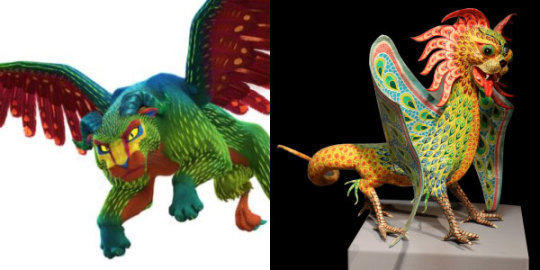
5. Alebrijes
I left these for last because they don’t have any deep meaning. Alebrijes are colorful fantastic animals that a man called Pedro Linares saw in a fever dream. He was a skilled artisan, so when he woke up from his long sickness, he brought them to life in his art.
In Coco, alebrijes are spiritual guides, and while their designs are to the likes of the real alebrijes, the film actually gave them a more important role than they have for us.
Music
6. Genres of Mexican music
The songs in Coco all belong to genres we’ve grown up with, so even if someone isn’t that knowledgeable in music theory or genres, we could vaguely tell they sounded “Mexican” (some more than others). Someone who is more knowledgeable of music genres can help me out here, but I think:
– Remember Me / Recuérdame is a bolero ranchero.
– Much Needed Advice / Dueto a través del tiempo is a ranchera.
– Everyone Knows Juanita / Juanita is a corrido.
– Un Poco Loco is a son jarocho.
– The World Es Mi Familia / El mundo es mi familia is huapango inspired.
– Proud Corazón / El latido de mi corazón is a a son (son de mariachi? I’m most uncertain about this one).
6.5 Un Poco Loco
Un Poco Loco starts in English as
What color is the sky, ay mi amor, ay mi amor, You tell me that it’s red, ay mi amor, ay mi amor
And in Spanish as
Que el cielo no es azul, ay mi amor, ay mi amor, Es rojo dices tú, ay mi amor, ay mi amor
(You say the sky isn’t blue, oh my love, oh my love, It’s red, you say, oh my love, oh my love)
This might be a deliberate reference to a huapango called “Cielo rojo,” which says:
Mientras yo estoy dormido Sueño que vamos los dos muy juntos A un cielo azul Pero cuando despierto El cielo es rojo, me faltas tú
(As I sleep I dream of us close together Going towards a blue sky But when I wake up The sky red, I am missing you)
Within the universe of the movie, this would make it an anachronistic reference, though. Additionally, Cielo rojo is a song of loss and Un poco loco is about a woman who thinks very differently and likes to say everything backwards, and that makes him crazy (in a good way!). Hence, in English we’ve got her saying to put his shoes on his head instead of his feet, and in Spanish him saying she might think with her feet and also how she keeps playing with his thoughts. Cielo rojo is a pretty sad song.
7. La Llorona
And I purposefully left La Llorona out of that list (it’s originally a son istmeño, though).
There’s a full musical number in Spanish, which seems to have suprised some people. For those of us who watched Coco in Spanish, it wasn’t too hard to guess it was this one: La Llorona was likely left in Spanish because it’s a very old folk song, one of those that are so old it has no known author and there are many different versions of the lyrics.
“Llorona” just means “weeper,” which is not really as unusual of a word in Spanish as it is in English. It’s closer to “crybaby” in use. She’s also what we call a character in a Mexican folktale. If you’re curious, the version used in Coco says the following, with “llorona” being the singer herself:
Poor me, llorona, llorona dressed in sky blue Even if it costs me my life, llorona, I won’t stop loving you I climbed the highest pine tree to see if I could spot you Since the pine tree was so green, llorona, it cried upon seeing me cry
What is grief and what is not grief, llorona: it all is grief to me Yesterday, I was crying to see you, llorona; today, I’m crying because I saw you
Poor me, llorona, llorona dressed in sky blue Even if it costs me my life, llorona, I won’t stop loving you
Famous people
8. Ernesto de la Cruz
“Isn’t he an original charact-” NO LISTEN STAY WITH ME.
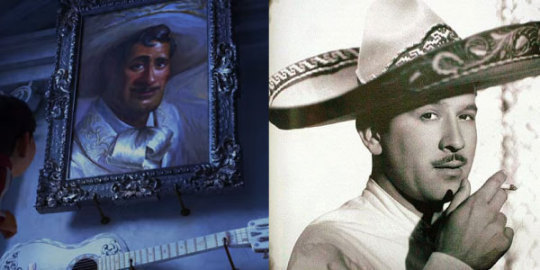
Remember how I said Remember Me is a bolero ranchero? Guess who we associate boleros rancheros with?
That would be Pedro Infante, who happens to have a strong resemblance to no other than Ernesto de la Cruz.
It’s probably not a coincidence at all, as later on we see Ernesto with Pedro Infante and Jorge Negrete at his party. Ernesto de la Cruz was explicitly stated to be inspired on both of them and another singer of the same genres, Vicente Fernández.
My parents left the movie saying “Pedro Infante didn’t deserve that burn,” lol.
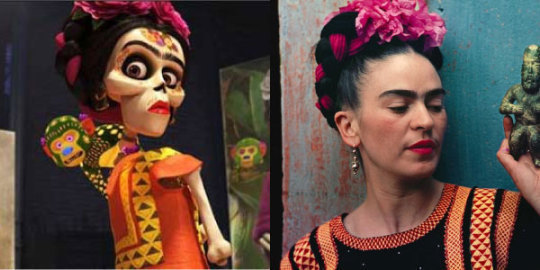
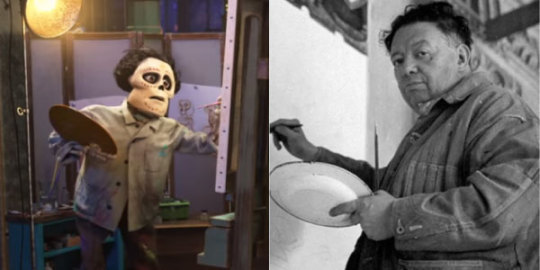
9. Frida Kahlo (and Diego)
She does have a rather prominent role so she’s hard to miss. For those unaware, Frida is the artist who made the flaming papaya.
The themes in Frida’s are autobiographical, as she had a rather unusual life due to polio and injury. She painted herself and her suffering a lot. That might be why we get performances with many Fridas and things like a crying cactus that’s herself.
Bonus: her husband, Diego Rivera, is also in the same studio where we meet Frida. He was an important artist, specifically a muralist.
10. Other Mexican celebrities
I already brought up Pedro Infante and Jorge Negrete as characters that appear right beside Ernesto de la Cruz.
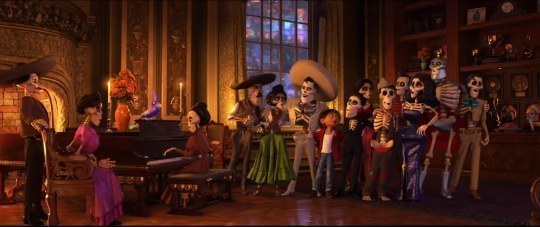
But we also get to see a cameo of many other famous Mexican names in Ernesto’s studio! Excluding the people at the piano, from left to right:
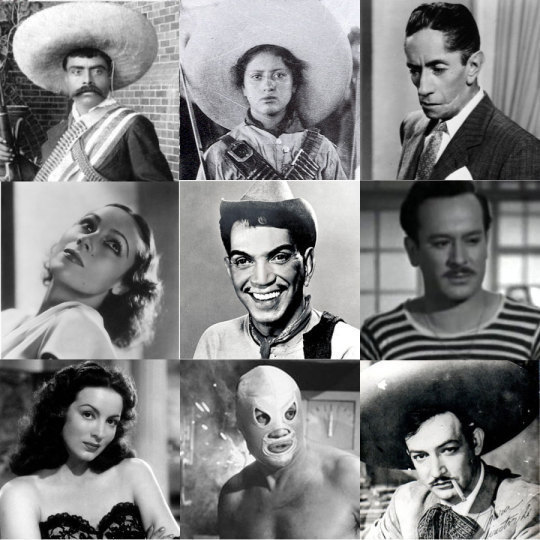
Emiliano Zapata, a revolutionary; (my best guess is) Adela Velarde, another revolutionary; Ernesto and Miguel; (probably) Agustín Lara, composer and singer; (probably) Dolores del Río, actress (in Hollywood too!); Cantinflas, comedian and actor; Pedro Infante, singer and actor; María Félix, actress; El Santo, wrestler and actor; Jorge Negrete, singer and actor.
They kind of looked like this:
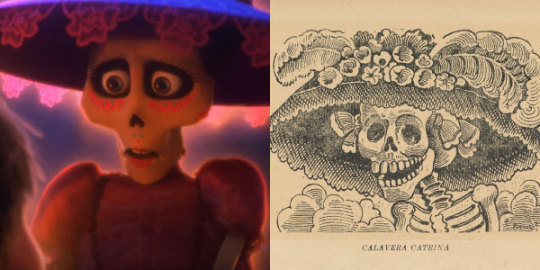
Another bonus: this gal looks like the calavera garbancera / the Catrina illustrated by José Guadalupe Posada.
There might be more things I’m missing or forgot; if that’s the case, feel free to let me know! You can also fix my music genres for me since that’s never been my forte.




 i'll apple your turnover