Have you considered letting people be? Money is something that takes ages and tons of effort and work to get, ain’t my fault ya ain’t happy with whatever you’re doing. Sloth is a sin, too, by the way.
yeah, sure glad there are no major sins involving money and its glorification
1)”The Seven Deadly Sins” were just made up by some rando monk in, like, the 4th century. They’re headcanon and there’s nothing inherently more ~Biblical~ about them than any other interpretation of the text like, say, Arianism. They aren’t From “God” or anything.
2)Being born wealthy, which is how most rich people get rich, takes little effort on the birthee’s part. Certainly not enough to justify distribute resources and ordering society on its basis.
3)”Arbitrage” is the selling of a currency for a greater value than you purchased it. It’s money-changing, basically. What did Joshua(Jesus) think of that, again? It’s also, though, a good metaphor for capitalism in general, because essentially all relationships in capitalism can be described through the term and its mechanics.
For Instance: if the raw materials to make a burger cost $.50, employees are paid ~$.5 per burger(or the time it takes to make the burger) for their labor, and
it is sold for $4, then profit per burger to the “owner” is $3.45, or ~700%(I think that’s right, I’m terrible at math though). So where does that change in value come from? Well, no person wants to eat raw meat, veggies, and grains; they want to eat a burger. Few people want to process those raw materials into a burger every time they feel like eating one, they just want to buy and eat a burger. Does the owner do any of this?
No, it is Laborers who do that processing, and the work to offer that burger for sale, and the work to maintain a reliable, safe, and clean place to find and buy that burger. The owner “makes” profit through the “arbitrage” of “buying” the burger at $.55 and selling it at $4, a “profit” the owner “creates” by using their control of wages to set them far below the value created by the labor those wages compensate. All the “owner” does is provide capital, which they wouldn’t have nearly as much of if they weren’t allowed to arbitrage away all the value created by Labor as their own personal “profit” in the first place, by “farming” the value-to-wages imbalance they create.
4)Storytime:
Just then, a man came up to Joshua and inquired, “Teacher, what good thing must I do to obtain eternal life?”
Joshua answered, “‘Do not murder, do not commit adultery, do not steal, do not bear false witness, honor your father and mother, and love your neighbor as yourself.’
“All these I have kept,” said the young man. “What do I still lack?”
Joshua told him, “If you want to be perfect, go, sell
your possessions and give to the poor, and you will have treasure in
heaven. Then come, follow Me.”
When the young man heard this, he went away in sorrow, because he had great wealth.
Then Joshua said to His disciples, “Truly I tell you, it is difficult for a rich man to enter the kingdom of heaven. Again I tell you, it is easier for a camel to pass through the eye of a needle than for a rich man to enter the kingdom of God.”
When the disciples heard this they were greatly astonished and asked, “Who then can be saved?”
Joshua looked at them and said, “With man this is impossible, but with God all things are possible.”
“Look,” Peter replied, “we have left everything to follow You. What then will there be for us?”
Joshua said to them, “Truly I tell you, in the renewal
of all things, when the Son of Man sits on His glorious throne, you who
have followed Me will also sit on twelve thrones, judging the twelve
tribes of Israel. And everyone who has left houses or brothers or sisters or father or mother or wife or children or fields for the sake of My name will receive a hundredfold and will inherit eternal life. But many who are first will be last, and the last will be first.
5)So here’s a little bit of biblical exegesis for you. Why is it difficult for a rich person to enter heaven? The passage tells you: “when the young man heard this, he went away in sorrow, because he had great wealth”. Wealthy people have Stuff, they have to give it away to get into heaven, they physically have more work to do.
But there’s more to that. They are tied, emotionally and mentally, to that Stuff. They care about that Stuff.
The young man grieves the thought of losing that Stuff. They care more about that Stuff than they do their fellow humans(the young man is sorrowful at the prospect of giving his Stuff to the poor), and they care more about it than they do God(the young man is sorrowful about giving away his Stuff to gain a closer relationship with God).
The wealthy pursue and seek that Stuff, Rather than God. So that’s also what makes it difficult: they’ve got to stop caring more for all that Stuff they’ve got than they do God, and they’ve got to get all that Stuff out of the way of their relationship with God. You’ve got to leave Stuff –lands, names, families, etc– behind, with no desire for reward, to get good with God.
So what is God? Well, that’s a big question, but we can at least tell from this passage that God is that which wants you to help your poor fellows; to not kill them; to not take, or deprive them of, what is rightfully theirs; to not lie(and that includes to yourself); to duly honor those who nurtured, cared for, and educated you; to love yourself, and love your fellows just as much. If, for the sake of gaining more Stuff, you’re taking for yourself the fruits of your fellows’ labor to “make” more “Profit” for yourself by “decreasing costs”(as if those are seeds or machines, rather than people), then you’re loving Stuff more than God. Specifically, You’re coveting the fruits of their labor, you’re stealing their possessions, and you’re treating them without love, all for your love of Stuff. And, even if your wealth is not the product of such arbitrage, if you are hoarding it to yourself while your neighbors and community suffer from want, then you are clearly not treating your neighbors with the love you are treating yourself with. These are yet more reasons why it is hard for rich people to get into heaven: wealth, in itself, is the product of injustice; of either taking from others what is theirs by right, or of denying aid to those in need, or of loving yourself more than others. That makes it the product of rejecting God’s commandments. God asks that you abandon and expunged this injustice –giving to the poor is a loving act, but it is also a Just one in that it gives away what was taken unjustly and creates balance(the essence of justice) by moving property from those who have too much to those who have too little– if you want to enter heaven. In other words to do these things, to follow God’s commandments, is to come to God.
6)Which one could say leads to a potential partial answer for the question “what is God?” as Joshua says, “with God all things are possible”; if, through doing Justice, it is possible to be saved, an impossibility for mortals on their own, and, through God, it is possible to do the impossible, then one can at least suggest that God is, in part, Justice.
Even without changing the horribly designed production systems, there is no real shortage. People don’t starve, have no fresh water, have no houses to live in, etc. because there are not enough of these things. People don’t have access because capitalism denies them it.
There’s enough to share for everyone. It’s not a zero sum game for poor and oppressed peoples.
I known the argument that only GMOs can save us is untrue for the reasons above, but is overpopulation draining resources and killing the earth a lie promulgated by capitalists as a diversion as well? Would we be fine with this many people under a different economic/social system?
Yes, overpopulation is a capitalist/racist myth too. It originated in racist eugenics theory and ignores issues of distribution, infrastructure/technology, and disparate impact in favor of fearmongering about poor/brown people having too many babies.
This one pops up a lot, so I’m going to post some links on it here:
So, yes, it’s absolutely not the number of people that’s the main problem, but how resources are used and environmental management practices are done. If you were going to get rid of people to fix environmental problems, you would start with rich white Westerners, the opposite of who gets targeted by “overpopulation” panics.
I’m reblogging this post from last year, because I see so many opinions about the environment that repeat this nonsense.
It’s racist imperialist capitalist bullshit, and it leads to the exact opposite of real solutions.
I believe that, as a society, we have enough resources to feed and house everyone; each person should be provided with a livable minimum that will allow them to secure a comfortable and happy existence. I believe that many jobs aren’t necessary in the grand scheme of things as well, and that ultimately food services should be automated or reworked so that people don’t have to spend huge chunks of their lives flipping burgers for the profit of fast food millionaires. If we were to actually employ some know-how as a society (possible in a society steered by democratic planning and worker/community control of industry), we could employ everyone, utilize machines to help workers with their jobs (rather than as competition for the benefit of the rich), drastically cut down the work week, and allow people to pursue whatever their interests and talents push them towards. Socialism isn’t about “the fast food worker and the surgeon making the same amount of money”. It’s about pushing society towards a state of affairs where money isn’t the plutocratic arbiter of our life choices, by decommodifying the social realm as much as possible.
Like….I want you to understand that there aren’t just some inherent castes of people who flip burgers or perform surgeries; those castes are shaped by the way capitalism stratifies people and funnels them into jobs and opportunities. In a more just society where people had more free time and qualitative access to education and resources, we’d probably see millions of people tied down to no particular job in the capitalist sense of today. “Burger flippers” would also be artists, builders, farmers, etc. Specialization would still happen, definitely, but where it does occur would likely be accompanied by social prestige and intense satisfaction for the craft – that comes with the territory when the people involved actually make the decisions (rather than submit to the decisions of bosses or property-owners). I’ve seen it argued before and I’ll reiterate it: I’d rather be entrusted to a surgeon who cares about helping people than one who’s only involved to become rich. And it’s not like surgeons and doctors will be destitute under socialism or something – they’ll be as able to self-actualize and enjoy the fruits of society as anybody else, if not moreso in some small ways (through that aforementioned prestige and respect and all that stuff).
This “you want everyone to be paid the same” argument misunderstands what socialists are aiming for; it’s too myopic and can’t help but assume socialism is just capitalism with hyper-redistributive taxation. Think outside of the box a bit, anon.
best description of socialism ive ever read tbh
Automation is something to be dreaded under capitalism because it makes precarious workers more vulnerable – but that’s because of capitalism, not because mechanisation is inherently anti-human.
So if we could have convenient food prepared by robots rather than people
(hopefully healthier than current fast food), and the people who previously did that work can instead now do work that is meaningful for them and society, then bring on the robots.
When we consider doctors, we should not do so without considering the highly undemocratic way medical knowledge and authority is controlled. There are numerous ways hierarchies of class, race, and gender play into who gets to become a doctor, compared to a nurse, compared to a nursing aide, and then within a medical setting whose opinion counts (and the nasty fights over scope of practice).
There is also the problem in my country of medical associations dictating quotas for doctors and specializations based on maintaining their privileged position in terms of money, prestige, and negotiating power with the government by limiting the number of workers rather than based on the needs of people in our society.
My idea of socialism is that it allows people to spend time on multiple skills and pursuits, and not be defined is such an overwhelming way by paid work as a fast food worker or a doctor.
If we decided what our society needed and everyone had tasks to make sure that work was done, then people would have a great deal more free time. People could do those things that bring them joy and fulfillment, as well as the tasks that society needs done which are pretty much guaranteed not to do that (like weeding flowerbeds, shoveling snow, keeping inventories).
(This would happen firstly, because many jobs today require people to be present even after all their work is done for that day or that week because limiting leisure time is a crucial part of work-discipline. If we are not trying to recreate coercive and exploitative work relationships, then people would simply complete the necessary work and be free to do something else. Secondly, free time would also increase if we used automation as this would free up people for different work. By rationally approaching tasks and jobs that currently require a great deal of overtime (I’m looking at you, surgeons), and having more people to perform them, then those jobs would also have a reasonable work-to-leisure ratio.)
Then someone could write a treatise on the native plants of their area, continue taking courses to learn how to be an architect, spend hours perfecting glass blowing, learn a new style of dance, compose their own songs, or read all the works by Martha Wells. With time and the availability of resources like teachers and practice space, people could nurture talents and stretch themselves to find just what they could accomplish, rather than having their potential curtailed by what they and their families can afford.
What would people create if they really could be anything and any number of things?
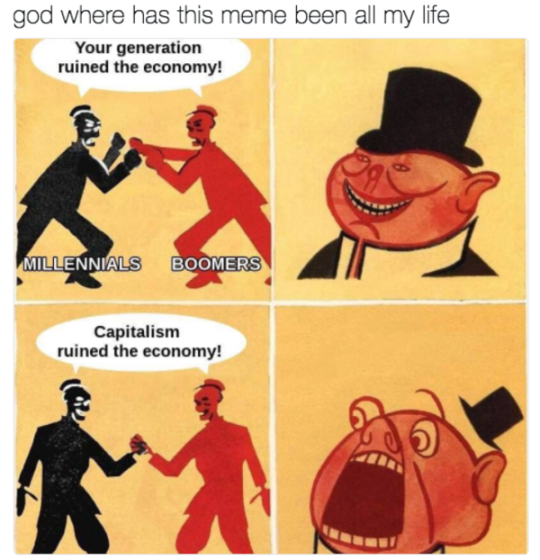
The supposed different “generations” i.e. millennials/Gen X/boomers etc is just liberalism’s attempt to replace class analysis by framing the different generations as coherent classes with different interests. It conveniently fails to mention that there are working class & ruling class people in all generations.
By making all ppl of a certain age responsible for inflation & higher cost of living or w/e, the responsibility of the ruling class is obscured, to the detriment of the working class & to the benefit of the ruling class.
“There’s a much quoted proverb in the world of finance that I hate: Give a man a fish and you will feed him for a day. Teach a man how to fish and you will feed him for a lifetime. I say bullshit to this. Do the poor really not know how to fish? And what good is it to know how to fish if the rights to fish are owned by powerful landlords? And if the river is polluted by upstream tyrants? And what good is it to be taught to fish if the price and distribution of fish is controlled by conglomerate monopolies?””
ok so let’s talk a bit about jobs vs passion. my last fulltime job was at a big game development studio; the kind of job you’re (supposedly) passionate about. most of my colleagues adored the games we made, and so they didn’t care that the company had a major diversity problem, that our salaries were below average, that we didn’t get overtime compensation yet stayed ‘til 11PM more often than what’s healthy, and that the company promoted an unhealthy alcohol culture. because we were passionate. this was the kind of job you grow up dreaming about; don’t go throwing it away because some colleagues are harrassing you or because you get no recognition for your efforts!
for more than a year I was tired. stressed. in constant pain. my anxiety was through the roof. I worked on these “dream projects” and I felt dead inside.
when I quit that job I started freelancing as a writer. I got some really good jobs. I also got a bunch of small-time, low-paid, “hey at least your name is on it so isn’t it enough to pay 10$ for this text?” kind of jobs.
with the typical millenial housing situation of an apartment that I could barely afford on a fulltime pay and a constant stream of job offers that were underpaid I spent four months doing what I love, while constantly overwhelmed by stress. my insomnia got really bad, and when I managed to fall asleep I would dream about my bank balance. I would dream of losing whatever stability I had left in my life, simply because I couldn’t afford a “normal adult life”.
and so, today I got a job. it’s a fairly standard QA job at a medium sized game development studio. unlike any other game companies I’ve been at they offer humane working conditions. they don’t expect me to show up too early and stay too late because I’m passionate. the hours are nine to five, and they disapprove of overtime. the pay is slightly above average, and I get health benefits. I’ve been through several interviews, and at no point has someone tried to belittle my career or tried to convince me to work for less than I’m worth.
for the first time in many years of my career, I’m happy. I’m at ease. I applied for this job because I wanted to get away from the passionate part of the industry. I wanted a job where I could go home at five and dedicate my freetime to my own writing projects. I wanted to work at a place that didn’t eat my heart and soul and energy as I contributed to projects that wouldn’t even bear my name in the end credits.
so what I’m trying to say is that there’s nothing wrong with having a “normal” job. you’re not giving up on your dreams if you take a job outside your main interests. if it offers stability in your life, it’s enough.
This really resonates with me because I left the architectural industry last year. The hours were unreasonable, work stressful and devolved into the new projects filling me with dread. My boss kept hinting I wasn’t doing enough, I wasn’t passionate enough… I finally left, and after a difficult half year, I finally found a job outside the industry. It is not a dream job, and it is not where my passion lies, but the work lets breathe. And I tell you, I now value “breathing” over “making my dream come true” any day.
if you have a job that you can do reasonably well without intense stress and leave at the office when you leave, you can actually spend as much free time as you like Making Your Dream Happen
like, yeah, you can settle down in a cafe on sundays and write your novel, because you have that time carved out and you can afford it. you can put extra money towards materials for your sculpting project. save up for a kiln or fancy paints or whatever. get a gopro and convince your friends to act in your arthouse zombie movie on the weekend because it’ll be fun.
dreams can be dreamed on many levels. jobs only have to be successful on one level, and that is the level where you make enough money to live your goddamn life.
Work to live, don’t live to work.
To all my followers who want to write, animate, and create – this is very real and true! Please take note!!
Academia is really bad about this. “Passionate” is conflated with “willing to work 60-70 hours/week, move anywhere in the country for a new job once a year, live apart from your significant other for years at a time, put your family life on hold, etc etc.” If you’re not willing to do all that, you just don’t want it badly enough. Fuck that. Fuck any employer who thinks that way.
Before you actually start reading communist theory you assume it’s gonna all be about violent revolution and setting cops on fire but in reality most of it’s like… just descriptions of intuitive and efficient ways to organize society. It’s stuff that doesn’t feel like it should be radical, but stuff that politicians, urban planners, etc. should already be doing (and then you realize that they aren’t and it’s incredibly frustrating).
Like, consolidating industry so redundant work isn’t done by multiple privately owned companies working towards the same end (eg. Google and Amazon both trying to develop AI competitively rather than just letting computer scientists work together and share research) just makes sense. Equally distributing the amount of work available solves the twin problems of unemployment and overemployment (people forced to work multiple jobs or overtime). Letting people enjoy the fruits of automation by increasing leisure time was how people always envisioned the future, but instead people are terrified of technological progress because it threatens their job security.
A planned economy to minimize waste is just more efficient and in the best interest of basically everyone on earth. Capitalism is so backwards that genuinely innovative and efficient ideas are marginalized and discredited while the status quo promotes massive amounts of waste and unecesary labour. It’s almost painful to think about how much further we would be as a society by now if we didn’t have the ball and chain of our current profit-driven economic system dragging us down.
One of the most obvious and infuriating examples of how capitalism is an enemy of human progress is the state of green technology. Major oil companies have actively sabotaged the most important work being done in science and tech for the past 50 years, simply to protect their own interests, at the potential cost of all life on the planet.
Aside from the obvious moral argument that deliberatley delaying action on climate change is monstrous and will come at the expense of thousands and thousands of lives, it’s also ridiculous from a global economic perspective.
A worldwide transition to sustainable energy would create a massive amount of jobs and stimulate the economy in a huge way. Instead, we’re being told that our best hopes for new jobs are the pitiful amount of people it takes to man a pipeline (which is miserable work even if you get it) and the future of our economy is in the oil industry, which is crashing before our eyes. It’s almost comical how antithetical to the good of society our current trajectory is.
I’m fairly certain America hinges now on propaganda that everything is okay and we’re still a first world nation when actually, our country is slipping further and further, and we’re really just. The best third world country out here. Not even comparable to most first world countries, so we fucking aren’t one anymore
Sounds like we live in a police state where the rich tax the poor not to feed or protect them but to fund programs and legislature that defunds their resources and encourages them to die. The rich get richer and the middle class shrinks and suffocates while the entire country falls apart because corporate power greed refuses to see the consequences of their actions.
I wish I had the faith to believe what goes around comes around, but I think it’s time to understand that we’re the ones that need to come around and take action. The rich aren’t going to do jack shit for us anymore. Even the rich that care about people on the bottom don’t have the courage to help people en masse
Economically speaking, one of the foundations of a 1st world country is a strong middle class (source, my BBA in Economics and International Business), and it’s been abundantly clear that America’s middle class has been shrinking. Wages have been stagnant since pretty much the 1970′s, American CEO’s wage disparity is the highest in the world when compared to the average of their workers.
Basically, the us *isn’t* a first world country anymore. Our economy may still be one of the highest (I’m not sure if China has overtaken us yet), but our infrastructure is crumbling. Roads and school and bridges are in dire need of repair, our education system is laughable when you see how much money we have available for it. Military spending is out of control, often on things the military doesn’t even need or want. All in the name of continuously soaring profits for the highest echelon of society, who never needed it to begin with.
Here’s some expresses from a recent article about a UN official investigating poverty in the US:
“A United Nations official investigating poverty in the United States was shocked at the level of environmental degradation in some areas of rural Alabama, saying he had never seen anything like it in the developed world.
“I think it’s very uncommon in the First World. This is not a sight that one normally sees. I’d have to say that I haven’t seen this,” Philip Alston, the U.N.’s Special Rapporteur on extreme poverty and human rights, told Connor Sheets of AL.comearlier this week as they toured a community in Butler County where “raw sewage flows from homes through exposed PVC pipes and into open trenches and pits.”
“Some might ask why a U.N. Special Rapporteur on extreme poverty and human rights would visit a country as rich as the United States,“ Alston said. “But despite great wealth in the U.S., there also exists great poverty and inequality.”
Alston also pointed out that the U.S. “has been very keen” on other countries being investigated by the U.N. for civil and human rights issues.
“Now, it’s the turn to look at what’s going on in the U.S.,” Alston said. “There are pretty extreme levels of poverty in the United States given the wealth of the country. And that does have significant human rights implications.”
“The idea of human rights is that people have basic dignity and that it’s the role of the government—yes, the government!—to ensure that no one falls below the decent level,” he said. “Civilized society doesn’t say for people to go and make it on your own and if you can’t, bad luck.””


 i'll apple your turnover