They’ve each got oceanic themes to their designs – thunderstorm at sea, sunlit kelp forest, underwater lava, vibrant coral life/sunken treasure (bc Hunk is a treasure) and tropical beach (with additional Blue Lion influences)
Designing ‘em was super fun. I stopped liking a lot of it for a while though – and really didn’t want to have to redo it all to be happy with it – so it stalled for a long time. But now it just feels a shame not to share all that work anyway. So! Here we are
The internet went from showing food recipe videos to alchemy in less than a decade. There’s going to be a quick video on how to make the philosopher’s stone from tomato sauce next week.
I WANNA DRINK THE TRANSPARENT SODA
leave milk out unrefrigerated in your house for 2 days
Some days ago, my sibling sent me this video out of the desperate hope I could provide the catharsis of seeing it torn to pieces. It has now been coming on 72 hours, and only now have I recovered enough to be able to do much of anything but scream, “WHAT?!” and “NO!” at the screen.
I cannot bring myself to confront the claims in this video in the order they are put forth without losing my will to live after the first one, so I will start with the least crazy and work my way up.
Bananas to ripen things: More or less true. You’ll sometimes see advice to cooks to store underripe fruit in a paper bag with one piece of overripe (but not rotten) fruit to ripen it more quickly. Misrepresentations: It will probably take longer than overnight to ripen something as green as some of those tomatoes, and it doesn’t have to be a banana.
Coca-cola and milk: The coke is more acidic than the
milk and curdles it, resulting in solid globs of milk protein which
settle out. The brown dye in the coke sticks to the milk protein globs,
leaving the excess liquid more or less clear. Misrepresentations: The video has been enormously sped up, which the editing does not make clear; the reaction takes hours.
Ketchup to clean metal: To my mild surprise, this is actually a thing (though you could just make a paste out of salt, flour, and vinegar and scrub with that and not get ketchup stains on everything)… Misrepresentations: …for cleaning copper and bronze. Which the jug shown in the video is not. The acid in the ketchup might take some of the tarnish off, say, aluminum, but at that point you might as well just use vinegar.
“Warm water clears wax from fruits!”: This is a mysterious and arcane procedure called “washing.” Misrepresentations: I don’t know what the hell they even did to the video on this sequence but as a person who has washed many apples in warm water, it does not look like that and the thin layer of edible wax applied to make them look good in the grocery store does not come off that easily.
Insta-freeze bottle: This is a real thing… Misrepresentation: …which absolutely will not happen if you follow their instructions, because a) they neglect to mention an important caveat (the water needs to be purified/distilled) and b) 5 minutes is not long enough for a water bottle to supercool. If you google any of the myriad videos and articles of people doing this trick, you’ll see numbers like “3 hours in the freezer” or “40 minutes in a salted ice bath.”
There is video of the trick working. Either that footage was taken from someone else, or they knew how to do it, did it, and then deliberately lied about the time for no apparent reason.
Putting a broken plate in milk for two days magically fixes it: To my immense surprise, they didn’t make this one up; the idea is that the milk protein casein can form into a plastic at high temperatures and bind to the ceramic. Googling it turned up some hobbyist potters commenting that they’d used it to salvage things that had cracked slightly in the kiln. Misrepresentations: Once again, they’ve misrepresented the method: everything I saw talking about how to do it said to boil the milk and then soak for an hour, not leave it out for two days like an offering to the pixies. And most of what I saw reported about it also said it only really works on hairline cracks, not full breaks, and doesn’t hold up long-term because the real structural damage isn’t repaired. And may leave a faint and persistent odor of boiled milk.
This is the kind of gibberish predicated on so many nonsensical assumptions that unpacking it would be more trouble than it’s worth. Plus, well, I can barely see anything with the low video quality, but what I can see of the vague blur doesn’t look much like a honeycomb in the first place. Suffice to say:
“Honey looks like a honeycomb” isn’t even in the ballpark of what’s generally meant by “genetic memory,”
what’s generally meant by “genetic memory” is also complete hooey, and
fluid dynamics is weird and swirling a thick, viscous, water-soluble liquid with a layer of water on top is going to do weird things.
But at least that I could potentially attribute to ignorance rather than deliberate intent to deceive, unlike…
Hot coals and peanut butter
This is the reason it’s taken me this long to post this. Every time I think about it my soul starts to leave my body. It’s such a mind-boggling level of bullshit that every time I’ve tried to put words around an explanation I’m quickly reduced to staring at the screen and mouthing “No” to myself in a voice of quiet despair, because I can’t even figure out where to start.
Well, okay, I guess I might as well start by saying I think their… let’s say inspiration on this was articles about scientists who made diamonds out of peanut butter and carbon dioxide. …With a press that’s designed to recreate the conditions of the earth’s mantle, and which is prone to exploding. So, you know, not something you can do in your kitchen. Unless you have one hell of a kitchen.
You can see the direct links to this in the nonsensical claim that this “works” because peanut butter contains carbon dioxide. (It doesn’t, particularly. It’s crushed peanuts mixed with oil. You know what would have a lot of carbon dioxide? The fire you pulled that glowing lump of charcoal out of.) It also mentions “pressure” when no particular pressure is involved, presumably because we’ve all heard about turning coal into diamond under heat and pressure.
Chemically speaking, there’s very little to make that crystal out of except carbon, unless you want to posit a mass migration of all the sugar molecules in the peanut butter to the center of the coal. And “carbon crystal” = “diamond,” and do you think if it was that easy to make diamonds they’d be that expensive?
I will guarantee you that crystal is a lump of quartz they covered in black crud and then peanut butter to pretend it was the charcoal.
But, of course, all of that is irrelevant, because by reblogging this at all, even to performatively despair that the internet does not seem to have come all that far since the days of Infinite Chocolate, I’m playing into their hands. Lifehack clickbait has done this forever– they deliberately seed in wrong or awful advice because people will share that to say how stupid/wrong it is. They led with complete insanity to get attention, and I gave them eyeballs on the video watching this, and I’ll be giving them more from writing this.
Maybe I’ll stick to the chaos god theory. It’s less depressing.
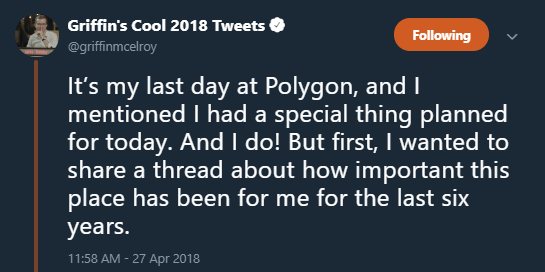
I’ve talked a lot about Imposter’s Syndrome and the all-encompassing, paralytic thrall it’s cast over me for basically my entire life. I second guess my shit constantly. I’m slow to start new projects, because my brain assumes I’ll be incapable of making them any good.
This was especially true from college onward. I majored in broadcast journalism, a field I found myself wholly unsuited for. I was uncomfortable talking to people, especially strangers — which, you know, kind of comes with the territory.
At Joystiq, I wrote news posts and reviews, and the whole time I was there, I never thought I was very good at it. I believed I was in a field that I was terrible at, and feared it was only a matter of time before I was discovered.
That’s Imposter’s Syndrome 101. And even as I started doing stuff I was a bit more comfortable with — namely, the Joystiq podcast and MBMBaM, I was never able to be fully confident in the work I was doing. It kept me up at night, wondering when the other shoe was going to drop.
When we started talking about moving over to start Polygon, that fear became the loudest voice in the room. I knew that with starting a new project came an enormous amount of scrutiny, and that I wouldn’t be able to sail under the radar much longer.
I was Deputy News Editor when Polygon launched, meaning now, I was responsible for helping to oversee and help train other reporters in my field. As much as I loved this work, I couldn’t shake the guilt that I was in no position to teach folks these ropes in ANY capacity.
Two years later, my Imposter’s Syndrome and its associated anxiety reached a breaking point. I considered leaving games altogether, then, and focusing on the podcasts — a realm where my lack of confidence still existed, but was much quieter than it was in this, my full-time job.
Around that time, Polygon started to rethink its video efforts. The strategy had been a focus on high-touch video packages and longform storytelling. As superb as that stuff was, it was a somewhat unsustainable model that left a lot of gaps in what our channel could offer.
We needed someone to spearhead video for the site, and, being unhappy and uncertain about my journalistic chops, I saw it as a vine I could swing onto — despite the fact that I had zero idea how to actually make a video. Somewhat hesitantly, I agreed to take on the task.
The first month in this position was fucking terrifying. Not only did I have to self-educate myself about a lot of technical skills, I also wrestled with the responsibility of rebuilding our website’s video strategy from the ground up.
But I stuck with it, trying to improve the quality and quantity of the Overview-style stuff we were making in those days. A year in, and I felt like our video output was passable, if still not entirely in my wheelhouse.
Then, about sixteen months after taking the new position, and after a weeklong strategy meeting w/ our ragtag video team: We did the first Monster Factory.
The reception to that first Monster Factory was a total sea change, both for the tone of the videos we started to make, and for how I thought about the work I could do in this industry.
There was a realization that my middling feelings about my work was actually a direct result of how I tried to distance myself from the things I was making.
That “flying under the radar” approach was precisely the cause of why I felt like my work was merely adequate — it was only through really leaning in that I started making things I was proud of.
Which brings me to what I want to say about Polygon. There has never been a moment while I’ve worked here that I did not feel encouraged to chase that instinct.
(That isn’t to say that ideas don’t get shot down — they totally do! But only after long, supportive discussions about how to make our ideas and passions work.)
I said when we announced we were leaving that I adore our team, but that goes beyond the individual level — though I do admire the individuals, as well. I adore the TEAM, and this atmosphere of experimentation and boundless personal expression that it fosters. And all of this culminates, in my mind, with one particular video series.
It began as a very silly joke I made during a weekly meeting, which the team encouraged me to chase after.
I shot the first episode that same day, and by the end of the week, the video was live. It was, and continues to be, the strangest thing I’ve ever done.
This series, and the other stuff I’ve done in the past few years at Polygon — it leaves no room for the Imposter’s Syndrome that has cast a shadow over my entire creative life. Though it seems an unlikely candidate for this truth, it was one of the most personally, creatively empowering things I’ve ever worked on.



















 i'll apple your turnover