I volunteer for the OTW, the parent nonprofit organization that runs AO3. So do, as of the last monthly newsletter, 678 other people. The OTW has no paid employees; everyone there is a volunteer.
The average weekly work expectations for OTW volunteers run around 5 hours per week for most committees. Of course, in reality, people are all over the place. Some do 1-2 hours a week, some 30 or 40 or even more – a full work week without pay.
Let’s say that, hypothetically, a volunteer works only 1-2 hours per week, and their work is only worth $10 per hour. (It’s probably worth more – the opportunity costs of most skilled labor is worth more than that – but let’s low-ball it.) That means that every single week, that volunteer is donating $10-20 dollars of their time to the OTW. Some people are donating hundreds of dollars of their time each week, for months or years on end to help keep all its projects running.
Because of course there are multiple projects. There’s TWC, the freely available, peer-reviewed academic journal that just celebrated its 10th anniversary. There’s Fanlore, our fannish history wiki that has over 46,000 articles. There’s Open Doors, which rescues at-risk archives from disappearing. There’s Legal Advocacy, which donates legal expertise to help fans address copyright and other issues. And then there’s the AO3, which is currently listed as the 264th most popular website in the world (#98 in the US). Any one of those projects could easily encompass an entire nonprofit organization by itself. None of them has even a single paid employee. No OTW website shows any ads.
The real secret to the OTW’s success is not that it pulls in just enough money every year to cover its server expenses and overhead – though it does that, and every volunteer is grateful to our donors for keeping the lights on. It’s that the OTW somehow runs entirely on volunteer power. There’s no way we could pay for all the expertise and effort we receive. Other nonprofit websites like the Wayback Machine and Wikipedia pull in millions in funding every year to cover relatively small staffs. We survive without having to write grants or beg wealthy donors because of our volunteers’ unseen donations of their time, expertise, and effort.
Maybe this year you don’t have any money. Or maybe you do, but you’re saving for a rainy day, or you gave it somewhere else. No worries. People volunteer because we want you to enjoy this labor of love. We want you here, building the OTW with us by using our projects. If you did donate, much love to you. Your generosity is deeply appreciated, and we’ll continue being the penny-pinching, wait-is-there-a-free-option, do-they-give-a-nonprofit-discount volunteers we’ve always been, to stretch your donation as far as it can go.
If you want to give something that isn’t money, consider this: How often is a volunteer thanked by someone who isn’t a fellow volunteer? People volunteer because they want to know they’re making a difference. They want to build up the world. Think of how a kudos or a comment makes you feel, then consider how rarely volunteers get one.
You can read about all our committees here, and you can send one of them a quick thank you via the contact form, if you like. Or you can leave a comment with thanks on a Drive post on AO3. Maybe tell Finance how much you love the budget being available, or thank Development & Membership for all their hard work organizing the donation drive to keep the servers running, or show some love to our Communications Committee that’s keeping all these posts updated, or to the Translation Committee that translated them. Maybe you noticed that AO3 Documentation just put out a Tag Set FAQ in time for the exchange season. Maybe you’re wondering who keeps 679 people organized – that would be our Volunteers & Recruiting Committee. Maybe you want to thank the Systems Committee for getting out of bed way too early in the morning to fix the mailer (or whatever else decides to mysteriously break this week). However the spirit moves you, feel free to show some love. It goes a long way.
what if i told you that a lot of “Americanized” versions of foods were actually the product of immigrant experiences and are not “bastardized versions”
That’s actually fascinating, does anyone have any examples?
I took an entire class about Italian American immigrant cuisine and how it’s a product of their unique immigrant experience. The TL;DR is that many Italian immigrants came from the south (the poor) part of Italy, and were used to a mostly vegetable-based diet. However, when they came to the US they found foods that rich northern Italians were depicted as eating, such as sugar, coffee, wine, and meat, available for prices they could afford for the very first time. This is why Italian Americans were the first to combine meatballs with pasta, and why a lot of Italian American food is sugary and/or fattening. Italian American cuisine is a celebration of Italian immigrants’ newfound access to foods they hadn’t been able to access back home.
(Source: Cinotto, Simone. The Italian American Table: Food, Family, and
Community in New York City. Chicago: U of Illinois, 2013. Print.)
that corned beef and cabbage thing you hear abou irish americans is actually from a similar situation but because they weren’t allowed to eat that stuff due to that artificial famine
❤ FOOD HISTORY ❤
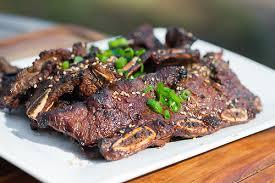
Everyone knows Korean barbecue, right? It looks like this, right?
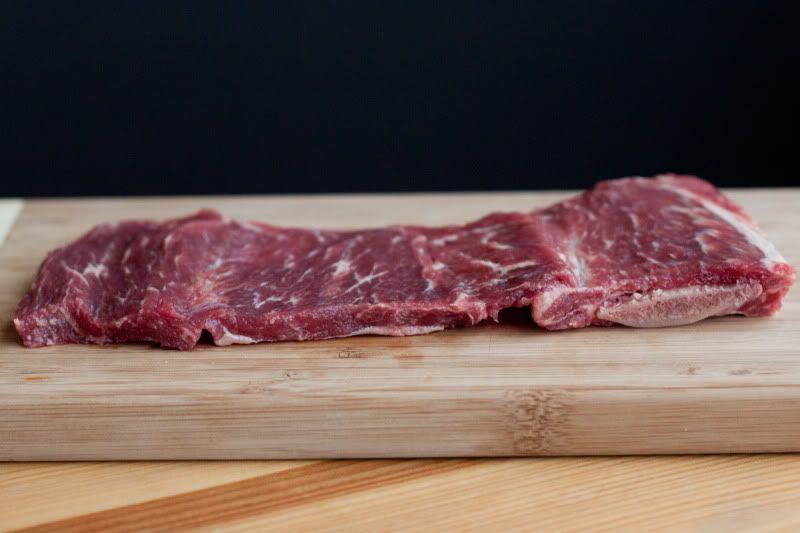
Well, this is called a “flanken cut” and was actually unheard of in traditional Korean cooking. In traditional galbi, the bone is cut about two inches long, separated into individual bones, and the meat is butterflied into a long, thin ribbon, like this:
In fact, the style of galbi with the bones cut short across the length is called “LA Galbi,” as in “Los Angeles-style.” So the “traditional Korean barbecue” is actually a Korean-American dish.
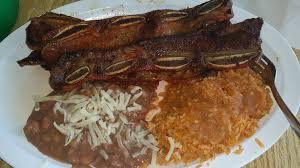
Now, here’s where things get interesting. You see, flanken-cut ribs aren’t actually all that popular in American cooking either. Where they are often used however, is in Mexican cooking, for tablitas.
So you have to imagine these Korean-American immigrants in 1970s Los Angeles getting a hankering for their traditional barbecue. Perhaps they end up going to a corner butcher shop to buy short ribs. Perhaps that butcher shop is owned by a Mexican family. Perhaps they end up buying flanken-cut short ribs for tablitas because that’s what’s available. Perhaps they get slightly weirded out by the way the bones are cut so short, but give it a chance anyway. “Holy crap this is delicious, and you can use the bones as a little handle too, so now galbi is finger food!” Soon, they actually come to prefer the flanken cut over the traditional cut: it’s easier to cook, easier to serve, and delicious, to boot!
Time goes on, Asian fusion becomes popular, and suddenly the flanken cut short rib becomes better known as “Korean BBQ,” when it actually originated as a Korean-Mexican fusion dish!
I don’t know that it actually happened this way, but I like to think it did.
Corned beef and cabbage as we know it today? That came to the Irish immigrants via their Jewish neighbors at kosher delis.
The Irish immigrants almost solely bought their meat from kosher butchers. And what we think of today as Irish corned beef is actually Jewish corned beef thrown into a pot with cabbage and potatoes. The Jewish population in New York City at the time were relatively new immigrants from Eastern and Central Europe. The corned beef they made was from brisket, a kosher cut of meat from the front of the cow. Since brisket is a tougher cut, the salting and cooking processes transformed the meat into the extremely tender, flavorful corned beef we know of today.
The Irish may have been drawn to settling near Jewish neighborhoods and shopping at Jewish butchers because their cultures had many parallels. Both groups were scattered across the globe to escape oppression, had a sacred lost homeland, discriminated against in the US, and had a love for the arts. There was an understanding between the two groups, which was a comfort to the newly arriving immigrants. This relationship can be seen in Irish, Irish-American and Jewish-American folklore. It is not a coincidence that James Joyce made the main character of his masterpiece Ulysses, Leopold Bloom, a man born to Jewish and Irish parents.
I feel like a lot of tumblr culture, especially the particularly ineffective brand of Tumblr Social Justice™, has somewhere along the line lost track of the difference between something having the potential to be bad, and being innately bad.
For instance, a white author writing a character of another race absolutely has the heightened potential for problematic portrayal, since that author lacks lived experience as a member of marginalized racial/ethnic group to draw on, and has a heightened chance to misrepresent that group. However, if they do their research, talk with individuals from that racial/ethnic group, consult with sensitivity readers, etc., they may still tell a very honest, sympathetic, good story with good representation. It is not innately bad, simply because of the author’s race; though I’ve seen arguments on tumblr insisting this is the case.
Another example is relationship dynamics; couples who have an age gap or a power imbalance (such as one individual being lower on a professional chain of command from the other) might have an increased potential for an abusive dynamic to form. The couple with the age gap has to be more conscious of differences in lived experience, and the couple with a power differential in the professional side of their relationship needs to overcome more hurdles to equalize things in the context of their personal dynamic. But neither of these things is impossible. These dynamics are not innately abusive; they might make abuse easier, or more common, but they don’t guarantee it. Just as avoiding these dynamics doesn’t guarantee a lack of abusive behavior.
Some situations/dynamics/endeavors have a heightened potential for things to go wrong. And we should be conscious of that potential and keep an eye out for problems – not to destroy the thing, but to encourage course correction (an edit to a manuscript; couples’ therapy; etc.). Many of these things, however, tumblr culture has labelled as innately bad, rejecting any possibility of the thing being done well and thus shutting down that encouraged course correction in favor of flat-out condemnation, without nuance, thought, or consideration. And by drawing clear lines of what is ‘innately bad’ and ‘innately good’ we also avoid giving due criticism of problematic things that have been assigned as ‘innately good.’
This hellsite is allergic to nuance, but damn, do I wish we could all be better at it and recognize that few things are as black & white and simple as we’d like them to be. Shit is messy. Everything is problematic. But not everything that can be bad is, and not everything that’s less likely to be bad is perfect.
Questioner: What’s the thing you’re most excited about doing for Stormlight 4?
Brandon Sanderson: I’ve got a really cool thing set up for Wit’s epilogue that I’ve been planning to do for a long time. So the Wit soliloquy at the end is going to be a little extra special.
Caleb to Beau: Are we gonna talk about Fjord waking up having a different accent Beau: Caleb, I’m gonna level with you the last time I asked someone a simple question about their past I found out that he was brainwashed to become a child soldier and tricked into murdering his parents in fire. All I asked was why he froze up around fire and that’s what I got. Fjord has magic powers coming from the sea and some ocean monster so I’m not gonna poke that hive of wasps by asking about accents
“Through their relationship they find some kind of hope and like future and reason to live you know, there’s umm this really good sense that they both have a future at the end of this film.” – Charlie Hunnam

 i'll apple your turnover